

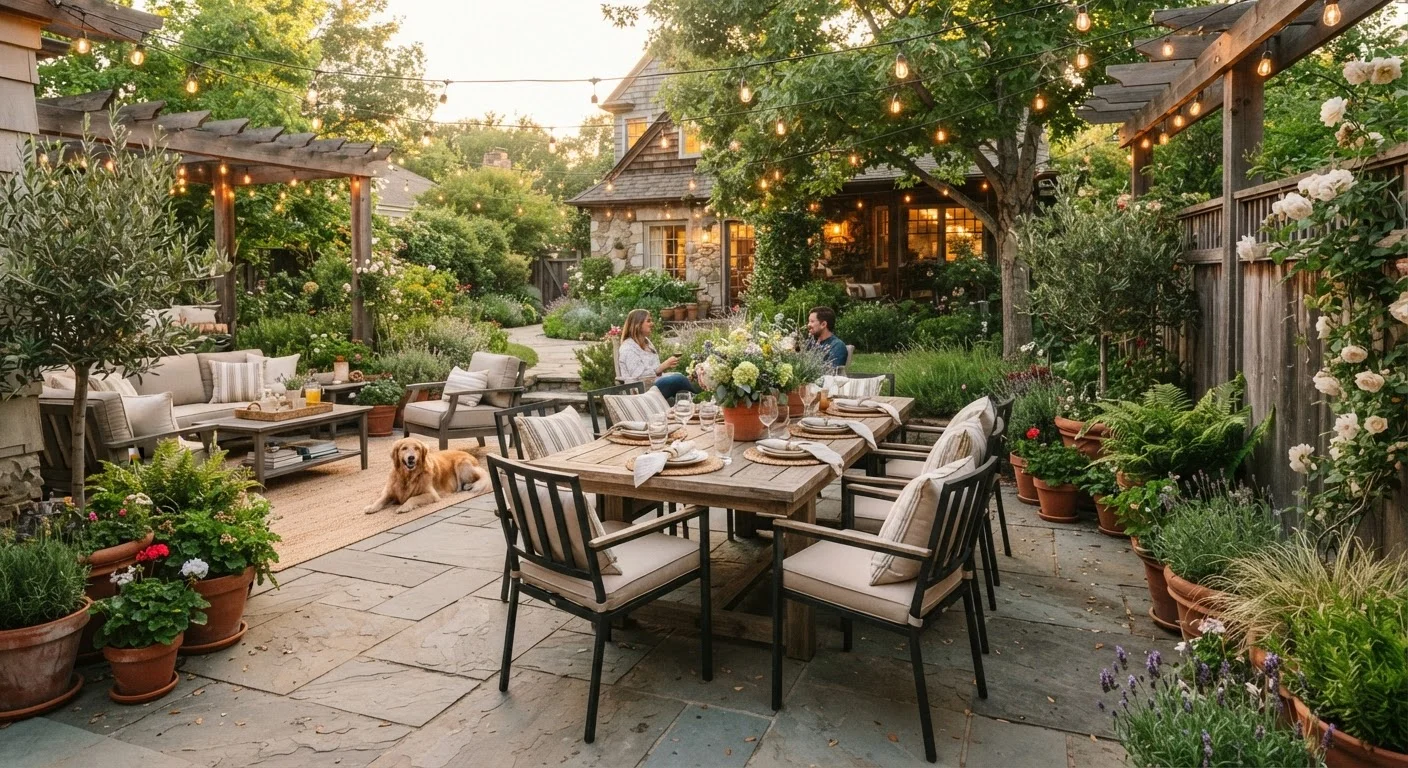
Start here
Why Your Patio Needs a Plan
Define your goals
Defining Your Patio's Purpose
Plan the layout
Getting the Size and Shape Right
Pick a surface
Choosing a Surface Material
Finish the space
Furnishing, Plants, and Looking Ahead
Why Your Patio Needs a Plan
A patio is more than a slab of concrete at the back door — it's a genuine extension of your home's living space. Approached thoughtfully, even a modest outdoor area can become a place for entertaining, relaxing, or simply unwinding after a long day. Without a clear plan, it's easy to invest time and money in a layout that doesn't fit how you actually live outside. This guide walks through the foundational decisions — from footprint and surface to furniture and plantings — so you can build something that earns regular use for years to come.
Defining Your Patio's Purpose
Before you choose a single paver, ask what the patio needs to accomplish. Will it host dinner parties for eight, or serve mainly as a quiet reading corner for two? Do children or pets need open space to move around? Will a grill, fire pit, or dining table share the footprint? Ranking those uses shapes every decision that follows.
Think about traffic flow, too. A patio adjacent to the kitchen connects naturally to indoor life and makes outdoor cooking more practical. A detached garden patio, set further into the yard, creates a sense of retreat. Neither approach is wrong — they simply serve different needs. A written use list also helps you avoid over-building in one zone while neglecting another.
Getting the Size and Shape Right
Patio dimensions should follow function. A dining table for six typically needs a 12 × 12-foot area once chairs are pulled out and a walkable path remains clear around the perimeter. A dedicated lounging zone can work in a 10 × 10-foot footprint. If your yard is narrow or irregular, consider how rectangular, L-shaped, or free-form layouts can complement the geometry rather than fight it.
Balance matters too: covering an entire yard in pavers often feels stark. Pairing the patio with lawn, plantings, or garden beds softens the result considerably. Our guide to balancing hardscape and softscape offers a practical framework for integrating both, and a well-balanced design also contributes to stronger curb appeal.
Choosing a Surface Material
Check Permit Requirements Before You Start
Many municipalities require a building permit for patio projects involving footings, attached overhead structures, or electrical connections. Even straightforward paver installations may be subject to local setback rules or stormwater drainage codes. Contact your local building or planning department before breaking ground. Completing work without required permits can result in fines or an order to remove the finished structure.
The surface you choose affects durability, maintenance, drainage, and overall cost. The four most common options are gravel, concrete pavers, poured concrete, and decking. Gravel is permeable, relatively affordable, and forgiving to install — but it shifts over time and needs periodic top-dressing. Concrete pavers offer a clean, modular look and can be replaced a piece at a time if one cracks or stains. Poured concrete is long-lasting but more difficult to patch invisibly when cracks develop. Decking adds warmth underfoot, though wood versions generally require periodic staining or sealing to remain weather-resistant.
For a detailed comparison of costs, longevity, and best-fit scenarios for each material, see our companion article on patio surface options.
Furnishing, Plants, and Looking Ahead
Once the surface is in place, furnishing turns the patio into a room. Scale is critical: oversized furniture in a compact space overwhelms it and limits movement. Start with an anchor piece — a dining table, a pair of loungers, or a conversation grouping — then layer in accessories from there. Choose materials suited to your climate; all-weather wicker, powder-coated metal, and teak each behave differently across seasons.
Mock Up Furniture With Tape First
Before purchasing any outdoor furniture, use painter's tape or rope on your patio surface to outline each piece's footprint. This reveals quickly whether a chosen arrangement actually fits and whether enough circulation space remains. Include the clearance needed to pull chairs away from a table — typically about 3 feet behind each seat.
Plants soften hard edges and make the space feel finished. If your patio receives limited direct sun, shade-tolerant container plants work particularly well around the perimeter. Thoughtful lighting extends usability into the evening — our article on outdoor lighting principles covers layering, safety, and energy efficiency. If year-round use is part of your vision, planning for shade structures or weather-resistant materials now is simpler than retrofitting them later; our guide to year-round outdoor living explores that planning process in depth.
Frequently Asked Questions
A 12 × 12-foot area is a practical starting point for dining and seating up to six people, provided chairs can be pulled out without obstruction. If you want separate lounging and dining zones, plan for significantly more square footage and sketch each zone individually before settling on a final footprint.
Permit requirements vary by municipality and project type. Surface-level gravel or paver installations often don't require a permit, but structures with footings, attached roofs, or electrical connections typically do. Contact your local building or planning department before starting any work to understand what applies in your area.
Gravel is generally the most accessible option — it requires minimal tools, no curing time, and is forgiving to install. Concrete pavers over a compacted, leveled base are also manageable for motivated beginners. Poured concrete and built decking typically benefit from professional installation to achieve a durable, level result.
Common options include a freestanding pergola, a shade sail, a retractable awning, or large patio umbrellas. Each varies in cost, permanence, and installation complexity. If you plan to attach any structure directly to your home, check whether a permit is required in your municipality before proceeding.
Powder-coated aluminum, teak, and all-weather wicker are among the most widely used outdoor furniture materials. Each has different maintenance needs — teak benefits from periodic oiling to preserve its color, while powder-coated metal resists rust but can chip if not touched up. Match your choice to your local climate and maintenance preferences.
The content on this site is for informational purposes only and is not a substitute for professional advice. Always consult a qualified professional for guidance specific to your situation.