

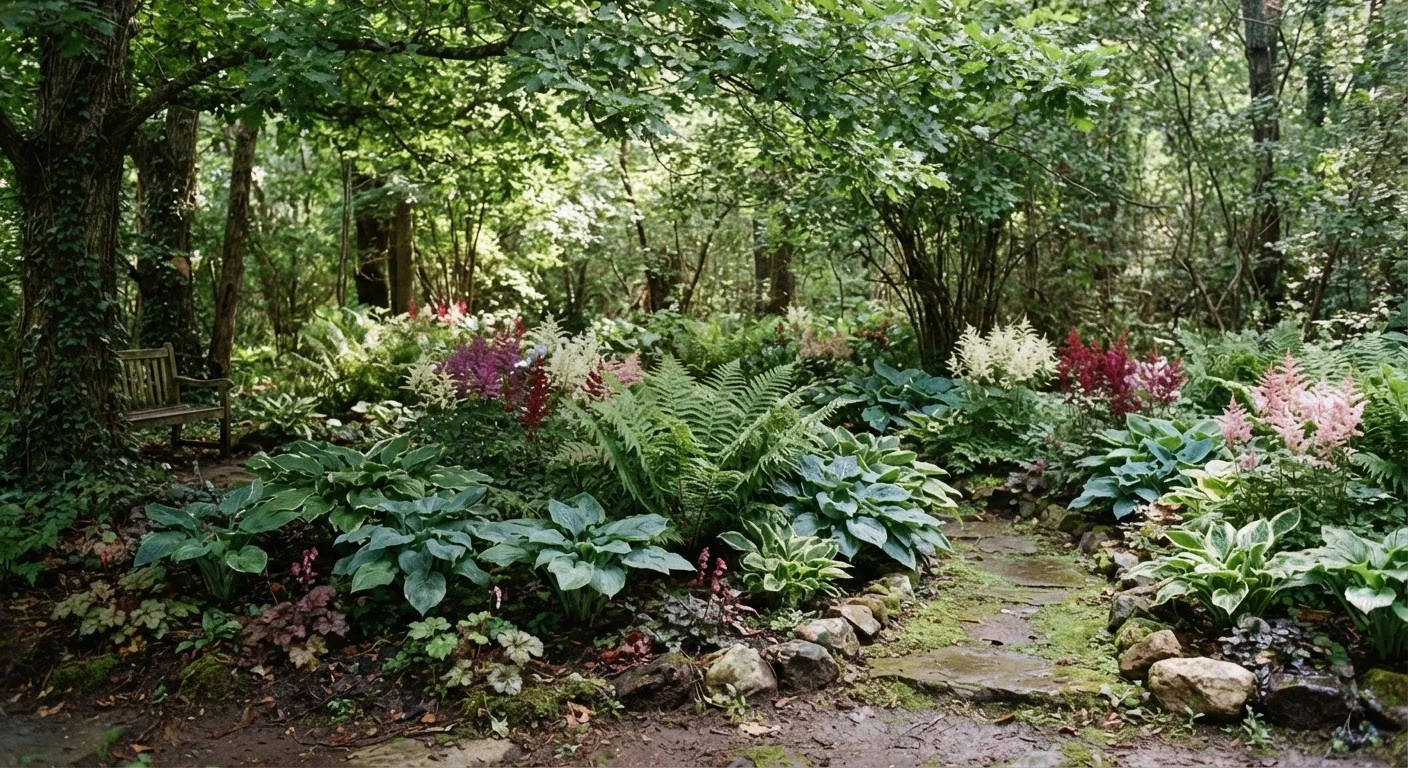
Understanding Shade: Partial, Full, and Deep
Not all shade is equal, and choosing the right plants starts with an honest assessment of how much light your space actually receives. Garden professionals generally recognize three categories:
- Partial shade: 3–6 hours of direct sun daily, often morning sun with afternoon shade — the most forgiving condition for a wide range of plants.
- Full shade: Fewer than 3 hours of direct sun daily, common under dense tree canopies or on north-facing walls.
- Deep shade: Little to no direct sunlight, such as beneath dense evergreens or against a shaded foundation. Plant choices here are limited but not zero.
Before purchasing any plants, spend a day observing how sunlight moves across your space at different hours. What feels "shady" at noon may receive useful morning light that many shade-tolerant plants can use effectively.
Partial shade
A garden condition in which a site receives 3–6 hours of direct sunlight daily, typically morning sun followed by afternoon shade. Most shade-tolerant plants perform well in partial shade.
Full shade
A condition where a site receives fewer than 3 hours of direct sun per day. Plant selection is narrower, but many ferns, hostas, and ground covers thrive here.
Deep shade
The most light-limited condition, found under dense evergreen canopies or against shaded foundations. Very few flowering plants succeed; focus shifts to foliage plants and ferns.
Humus-rich soil
Soil with a high content of decomposed organic matter, which improves drainage, moisture retention, and nutrient availability — conditions preferred by many shade-loving plants.
Deciduous
Plants that shed their leaves seasonally, typically in autumn, and regrow them in spring. Many shade-tolerant perennials and ferns are deciduous.
Evergreen
Plants that retain their foliage year-round. In shade gardens, evergreen ground covers and shrubs provide structure and color even in winter months.
If you're integrating a shade planting scheme into a larger outdoor redesign, the Patio Planning from the Ground Up offers a solid framework for thinking through layout and planting zones together.
Ground Covers for Shaded Areas
Ground covers suppress weeds, stabilize slopes, and create a finished look under trees where lawn grass struggles. These options perform reliably across partial to full shade conditions:
| Easiest shade condition for plant variety | Partial shade (3–6 hours sun daily) |
| Most versatile shade ground cover | Pachysandra — tolerates deep shade and dry soil |
| Best soil type for most shade plants | Moist, well-drained, humus-rich, slightly acidic |
| Common challenge in dry shade | Competition from tree roots for water and nutrients |
| Foliage vs. flower focus | Foliage-forward plants (hostas, heuchera) are more reliable in deep shade |
| Native fern for year-round interest | Christmas fern (Polystichum acrostichoides) — evergreen and drought-tolerant |
- Pachysandra terminalis (Japanese spurge): Evergreen, spreads steadily, tolerates deep shade. Thrives in well-drained acidic soil. Avoid overwatering.
- Ajuga reptans (Bugleweed): Low-growing with attractive bronze or purple foliage and spring flower spikes. Handles partial to full shade; spreads quickly — monitor boundaries.
- Vinca minor (Periwinkle): Trailing evergreen with blue-violet spring flowers. Tolerant of dry shade once established. Note: can spread beyond intended areas in some regions — check local guidance before planting.
- Lamium maculatum (Spotted dead nettle): Silver-marked foliage brightens dark spots; pink or white flowers in late spring. Works well in dry shade under mature trees.
For gardeners working within containers on a shaded patio or balcony, several of these ground covers adapt well to pot culture — the Container Gardening on Small Patios and Balconies covers plant pairing and watering strategies in detail.
Shade-Tolerant Shrubs, Perennials, and Ferns
Layering taller plants behind lower ground covers creates visual depth and a more naturalistic feel. Consider these reliable performers:
Shrubs
- Hydrangea macrophylla (Bigleaf hydrangea): Thrives in morning sun with afternoon shade; large flower heads in blue, pink, or white depending on soil pH. Needs consistent moisture.
- Leucothoe fontanesiana (Drooping leucothoe): Arching evergreen shrub with attractive fall color. Well-suited to acidic, moist soil under trees.
- Kerria japonica (Japanese kerria): Bright yellow spring flowers on arching green stems; tolerates dense shade better than most flowering shrubs.
Perennials
- Astilbe spp.: Feathery plumes in white, pink, red, or purple; blooms mid-summer. Prefers moist, humus-rich soil. An excellent companion plant — see Companion Planting for pairing ideas.
- Hosta spp.: Grown primarily for bold, textured foliage in greens, blues, and variegated patterns. Extremely shade-tolerant; deer browsing is a common challenge.
- Heuchera (Coral bells): Mounding foliage in rich burgundy, caramel, lime, and silver tones. Partial shade produces the best color intensity.
Ferns
- Athyrium filix-femina (Lady fern): Delicate, arching fronds; deciduous. Ideal for moist, humus-rich woodland gardens.
- Polystichum acrostichoides (Christmas fern): Evergreen native fern; reliable in full shade and dry conditions once established.
- Osmunda regalis (Royal fern): Dramatic, upright form reaching 3–6 feet in reliably moist spots — excellent near garden ponds or low-lying shaded areas.
~30%
Of residential yards estimated to have significant shade areas
Commonly cited in extension horticulture literature as a reason shade-tolerant planting guidance is widely needed.
3–6 hrs
Daily sunlight defining partial shade
Standard horticultural classification used by university extension services across the US.
6–8 weeks
Typical establishment period for shade ground covers
Most shade ground covers require consistent moisture during the first 6–8 weeks after planting to develop a strong root system.
Many of these plants remain visually interesting year-round, a key consideration if you're making an outdoor space work year-round.
The content on this site is for informational purposes only and is not a substitute for professional advice. Always consult a qualified professional for guidance specific to your situation.