

Why Sign Recognition Goes Beyond the DMV Test
Most drivers pass their licensing exam knowing enough sign shapes and colors to get by. But years behind the wheel can erode that knowledge, especially for signs that appear infrequently or carry nuanced requirements. Misreading a regulatory sign isn't just a traffic violation — it can place you and others in danger.
This reference guide focuses on the signs drivers most commonly misinterpret or forget, organized by what action they legally require you to take. For a broader look at preparing your vehicle and habits before a long drive, see our pre-trip preparation checklist.
| Number of official US sign shapes | 9 (octagon, triangle, circle, diamond, pentagon, crossbuck, rectangle, pennant, trapezoid) (Federal Highway Administration Manual on Uniform Traffic Control Devices (MUTCD)) |
| Color of regulatory signs | White background with black or red text/symbols (MUTCD, current edition) |
| Color of warning signs | Yellow or fluorescent yellow-green background (MUTCD, current edition) |
| Work zone fine multiplier | 2x–3x standard fine in most US states (Varies by state law) |
| School zone sign shape | Pentagon (five-sided) (MUTCD, current edition) |
Regulatory Signs: You Must Comply
Regulatory signs carry the force of law. Ignoring them can result in citations, crashes, or both.
Regulatory sign
A sign that communicates a legal requirement drivers must follow, such as stopping, yielding, or observing a speed limit. Failure to comply can result in a traffic citation.
Warning sign
A sign, typically yellow and diamond-shaped, that alerts drivers to a hazard or change in road conditions ahead. These signs advise caution but do not mandate a specific action.
Advisory speed
A recommended — not legally required — speed for a specific road condition, typically posted on a yellow plate beneath a warning sign. Drivers should treat it as a practical safety guideline.
Right-of-way
The legal right of a driver, cyclist, or pedestrian to proceed first in a given traffic situation. Right-of-way rules are defined by traffic law and communicated by signs and signals.
Work zone
A designated area where road construction, maintenance, or utility work is taking place. Work zones use orange signs and often carry elevated fines for violations.
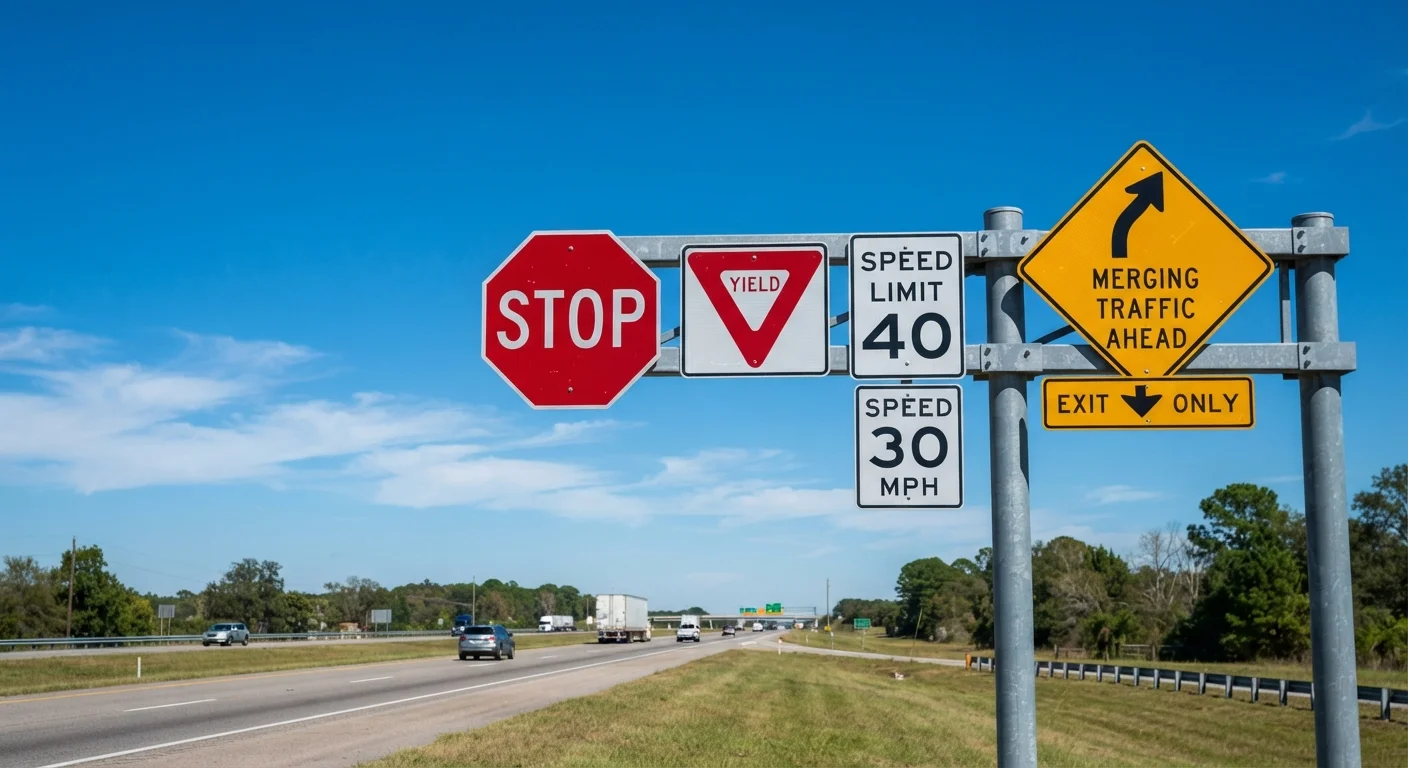
- Stop (octagon, red): Come to a complete stop before the stop line or crosswalk. A rolling stop is illegal in every US state. At a four-way stop, the first vehicle to arrive goes first; when two arrive simultaneously, the driver on the right has priority.
- Yield (downward triangle, red and white): Slow down and give way to crossing or merging traffic. You are not required to stop unless traffic makes it necessary. Failing to yield is among the leading causes of intersection collisions — see our guide on navigating junctions and priority roads for right-of-way detail.
- Do Not Enter / Wrong Way (red): These two signs work as a pair. "Do Not Enter" appears at the entrance of a one-way road; "Wrong Way" is positioned further down. If you see either, stop, do not proceed, and turn around safely when it is clear.
- No U-Turn: A prohibitive sign that applies continuously through the zone it covers, not just at the sign itself. Many drivers treat intersections beyond the sign as exempt — they are not.
- Speed Limit: The posted number is a legal maximum under ideal conditions, not a target. In adverse weather or heavy traffic, a lower speed may be legally required. Our article on driving in rain, fog, and snow covers appropriate speed adjustments.
Warning and Guide Signs Drivers Often Misread
Warning signs (yellow diamonds) advise of hazards ahead; they do not mandate a specific action but signal that one may be necessary. Guide signs (green or blue rectangles) provide navigational information.
~40%
Intersection-related crash share
The Federal Highway Administration estimates that roughly 40% of all crashes in the US occur at or near intersections, where sign compliance is critical.
2x–3x
Work zone fine increase
Most US states double or triple traffic fines for violations committed within active work zones to protect road workers.
- Advisory Speed Plates (yellow, below a warning sign): The number on these plates is a recommended safe speed for the condition shown — a sharp curve, a ramp, or an intersection. This is advisory, not a legal limit, but exceeding it in poor conditions significantly raises crash risk.
- Divided Highway Begins / Ends: "Divided Highway Begins" means a median will separate opposing traffic ahead — move to the right. "Divided Highway Ends" means opposing traffic will share the roadway again. Drivers frequently confuse which sign means which.
- Traffic Signal Ahead: Placed before signals that are difficult to see due to terrain or curvature. Its purpose is to prevent sudden hard braking. Anticipate the signal; don't wait until it's in view.
- Exit Only (green): A lane marked "Exit Only" does not continue on the main highway. Drivers who miss this merge late, creating dangerous last-second lane changes.
When something unexpected forces a route change, clear sign recognition becomes even more critical. Our guide to handling detours and breakdowns explains how to navigate unfamiliar roads calmly.
School, Work Zone, and Pedestrian Signs
These categories carry heightened legal consequences and require sustained attention, not just a glance.
- School Zone (fluorescent yellow-green pentagon): Speed limits in school zones are strictly enforced and often lower than surrounding roads. Crucially, reduced speeds typically apply during posted hours — not just when children are visibly present. Check posted time restrictions before assuming the standard limit applies.
- Work Zone (orange): Fines in active work zones are frequently doubled or tripled by state law, and workers may be present even when equipment is not visible. Orange signs replace standard regulatory and warning signs within the zone — treat them with equal legal weight.
- Pedestrian Crossing (yellow diamond or fluorescent yellow-green): Requires you to be prepared to stop for pedestrians. A crosswalk without a signal still carries right-of-way obligations; in most US states, pedestrians already in the crosswalk must be allowed to cross completely before you proceed.
Just as dashboard indicators tell you what's happening with your vehicle, road signs communicate the road environment ahead. If you're less confident reading either, our dashboard warning lights guide covers the parallel skill for your instrument panel.
This article provides general educational information about US road signs. Always consult your state's driver handbook and current traffic laws, as specific rules and penalties can vary by jurisdiction.
The content on this site is for informational purposes only and is not a substitute for professional advice. Always consult a qualified professional for guidance specific to your situation.