

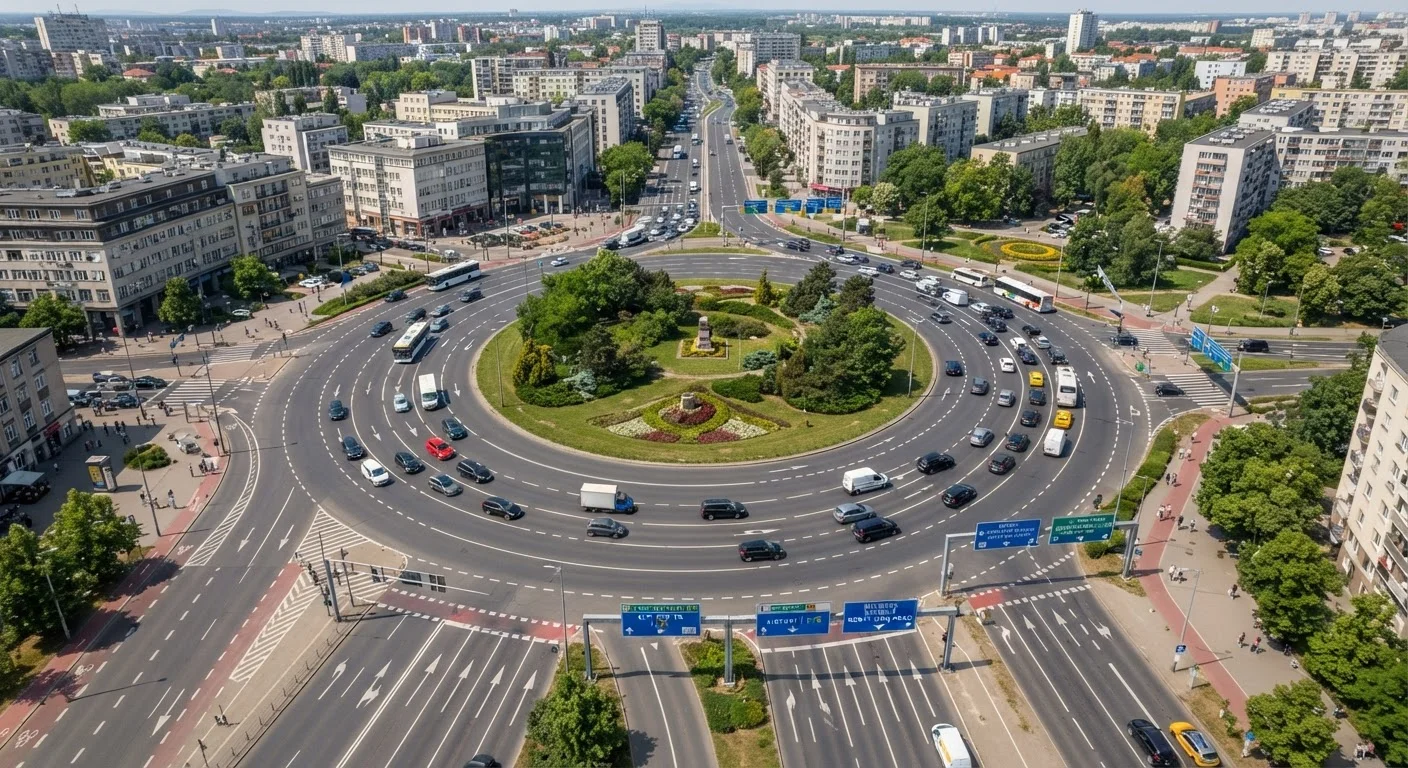
Why Intersection Navigation Gets Drivers Into Trouble
Intersections — whether roundabouts, four-way junctions, or priority roads — concentrate traffic from multiple directions into a single decision point. It is precisely this convergence that makes them the location of a disproportionate share of traffic collisions. Confusion about who has the right of way, late signaling, and incorrect lane selection are recurring factors in intersection incidents across the US.
Part of the problem is inconsistency. A driver who learned to navigate simple stop-sign junctions may feel uncertain at a multi-lane roundabout or an unmarked rural intersection. Similarly, priority roads — where one road has formal right of way over crossing streets — are not always clearly intuitive without knowing what to look for. Refer to the road signs every driver should know for a detailed breakdown of the signage used to mark these conditions.
The good news is that all of these scenarios follow clear, learnable rules. Approaching each intersection type with the right mental framework — slow, identify, yield, signal, proceed — dramatically reduces uncertainty and improves safety for everyone on the road.
What you will need
Step-by-Step: How to Navigate Any Intersection Safely
The following steps apply universally across roundabouts, junctions, and priority roads. They are designed to be repeatable habits, not one-time checklists. Drivers who internalize this sequence develop a consistent, low-stress approach to even unfamiliar intersection layouts.
Current State Driver's Manual
Provides the legally accurate right-of-way rules and intersection procedures specific to your state.
Navigation App (e.g., phone GPS)
Alerts you to upcoming junctions, roundabouts, and road types so you can prepare in advance.
Identify the intersection type before you reach it
As you approach any junction, roundabout, or priority road, identify what type of intersection it is while you still have time to adjust your speed. Look for signs such as a yield sign (inverted red triangle), a stop sign (red octagon), or a priority road sign (yellow diamond in the US context, or equivalent markings). At roundabouts, the circular layout and directional arrows are visible well in advance. Knowing the intersection type tells you which rule set applies.
Reduce speed and position your vehicle correctly
Begin slowing down well before the intersection. Choose your lane based on your intended direction: right lane for right turns, left lane for left turns, and an appropriate lane for going straight. At multi-lane roundabouts, use the left lane for exits beyond the 12 o'clock position and the right lane for earlier exits. Incorrect lane positioning before entry is one of the most common errors at roundabouts and complex junctions.
Apply the correct right-of-way rule for the intersection type
Each intersection type has a distinct priority rule:
- Roundabouts: Traffic circulating inside the roundabout always has priority. Yield to vehicles already in the circle before entering, regardless of how long you have been waiting.
- Uncontrolled four-way junctions (no signs): The driver who arrived first proceeds first. If vehicles arrive simultaneously, the driver on the right has priority.
- Stop-sign junctions: Come to a complete stop. At a four-way stop, apply the same first-arrived, then yield-to-the-right rule.
- Priority roads: Drivers on the main (priority) road have right of way; drivers entering from side roads must yield.
Signal your intentions clearly and early
Use your turn signals before turning, not during. At roundabouts, signal right as you approach your exit and cancel the signal once you have exited. At standard junctions, indicate at least 100 feet before your turn in most urban settings (distances can vary by state law). Clear signaling gives other road users time to respond predictably, reducing the chance of conflict.
Execute the manoeuvre smoothly and check mirrors on exit
Proceed through the intersection at a steady, controlled speed — avoid sudden acceleration or braking mid-manoeuvre. Once you have cleared the junction or exited the roundabout, check your mirrors to confirm no vehicles are unexpectedly close behind you. Resume normal road speed only after you are fully clear of the intersection area.
Use the Two-Second Scan Rule
Before entering any junction or roundabout, pause briefly and scan left, front, and right — even when signals or markings appear to give you the green light. A moment of observation is far less costly than reacting to a hazard mid-manoeuvre.
Right-of-Way Rules Are Not Optional
Failing to yield correctly is among the most common causes of intersection collisions in the US. Right-of-way rules exist to create predictable traffic flow — disregarding them, even unintentionally, puts everyone at risk. If you are ever uncertain who has priority, slow down and yield rather than proceeding based on assumption.
If you regularly travel routes that include a variety of road types, the differences between motorway and urban driving strategies are also worth understanding — the two environments demand distinct risk-awareness habits.
Common Mistakes and How to Avoid Them
Even experienced drivers fall into patterns that create unnecessary risk at intersections. The most frequent errors include:
- Rolling stops: A vehicle must come to a complete stop at a stop sign — wheels fully stationary. Rolling through, even slowly, is both illegal and dangerous.
- Hesitation in roundabouts: Once a safe gap is confirmed, commit to entering. Stopping inside the yield zone or hesitating mid-entry disrupts traffic flow and increases rear-end risk.
- Misjudging priority on rural roads: On unfamiliar routes, side-road drivers sometimes assume they share equal priority with the main road. Always look for yield signs or road markings before treating an intersection as equal-priority.
- Cutting across lanes: Making wide turns that cross into adjacent lanes — common on right turns at junctions — puts cyclists and oncoming vehicles at serious risk.
Never Assume the Other Driver Will Yield
Even when you have the legal right of way, always confirm that approaching drivers are actually stopping or slowing before you proceed. Defensive driving means treating every intersection as a potential conflict point, regardless of who technically has priority.
For road trips that involve unfamiliar territory — including rural junctions and scenic back roads — see our guide on navigating scenic routes vs. highways to plan ahead for different road conditions. And if things go unexpectedly wrong mid-trip, handling detours and disruptions offers practical guidance to stay safe and on track.
The content on this site is for informational purposes only and is not a substitute for professional advice. Always consult a qualified professional for guidance specific to your situation.