

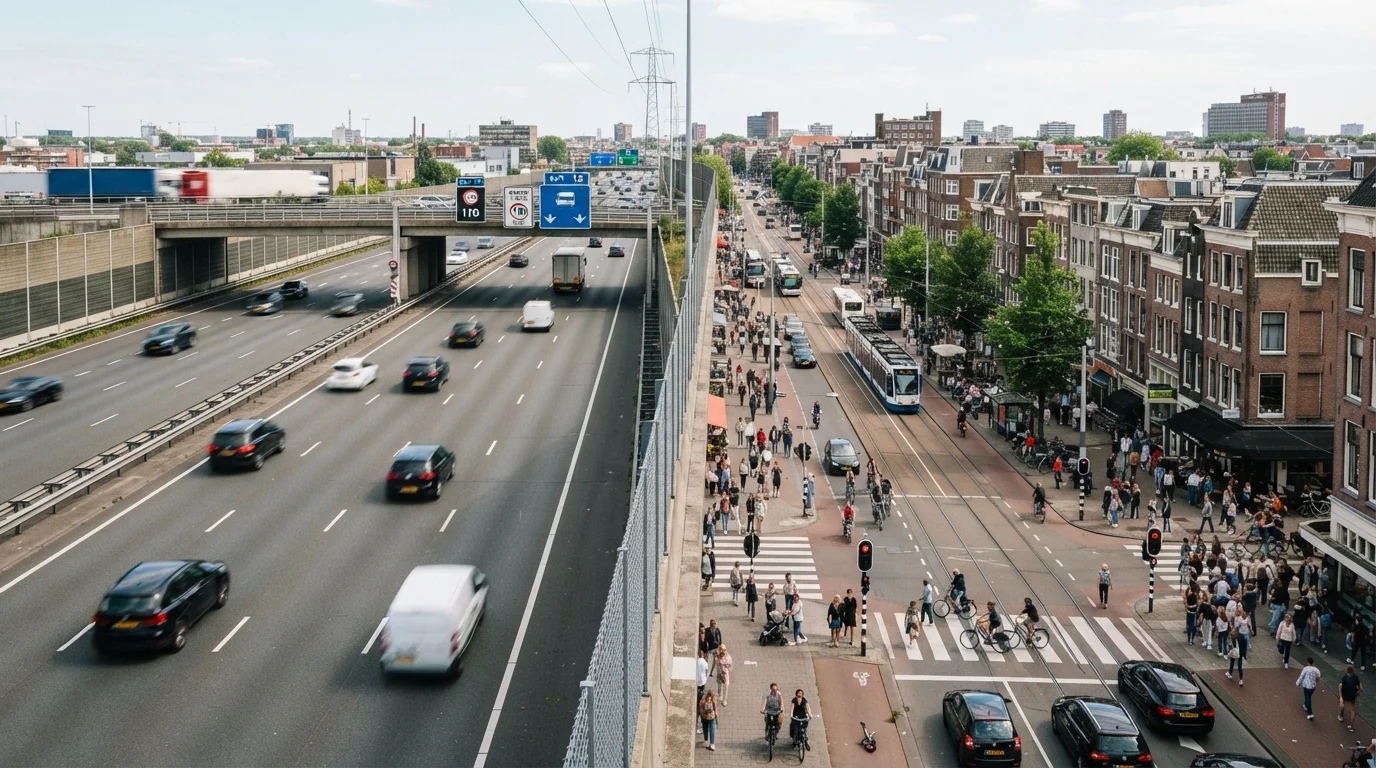
Option A
Motorway Driving
High-speed, long-distance travel with structured lane discipline.
Best for: Drivers covering long distances who need to manage speed, fatigue, and following distance on controlled-access roads.
Option B
Urban Road Driving
Stop-start navigation through complex, unpredictable environments.
Best for: Drivers navigating city streets who must constantly anticipate pedestrians, cyclists, junctions, and tight spaces.
Why Road Type Changes Everything About Safety
Two drivers can both be following the rules, yet face entirely different risks depending on whether they're on a motorway or threading through city traffic. The physics, the hazard mix, and the mental demands are distinct — and a single safety strategy doesn't serve both environments equally well.
Motorways (including US interstate highways) are engineered for speed and flow. Access is controlled, cross-traffic is eliminated, and pedestrians are absent. Urban roads, by contrast, are layered environments where vehicles share space with cyclists, pedestrians crossing mid-block, delivery vehicles double-parked, and intersections operating on shifting priority rules. Understanding how risk differs between these environments is the foundation of safer driving habits for all experience levels.
| Criterion | Motorway Driving | Urban Road Driving |
|---|---|---|
| Typical speed range | 55–75 mph | 15–40 mph |
| Primary crash type | Rear-end, lane-change, run-off | Intersection collisions, pedestrian strikes |
| Main safety focus | Following distance, lane discipline | Hazard scanning, junction awareness |
| Greatest fatigue risk | High — monotony induces microsleep | Lower — constant stimulation keeps alertness up |
| Pedestrian/cyclist exposure | Minimal to none | Constant and unpredictable |
| Crash severity potential | High — greater energy at impact | Moderate — lower speeds reduce force |
| Key driver error | Tailgating and fatigue | Distraction and speed misjudgement |
Motorway Safety: Speed, Distance, and Sustained Attention
At motorway speeds — commonly 65–75 mph in the US — the consequences of error escalate quickly. Stopping distances grow dramatically with speed: at 70 mph, the total stopping distance (reaction plus braking) can exceed 300 feet under good conditions. That figure rises sharply on wet or degraded pavement.
The two-second rule is the standard minimum following gap in light traffic; many safety guidelines recommend three seconds or more at higher speeds or in poor conditions. Lane discipline — staying in the right lane except to overtake — reduces the unpredictability that causes rear-end and sideswipe crashes.
Fatigue is the motorway's most underestimated hazard. The monotony of sustained high-speed travel can induce microsleep — brief, involuntary lapses in awareness — even in well-rested drivers. Taking a break every two hours and sharing driving duties on long trips are practical countermeasures. Note that adverse weather conditions compound every motorway risk substantially, requiring further speed reduction and increased following distance beyond posted guidance.
~50%
Share of US traffic fatalities on rural/highway roads
According to NHTSA data, rural roads — including interstates — account for roughly half of all US road fatalities despite lower traffic volumes compared to urban areas.
3 sec
Recommended minimum following gap at highway speeds
Safety organisations generally advise a three-second following distance at highway speeds under normal conditions, extending further in rain, fog, or heavy loads.
Urban Road Safety: Hazard Scanning and Speed Management
Urban driving rarely exceeds 35–40 mph, but the density of potential hazards per mile is far higher. Pedestrians — including children — may cross unpredictably. Cyclists occupy lanes and can be obscured by parked vehicles. Delivery trucks, ride-share stops, and double-parking create sudden lane blockages. And junctions, where most urban collisions occur, require continuous priority assessment. See our guide on navigating roundabouts and junctions correctly for detailed right-of-way rules.
Effective urban driving relies on active hazard scanning — constantly reading 10–15 seconds ahead while monitoring side streets, parked cars, and pavements simultaneously. Slowing before reaching a junction, not just at it, gives you the reaction time that urban speeds can falsely suggest you don't need.
It's also worth noting that posted speed limits and safe speeds are not always identical. A 30 mph zone near a school during pick-up hours may warrant 15–20 mph in practice. Emotional state matters too — frustration in congestion or aggression at slow drivers amplifies risk significantly, as explored in our piece on road rage and emotional driving.
School Zones and Residential Streets
Urban speed limits in school zones are typically 15–25 mph when children are present, and many states enforce these limits with automated cameras. Residential streets with parked cars on both sides effectively narrow the usable lane width, making careful speed selection and door-zone awareness especially important. Always check local regulations, as enforcement rules and penalties vary by state and municipality.
Transitioning Between Road Types Safely
One overlooked risk occurs at the boundary between road types. Drivers exiting a motorway after sustained high-speed travel often underestimate how fast they're moving on the slip road or first urban street. Speed perception recalibrates slowly — what feels like 30 mph may actually be 50 mph. Checking your speedometer actively, rather than relying on feel, is a simple but effective habit during this transition.
Conversely, entering a motorway from an urban area demands a rapid mental shift toward longer sight lines, higher following distances, and awareness of faster-moving merge traffic. Planning your route in advance and using the right road type for your journey also reduces the frequency of these demanding transitions.
Ultimately, safe driving is an adaptive skill. Matching your strategy to the road you're on — rather than applying a single default mode — is what separates confident drivers from complacent ones.
The content on this site is for informational purposes only and is not a substitute for professional advice. Always consult a qualified professional for guidance specific to your situation.