

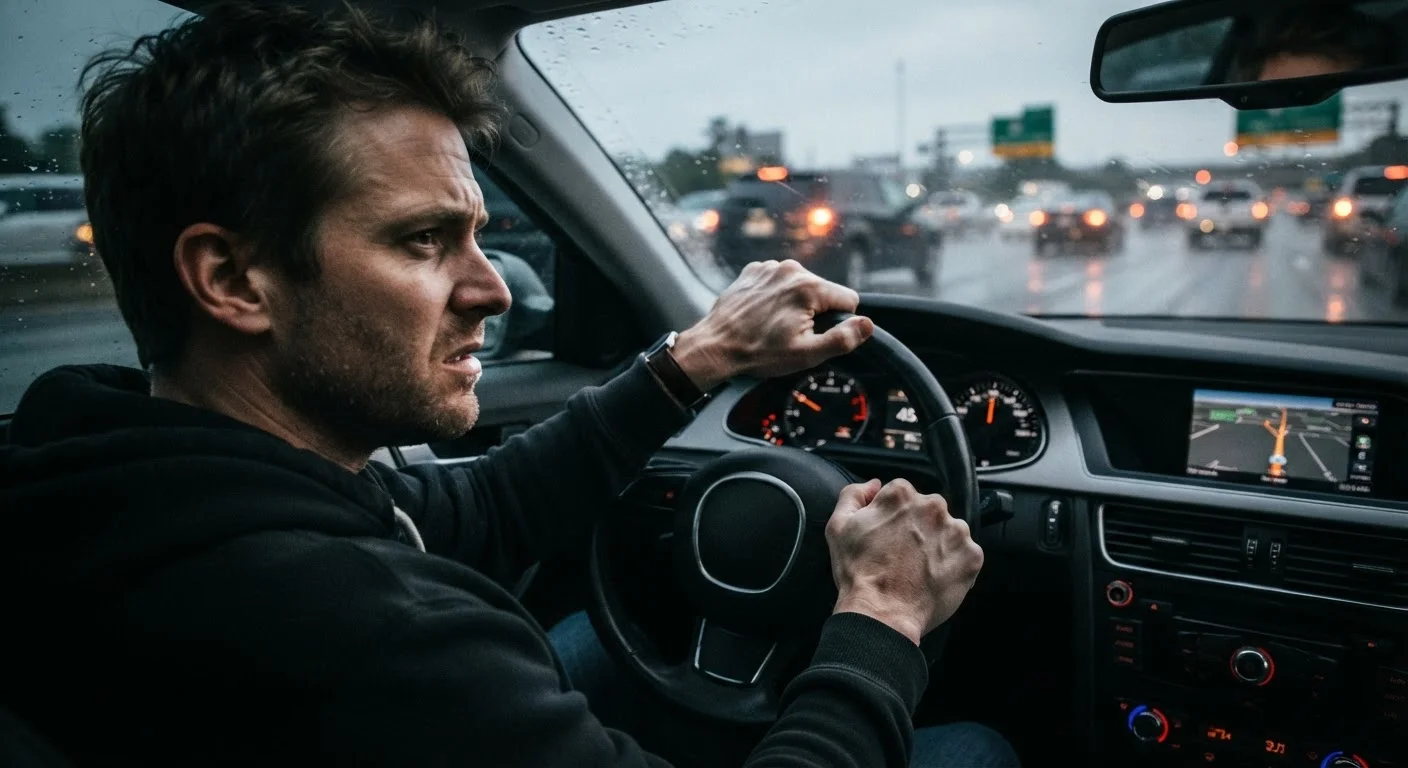
Why Emotions and Driving Are a Dangerous Mix
Driving is often framed as a physical skill, but it is equally a cognitive and emotional one. Every second behind the wheel demands divided attention: monitoring speed, reading road signs, anticipating other drivers' actions, and responding to unexpected hazards. When a strong emotion enters the picture, it competes directly for those cognitive resources.
Neurologically, heightened emotional states — particularly anger and anxiety — activate the brain's threat-response systems, which prioritize reactive, instinctive behavior over careful deliberation. This is precisely the opposite of what safe driving demands. The result: slower hazard detection, reduced peripheral awareness, and a tendency toward impulsive decisions like hard braking, abrupt lane changes, or aggressive acceleration.
This isn't unique to dramatic road rage incidents. Even moderate emotional distraction — replaying an argument, worrying about a work deadline, or feeling low after difficult news — diverts mental bandwidth in ways drivers rarely notice. Just as hands-free phone calls still divert cognitive attention, emotional preoccupation creates an internal distraction that doesn't announce itself.
80%
Drivers who report road rage or aggressive driving
According to AAA Foundation for Traffic Safety research, approximately 80% of drivers reported experiencing significant anger, aggression, or road rage at least once in a prior year.
66%
Aggressive driving's share in fatal crashes
The AAA Foundation for Traffic Safety has attributed aggressive driving behaviors to roughly two-thirds of all traffic fatalities studied in multi-year analyses.
2x
Increased crash risk when emotionally upset
Studies in naturalistic driving research have found that drivers in an emotionally agitated state are roughly twice as likely to be involved in a safety-critical event compared to calm baseline driving.
Road Rage: What It Is and How It Escalates
Road rage describes aggressive or violent behavior by a driver directed at another road user, typically triggered by a perceived slight — being cut off, tailgated, or honked at. What distinguishes road rage from general frustration is escalation: it moves from irritation into deliberate, threatening action.
Common road rage behaviors include: following another driver aggressively, blocking lane changes, flashing lights repeatedly, shouting or gesturing, intentional close passing, or in extreme cases, attempting physical confrontation. Each of these behaviors multiplies risk — not only for the target, but for every road user nearby.
Escalation often follows a predictable pattern. A triggering incident produces frustration. If the driver interprets the action as a personal insult, anger intensifies. Without a conscious effort to de-escalate, the driver may act on that anger impulsively. Research in driver psychology suggests that the feeling of anonymity inside a vehicle — combined with being in a hurry or already stressed — lowers the threshold for aggressive responses.
“The car gives people a sense of power and anonymity that lowers their threshold for behavior they would never display face-to-face. Combine that with stress and a culture of rushing, and the conditions for aggression are almost built into the daily commute.”
— Leon James, Professor of Psychology, University of Hawaii, and researcher on driver behavior and road rage
It's worth noting that road rage is distinct from, though related to, the broader problem of complacency and behavioral patterns that affect even experienced drivers. Both share a common thread: an overestimation of one's own competence or entitlement on the road.
Recognizing Your Own Emotional State at the Wheel
Self-awareness is one of the most practical safety tools available to any driver. Before starting a trip, it is worth a brief check-in: Are you rushing? Are you still processing a stressful conversation? Are you significantly tired or upset?
Physical cues of emotional elevation include a faster heartbeat, muscle tension (particularly in the shoulders, jaw, or hands gripping the wheel), shallow breathing, or a narrowed sense of focus — all of which are measurable signs that the nervous system is engaged in a way that competes with calm attentiveness.
Try a Pre-Drive Emotional Check-In
Before pulling out of your driveway or parking space, pause for 30–60 seconds. Ask yourself: how am I feeling right now, and is that state likely to affect my driving? If the answer reveals significant stress, anger, or distraction, taking a moment to breathe slowly — or reconsidering whether to drive at all — is a sound, low-effort safety habit.
During a drive, early warning signs that emotions are affecting your behavior include: following closer than usual, finding yourself reacting to minor actions by other drivers, accelerating aggressively, or becoming irritated at traffic conditions outside your control. Recognizing these patterns in real time allows for course correction before a situation escalates.
Emotional states also interact with other risk factors. A driver who is already anxious or fatigued is more vulnerable to road rage triggers than one who is calm and rested. The compounding effects of fatigue on judgment and reaction time can amplify emotional reactivity considerably.
Practical Strategies for Safer, Calmer Driving
Managing emotional driving is largely about preparation and recognition rather than in-the-moment willpower. Several approaches are consistently supported by road safety education:
- Allow extra time. Being in a hurry is one of the most reliable predictors of aggressive driving. Building buffer time into any journey removes the pressure that turns minor delays into frustration.
- Develop a pre-drive pause. Spending sixty seconds before starting the engine to take a few slow, deliberate breaths and set an intentional, calm mindset can meaningfully shift your baseline emotional state.
- Disengage from provocation. If another driver is behaving aggressively toward you, the safest response is to create distance, avoid eye contact, and decline to respond. Matching aggression with aggression reliably makes the situation worse.
- Use audio environment deliberately. Music with high tempo and aggressive tone is associated with more aggressive driving behavior; calmer audio tends to support a more measured approach. This is a small but controllable factor.
- Delay the trip if necessary. If you are acutely distressed — after an argument, upsetting news, or in a state of intense anxiety — delaying travel until you are calmer is a legitimate, reasonable safety decision.
Environmental driving conditions can add further pressure. Understanding how to adapt to challenging scenarios — from adverse weather to high-speed motorways versus dense urban roads — is part of building the full picture of driver safety.
Frequently Asked Questions
Yes. Research in driver behavior consistently shows that anger reduces attention to the road, increases speed, and shortens following distance. Angry drivers are more likely to miss signals, make abrupt lane changes, and misjudge gaps in traffic.
Aggressive driving typically refers to traffic violations like tailgating, unsafe passing, or running red lights — often driven by frustration. Road rage escalates further to deliberate intimidation: confronting another driver, intentional collisions, or threatening behavior. Both are dangerous; road rage may also carry criminal charges.
Yes. Any strong emotion — positive or negative — draws cognitive resources away from driving. Excitement can lead to distraction, overconfidence, or elevated speed. Safe driving requires a calm, focused mental state regardless of emotional valence.
Do not respond, make eye contact, or retaliate. Increase your distance from the aggressive driver, avoid getting boxed in, and if necessary, exit the road and wait in a safe, public place. Contact local authorities if you feel threatened.
Emotional distress after receiving bad news can significantly impair driving — similar in some ways to the cognitive load studied in distracted driving contexts. If you are acutely upset, it is safer to wait until you are calmer, have someone else drive, or use a rideshare service.
The content on this site is for informational purposes only and is not a substitute for professional advice. Always consult a qualified professional for guidance specific to your situation.