

Our Verdict
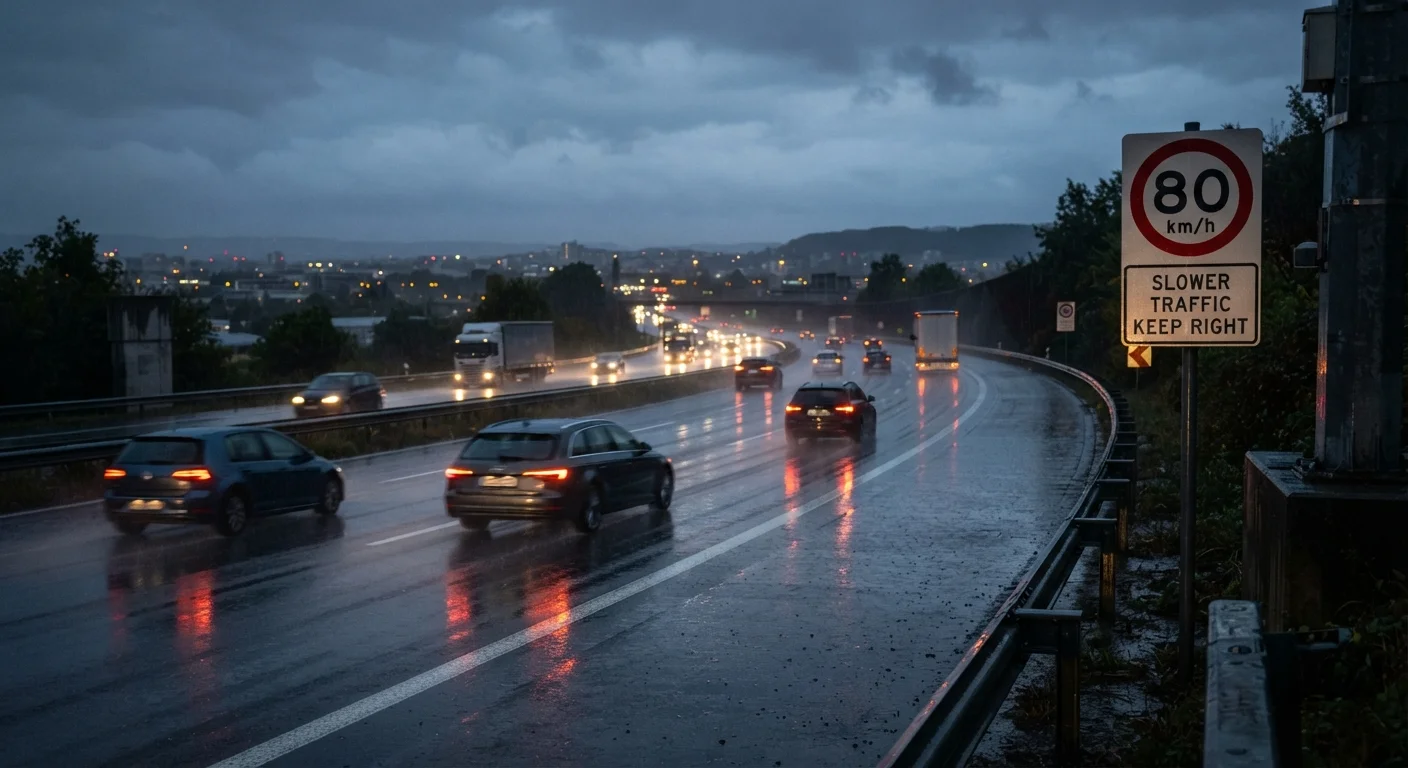
Speed limits are a necessary legal framework, but they are engineered for ideal conditions and cannot account for every variable a driver encounters. Treating the posted number as a floor rather than a ceiling is a common and dangerous misconception. Responsible drivers treat speed limits as a cap and actively read conditions to determine what is actually safe.
Any driver who wants to move beyond rule-following and develop the situational awareness that genuinely reduces crash risk in everyday driving.
What Speed Limits Actually Represent
Speed limits in the United States are established through traffic engineering studies and set at a level considered safe under normal, favorable conditions — dry pavement, good visibility, typical traffic volume, and an alert, unimpaired driver. They represent a legal maximum, not a recommendation for every moment of every drive.
The FHWA and state transportation agencies use a method called the 85th percentile speed to inform many posted limits — the speed at or below which 85% of free-flowing traffic travels. This is a statistical baseline, not a safety guarantee. It reflects how people drive, not necessarily how they should drive given real-time conditions.
Understanding this distinction is foundational. When a sign reads 65 mph, it means: do not exceed this number under ordinary circumstances. It says nothing about whether 65 mph is appropriate in dense fog, on an icy overpass, or through an active construction zone with workers present.
Pros of Speed Limits as a Safety Framework
Creates predictable, shared speed expectations for all drivers
When most vehicles travel at similar speeds, traffic flow becomes more consistent and rear-end crash risk from speed differentials is reduced.
Provides legal accountability and enforcement baseline
A measurable posted limit gives law enforcement a clear standard, helping deter the most dangerous speeding behavior on public roads.
Offers a concrete reference point for inexperienced drivers
Newer drivers benefit from a defined number while they develop the situational awareness needed to fine-tune speed for changing conditions.
Reflects engineering data for typical, favorable conditions
Limits are informed by traffic studies and road design standards, making them a reasonable baseline when conditions match the design assumptions.
Speed limits do meaningful work even if they are imperfect. They create a shared expectation among drivers, which reduces variance in vehicle speeds and makes traffic flow more predictable. Research consistently links higher speed differentials — not just high speeds — with increased crash severity. A posted limit brings vehicles closer to a common operating speed.
Limits also provide a legal accountability structure. Enforcement gives authorities a measurable, enforceable standard, and the threat of citation discourages the most dangerous speeding behavior. For newer or less experienced drivers, the posted number serves as an accessible, concrete reference point while more nuanced judgment develops.
Cons: When the Posted Limit Isn't the Safe Speed
Set for ideal conditions, not real-time variables
Speed limits are determined using studies conducted under favorable conditions; they don't automatically reflect what's safe during rain, ice, fog, or darkness.
Can create false sense of security at the posted number
Drivers who treat the limit as a safe target may underestimate risk in degraded conditions, contributing to crashes where speed was legal but inappropriate.
Do not account for road geometry or pavement quality
A posted limit on a straight highway may be dangerously high on a sharp curve or deteriorating road surface on the same corridor.
Traffic density and behavior aren't reflected in the number
A limit set for free-flowing traffic offers no guidance when lanes are congested, merging is active, or vehicles ahead are braking unpredictably.
Static signs cannot adapt to pedestrian or cyclist activity
School zones and crosswalks may have reduced limits at set times, but heavy foot traffic at other hours still warrants driver-initiated caution.
The conditions under which a speed limit was determined can be very different from what a driver faces at any given moment. Rain reduces tire grip and extends stopping distances significantly — yet the speed limit does not change when rain begins. The NHTSA has identified speeding — including driving too fast for conditions, even within the posted limit — as a factor in a substantial share of fatal crashes.
Consider these common scenarios where the legal speed may exceed the safe speed:
- Poor weather: Ice, snow, heavy rain, and fog all dramatically reduce visibility and traction.
- Heavy or unpredictable traffic: Merging zones, sudden braking, and dense congestion demand lower speeds and longer following distances.
- School zones and pedestrian areas: Even where posted limits are reduced, the presence of children or crowded sidewalks warrants extra caution.
- Road geometry: Sharp curves, narrow lanes, and compromised pavement require speed reductions independent of signage.
For drivers navigating both high-speed and urban environments, the calculus changes substantially by road type. See how safety strategies differ between settings in our guide on motorway vs. urban road safety.
Developing the Judgment to Choose Your Safe Speed
"Too Fast for Conditions" Is a Legal Standard
In most US states, drivers can be cited for traveling at a speed deemed unsafe for conditions — even if they are at or below the posted limit. This legal principle, sometimes called the "basic speed law," reinforces that the posted number is a ceiling, not a shield. Drivers retain legal and moral responsibility to adjust for weather, visibility, and road conditions regardless of what the sign reads.
Adjusting speed in response to conditions is not timid driving — it is skilled driving. Professional and commercial drivers are trained to constantly reassess: What is my stopping distance at this speed? Can I see far enough ahead to respond to a hazard? Is the road surface giving me the grip I need?
Several practical questions can guide this judgment in real time:
- Can I stop safely within the distance I can clearly see?
- Are road surfaces — especially bridges and shaded sections — potentially slick?
- Is traffic moving predictably, or are there sudden-stop risks?
- Are pedestrians, cyclists, or animals likely to enter my path?
Drivers who internalize these questions shift from passive rule-following to active hazard management. This is the core of defensive driving — a concept endorsed by safety organizations and driver education programs across the country.
~29%
Fatal crashes involving speeding as a factor
NHTSA data consistently shows that speeding — including driving too fast for conditions — is a factor in roughly a quarter to a third of all traffic fatalities annually in the US.
2x+
Increase in stopping distance on wet pavement
Traffic safety educators note that wet roads can more than double stopping distances compared to dry conditions at the same speed, underscoring why limits set for dry roads may not apply in rain.
The content on this site is for informational purposes only and is not a substitute for professional advice. Always consult a qualified professional for guidance specific to your situation.