

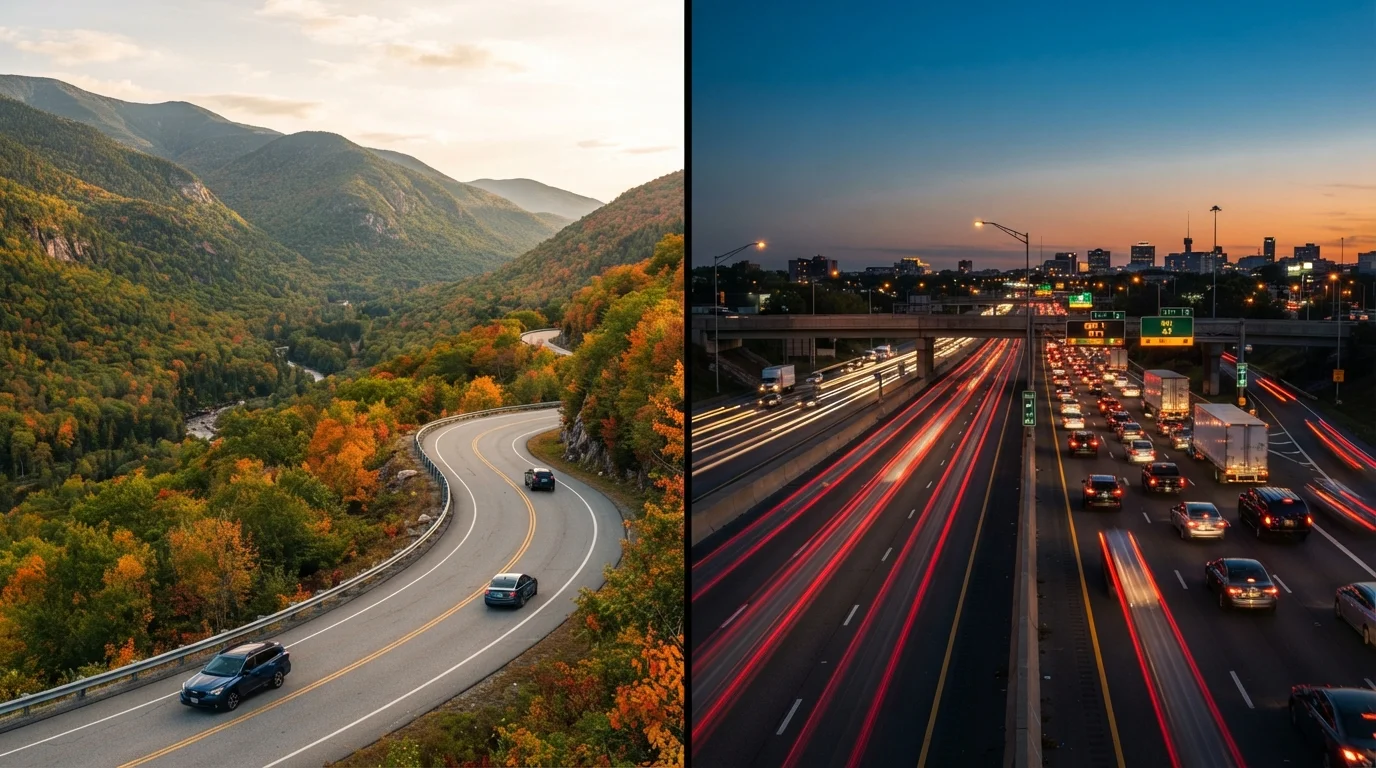
Option A
Scenic Routes
The immersive, experience-first road less traveled.
Best for: Drivers who prioritize discovery, photography, and a slower, more memorable journey over raw mileage.
Option B
Interstate Highways
The efficient, predictable backbone of long-distance travel.
Best for: Travelers who need to cover ground quickly, stick to a schedule, or minimize driving fatigue on multi-day trips.
What You're Actually Choosing Between
Selecting a route isn't just a navigation decision — it shapes the entire character of your trip. As explored in what defines a road trip, long-distance driving involves a distinct rhythm that your route choice will either support or disrupt.
Scenic routes — which include designated byways, state highways, forest roads, and coastal routes — are built around landscape and locality. They pass through small towns, hug coastlines, and climb mountain passes. The trade-off is time: a route that covers 200 miles on a map might realistically take four to five hours instead of three.
Interstate highways are engineered for throughput. Limited access points, wide lanes, consistent grades, and a reliable network of services make them the default choice for time-sensitive travel. What they rarely offer is scenery or serendipity.
Neither option is objectively superior. The right choice depends on your schedule, your vehicle, your travel party, and what you actually want from the drive itself.
| Criterion | Scenic Routes | Interstate Highways |
|---|---|---|
| Average speed | 35–55 mph | 65–75 mph |
| Fuel stop frequency | Unpredictable; plan ahead | Reliable every 20–40 miles |
| Road condition consistency | Variable; seasonal closures possible | Highly consistent year-round |
| Scenery and experience | High — landscapes, towns, overlooks | Low — functional, utilitarian |
| Driver fatigue profile | Mentally engaging; physically tiring on curves | Can cause monotony fatigue on long runs |
| Emergency services access | Limited; slower response times | Better coverage and response |
| Suitability for large vehicles / trailers | Often restricted or impractical | Well-suited |
Time, Distance, and the Hidden Cost of Scenic Roads
The most immediate trade-off is time. Scenic routes often follow the original pre-interstate road network — two-lane roads with speed limits of 35–55 mph, frequent curves, and towns where traffic slows to a crawl. A drive that takes three hours on the interstate can take five or more on a parallel back road.
That extra time isn't wasted if the journey is the point. But it has real implications for fuel consumption (stop-and-go driving reduces efficiency), daylight hours (arriving after dark on an unfamiliar mountain road carries safety risks), and fatigue. If you're planning a multi-day trip and debating pace, slow travel vs. fast-paced itineraries offers a useful framework for thinking through the broader trade-offs.
~46,000
Miles in the US Interstate Highway System
The Federal Highway Administration reports roughly 46,000 miles of interstate highway connecting all major US metros.
150+
Designated National Scenic Byways in the US
The US Department of Transportation's National Scenic Byways Program has designated over 150 roads across 46 states for their cultural, natural, or recreational value.
Highways also tend to offer better fuel economy at sustained highway speeds, though this varies significantly by vehicle. Drivers towing trailers or driving larger vehicles should factor in that mountain scenic roads — with their grades and curves — can push engines harder than a flat interstate cruise.
Safety Considerations on Each Road Type
Safety profiles differ meaningfully between road types. Interstates are statistically among the safer road types in the US: divided lanes, controlled access, wide shoulders, and standardized signage all reduce collision risk. Emergency response times are also generally faster along major corridors.
Scenic roads introduce variables that demand more active driving. Narrow lanes, unmarked hazards, wildlife crossings, and abrupt elevation changes require sustained attention. In wet or icy conditions, a mountain pass that was manageable in summer can become genuinely hazardous. The safe driving fundamentals — appropriate speed, following distance, and situational awareness — become especially important on rural back roads where mistakes have fewer second chances.
Night driving on scenic routes warrants extra caution. Limited lighting, deer activity at dusk and dawn, and the absence of reflective lane markings on older roads all increase risk. If your scenic segment runs long, plan to complete it during daylight hours.
Check Road Status Before You Go
Many scenic routes — particularly mountain passes and forest roads — are subject to seasonal closures, permit requirements, or temporary restrictions after weather events. Before departing, check the relevant state DOT website or call 511 (the national traveler information line) for current conditions. This is especially important in spring, when snowmelt can leave roads washed out, and in fall, when early snowstorms can close high-elevation routes with little warning.
Making the Most of a Mixed Approach
The most practical strategy for many long-distance trips is a hybrid route: use the interstate to eat up miles between major waypoints, then peel off onto scenic roads when you're near your destination or a region worth exploring slowly. This is particularly rewarding in areas like the American Southwest, where slower travel through the region reveals geological and cultural layers that a highway corridor simply bypasses.
When planning, consider these practical steps: map your total drive time on both routes before committing; identify fuel stops on scenic segments (they may be 50+ miles apart); check road conditions for mountain or coastal routes seasonally; and build in buffer time so a detour doesn't cascade into a missed reservation.
For regional explorations — where the scale is smaller and the density of interesting stops is higher — scenic roads often pay dividends that cross-country efficiency can't. Cross-country versus regional trip planning is worth reviewing if you're still deciding on the overall scope of your journey.
Ultimately, the road you choose is an expression of the traveler you are. Both types have their place — and the most memorable trips often use both.
The content on this site is for informational purposes only and is not a substitute for professional advice. Always consult a qualified professional for guidance specific to your situation.