

What Gutters Actually Do
Most homeowners think of gutters as a minor cosmetic feature — a metal trim piece around the roofline. In reality, they are a critical water management system. Every time it rains, your roof sheds water rapidly across a large surface area. Without channels to collect and redirect that flow, water cascades off the eaves in sheets, landing directly against your home's foundation and saturating the surrounding soil.
A properly functioning gutter system captures that runoff, carries it along a sloped channel, and discharges it through downspouts several feet away from the structure. This simple path — roof to gutter to downspout to ground — prevents a wide range of costly damage. To understand how gutters fit into your home's broader water management, see our guide on understanding your home's drainage system.
$4,000–$10,000+
Typical cost of foundation water damage repair
Industry estimates from home inspection and contractor organizations suggest foundation repairs from water intrusion frequently exceed $4,000, with severe cases climbing well beyond $10,000.
2x/year
Recommended minimum gutter cleaning frequency
Most roofing and home maintenance authorities recommend cleaning gutters at least twice annually, with additional cleanings for homes near heavy tree cover.
Up to 1,900 gal.
Runoff from 1 inch of rain on a 1,500 sq ft roof
A simple formula used by water management educators shows that one inch of rainfall on a 1,500 square-foot roof generates roughly 935 gallons — volumes that must be redirected away from the structure.
Why Gutters Fail — And What It Costs
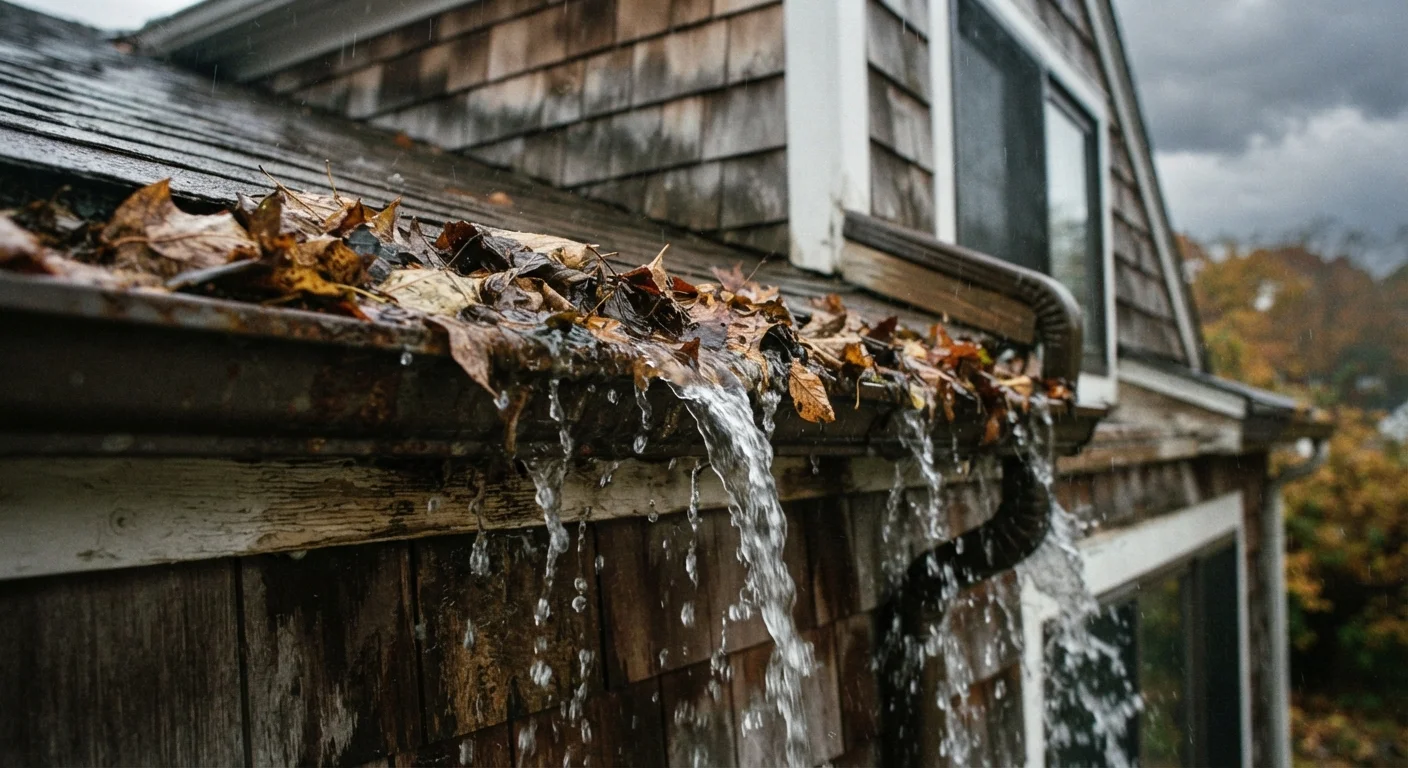
Gutters fail in predictable ways, and most of them are preventable. The most common cause of failure is debris accumulation — leaves, twigs, shingle grit, and seed pods that block water flow. When water can't move through the channel, it either overflows the edge or backs up under roofing material.
Overflow saturates the soil against your foundation, which is one of the leading contributors to basement moisture and, over time, foundation settlement. Water backing up under shingles can rot the roof decking and fascia boards — repairs that typically cost far more than routine gutter maintenance. Poor drainage at the foundation level is explored further in our article on why garden drainage problems get ignored until they're expensive.
Beyond blockages, gutters also fail from improper pitch (the slight downward slope toward the downspout), loose or missing hangers that cause sagging, and seam separation in sectional systems. Any of these conditions allows standing water to accumulate — accelerating rust in steel gutters and creating weight that pulls fasteners from the fascia.
Ice Dams in Cold Climates
In regions with freezing winters, clogged gutters contribute directly to ice dam formation — a condition where water backs up under shingles and refreezes, potentially lifting roofing material and causing interior leaks. Keeping gutters clear heading into winter is one of the simplest ice dam prevention measures available to homeowners. Proper attic insulation also plays a role; consult a roofing professional if ice dams are a recurring issue.
A Practical Maintenance Approach
The good news is that most gutter maintenance is straightforward and requires no special tools. A stable ladder, work gloves, a garden trowel or gutter scoop, and a garden hose are enough for most cleaning tasks.
- Inspect twice a year: Schedule a visual check in late spring (after pollen and seed season) and in late autumn once trees have shed their leaves.
- Clear debris by hand first: Scooping out packed debris before flushing is far more effective than relying on water pressure alone.
- Flush with a hose: Run water from the end farthest from the downspout. Watch for pooling, which indicates a pitch problem, and check that water exits freely at the downspout.
- Check downspout extensions: Ensure water discharges at least 4–6 feet from the foundation. Splash blocks or flexible extensions can help if the current setup drops water too close to the structure.
- Examine hangers and seams: Look for pulled fasteners, sagging sections, or visible gaps at joints. These are early warning signs worth addressing before they worsen.
Mark Your Calendar, Not Your Memory
Rather than relying on noticing a problem, set a recurring calendar reminder for gutter checks in May and November. A proactive 30-minute inspection is far less disruptive than discovering water damage after the fact. Many homeowners find it useful to combine this task with their biannual smoke alarm battery check.
One often-overlooked maintenance truth: gutters are part of a system that also includes your roof. For a broader picture of what roof-level maintenance looks like, our article on roof maintenance responsibilities is a useful companion read.
When to Call a Professional
Not every gutter issue belongs on a DIY checklist. Rotted fascia boards require carpentry repair before new gutters can be properly anchored. Gutters that connect to underground drainage pipes — common in some older neighborhoods — should only be inspected and cleared by someone familiar with the full drainage network to avoid damaging buried infrastructure.
Multi-story homes present a genuine fall hazard, and professional cleaning services use equipment suited to that height safely. If you notice persistent basement dampness, soil erosion patterns along your foundation, or water stains on interior walls below the roofline, have a contractor assess whether the gutter system is contributing to the problem. Skipping this step is exactly the kind of oversight discussed in our look at home maintenance tasks that are often overlooked until something breaks.
Gutter maintenance is one of those unglamorous tasks that pays disproportionate dividends. A system that costs a few hundred dollars to install can protect tens of thousands of dollars in structural investment — but only when it's kept clear, properly pitched, and firmly attached.
Frequently Asked Questions
Most homes benefit from gutter cleaning twice a year — once in late spring and once in late autumn after leaves have fallen. Homes with overhanging pine or oak trees may need cleaning three to four times annually, since needles and small debris accumulate faster.
Debris buildup causes water to overflow or back up under roofing material, which can rot fascia boards, stain siding, saturate foundation soil, and contribute to basement moisture problems. In winter climates, clogged gutters also promote ice dams that can damage shingles.
Single-story gutter cleaning using a stable ladder and proper footwear is generally manageable for most homeowners. Multi-story homes present a significant fall risk, and professional cleaning is strongly recommended for those situations.
Gutters should slope slightly — roughly a quarter-inch drop for every 10 feet of run — toward the downspout. If water pools in the channel after rain or you see rust staining in one spot, the pitch may be off and the gutter bracket may need adjustment.
Gutter guards can significantly reduce the frequency of cleaning by blocking large debris, though they don't eliminate maintenance entirely. Fine particles and shingle grit can still accumulate beneath some guard styles, so occasional inspection remains necessary.
Hire a licensed professional when gutters are pulling away from the fascia, when the fascia board itself appears rotted or soft, when downspouts are connected to underground drainage, or when the work involves a multi-story roofline. These situations carry safety and structural risks that go beyond routine cleaning.
The content on this site is for informational purposes only and is not a substitute for professional advice. Always consult a qualified professional for guidance specific to your situation.