

The Quiet Failures Hiding in Plain Sight
Most homeowners stay on top of the obvious stuff — a leaking faucet, a running toilet, a furnace that won't start. What tends to go unaddressed are the tasks with no urgent symptom: the components that work silently for years and then fail without warning. These are the overlooked items that turn into flooded basements, house fires, or four-figure repair bills.
The list below covers maintenance tasks that are routinely skipped — not out of negligence, but because they're easy to forget when nothing appears to be wrong. Tackling them proactively is far less disruptive than dealing with the aftermath. For a broader schedule of when to address these items throughout the year, see our season-by-season maintenance guide.
Dryer Vent Cleaning
Lint that escapes the trap accumulates inside the dryer duct over time, reducing airflow and creating a genuine fire hazard. The US Fire Administration has identified dryer fires as a significant cause of residential structure fires, with failure to clean vents cited as a leading contributing factor.
Disconnect the duct from the back of the dryer annually and clear it from both ends using a long-handled brush kit. Also check that the exterior vent flap opens freely and isn't obstructed by debris or nesting material. Longer or kinked duct runs may need more frequent attention.
Clogged dryer vents are a leading cause of residential fires — annual cleaning is non-negotiable.
Water Heater Pressure Relief Valve Testing
The temperature and pressure (T&P) relief valve on a water heater is a critical safety device — it releases if the tank overheats or over-pressurizes. Many homeowners have never touched theirs, which means a corroded or mineral-scaled valve may fail to open when it's actually needed.
Briefly lift and release the test lever once a year to confirm it opens and snaps back without dripping. If it continues to drip afterward or feels stuck, the valve should be replaced by a licensed plumber. This is not a task to defer — a failed T&P valve on an over-pressurized tank is a serious hazard.
A T&P valve that hasn't been tested in years may be corroded shut — check it annually.
Expansion Tank Inspection on Closed Plumbing Systems
Homes with a pressure-reducing valve at the water main operate what's called a closed plumbing system. When water is heated and expands, it has nowhere to go — which is why an expansion tank is installed near the water heater to absorb that pressure. These tanks have an internal air bladder that can fail over time, leaving the tank waterlogged and the system unprotected.
Tap the tank with your knuckle: a healthy tank sounds hollow at the top and solid at the bottom. If it sounds completely solid (full of water), the bladder has failed and the tank needs replacement. A licensed plumber can confirm this with a pressure gauge check and handle the swap safely.
A waterlogged expansion tank offers no pressure protection — a hollow tap test takes seconds.
HVAC Filter and Duct Vent Maintenance
Filter replacement is one of the most-discussed home tasks, yet it remains among the most neglected in practice. A clogged filter forces the blower motor to work harder, shortens equipment life, and degrades indoor air quality. Depending on household occupancy, pets, and filter type, replacements are typically needed every one to three months.
Beyond filters, check that supply and return vents throughout the home are open, unobstructed by furniture, and free of dust buildup. Blocked vents create pressure imbalances that stress the system. For a thorough breakdown of filter types, intervals, and when to schedule professional servicing, see our HVAC filters and servicing overview.
A clogged HVAC filter doesn't just reduce air quality — it shortens the life of the entire system.
Smoke and Carbon Monoxide Alarm Testing
Testing alarm batteries is well-known advice, but surveys consistently show that a significant portion of residential alarms contain dead or missing batteries. Beyond batteries, the sensors themselves degrade: smoke alarms are generally recommended for replacement every 10 years, and carbon monoxide detectors typically have a service life of 5 to 7 years.
Press the test button monthly to confirm functionality. Check the manufacture date printed on the back of each unit — if it falls outside the recommended service life, replace the entire device rather than just the battery. Placement matters too: CO detectors should be near sleeping areas, not just near fuel-burning appliances.
An alarm with a 12-year-old sensor may beep on test but fail to detect smoke in an emergency.
Roof Flashing and Gutter Condition
Roof-related leaks rarely announce themselves immediately. Water typically infiltrates through failed flashing — the metal strips sealing joints around chimneys, skylights, and vent pipes — and travels along rafters or sheathing before appearing as a stain inside the home, sometimes months later.
From the ground or a safely accessed vantage point, look for lifted, buckled, or missing flashing and check gutters for sagging, separated joints, or debris buildup that causes overflow toward the foundation. Gutters clogged with leaves direct water against fascia boards and into soffits, leading to rot over a single wet season. Our roof maintenance guide for homeowners outlines what you can safely inspect yourself and when a licensed roofer is warranted.
Roof leaks often travel far from their source — failed flashing can hide damage for months.
Caulk and Weatherstripping Around Windows and Doors
Caulk around window frames and door surrounds dries out, cracks, and shrinks over time — often becoming invisible as a problem because the gaps are small. But even minor air infiltration adds meaningfully to heating and cooling loads, and any water intrusion around window framing can lead to hidden mold or wood rot inside the wall cavity.
Walk the perimeter of your home once a year and probe suspect caulk with a fingernail. Crumbling or gapped caulk should be removed and replaced with an appropriate exterior-grade product. Check weatherstripping on doors for compression loss — if you can see daylight around a closed door, conditioned air is escaping continuously.
Cracked caulk is one of the cheapest fixes in home maintenance, yet one of the most skipped.
Building the Habit Before Something Breaks
The common thread across all of these tasks is that they ask very little of you — an annual inspection, a filter swap, a quick visual check — but the consequences of skipping them can be disproportionately large. A few minutes twice a year on a dryer vent or pressure relief valve is genuinely protective, not just cautionary advice.
Schedule Tasks, Don't Just Remember Them
Relying on memory for low-visibility tasks is how they get skipped year after year. Add recurring calendar reminders for each item — spring and fall are natural check-in points for most of them. Pairing a task with an existing habit (such as checking alarms when you change clocks) makes it far more likely to happen consistently.
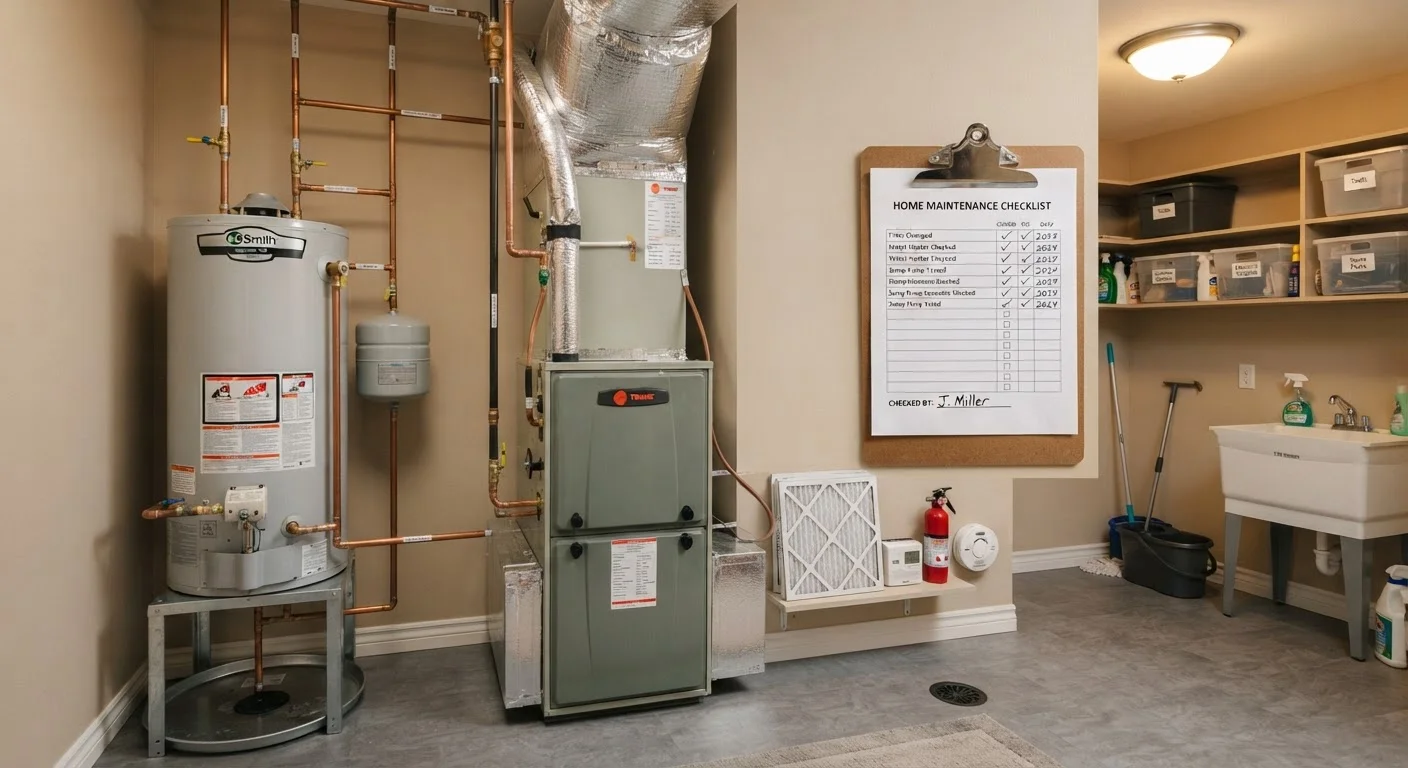
Consider logging each task as you complete it. A simple record of dates, observations, and any work done makes it easier to spot patterns and gives you documentation that's useful for insurance claims or future resale. Our guide on keeping a home maintenance log explains how to set one up without much overhead.
And if you're ever unsure whether a task falls within safe DIY territory, our article on where DIY becomes hazardous provides a clear framework for making that call.
This article is for general informational purposes only. Always consult a licensed contractor or qualified professional before undertaking work that involves electrical systems, gas lines, structural elements, or any task that may require permits under your local building code.
The content on this site is for informational purposes only and is not a substitute for professional advice. Always consult a qualified professional for guidance specific to your situation.