

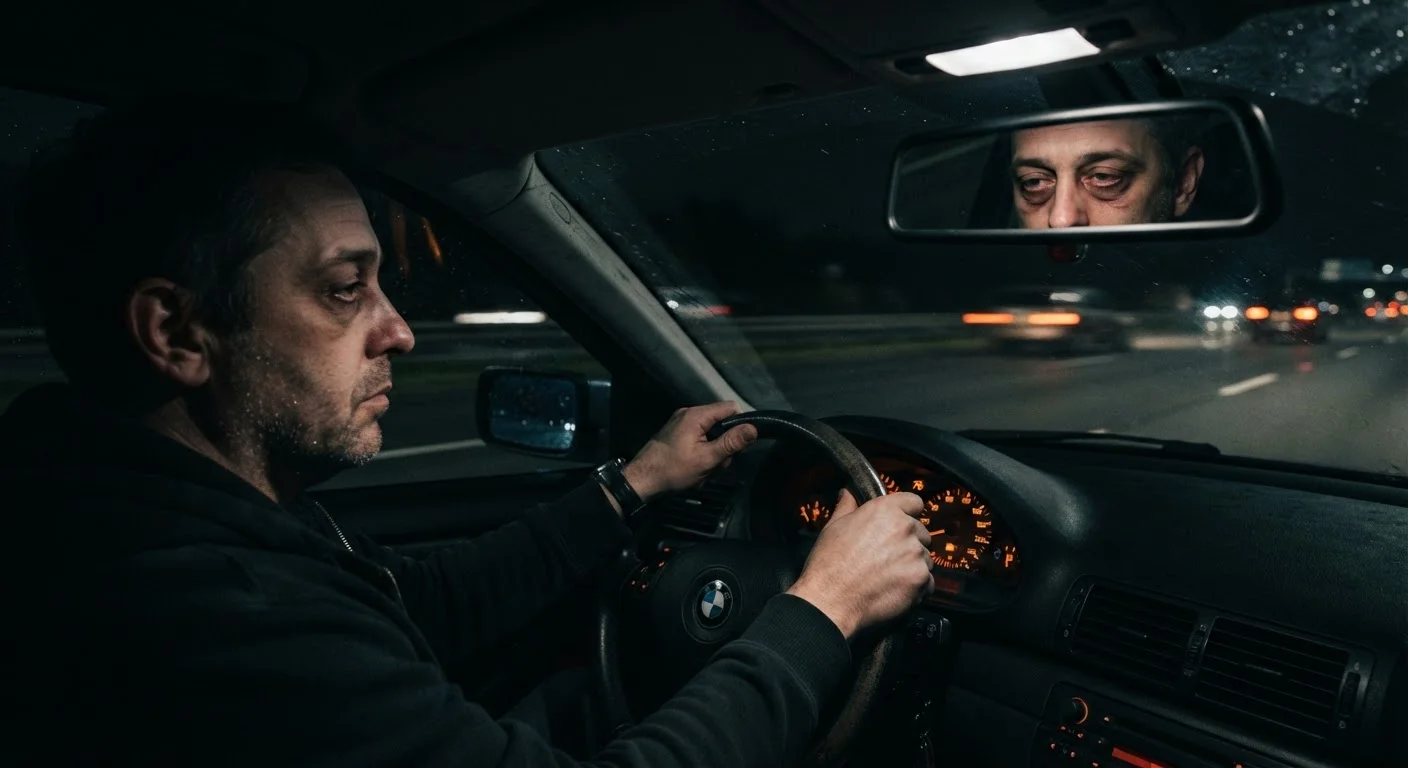
Why Drowsy Driving Is More Dangerous Than Most Drivers Realize
Driver fatigue is one of the most underestimated hazards on American roads. The NHTSA estimates that drowsy driving is a contributing factor in thousands of fatal crashes each year — a figure widely believed to undercount the true toll, since fatigue is difficult to confirm after a collision.
What makes this risk particularly insidious is that impaired alertness reduces a driver's ability to recognize their own impairment. Unlike alcohol, which leaves physical and chemical evidence, fatigue leaves no trace. Yet its effects on driving ability — slowed reaction time, narrowed attention, poor hazard recognition — are strikingly similar. Understanding the real science behind drowsiness is the first step toward taking it seriously.
For a broader look at how emotional and cognitive states affect driving, see our article on how your mood affects your driving risk.
~100,000
Police-reported drowsy driving crashes annually (US)
The NHTSA estimates around 100,000 police-reported crashes per year involve drowsy driving, though actual numbers are considered significantly higher due to under-reporting.
1.76x
Crash risk increase with 6–7 hours of sleep
AAA Foundation for Traffic Safety research found drivers sleeping six to seven hours nearly doubled their crash risk compared to those sleeping eight or more hours.
190 ft
Distance covered in a 2-second microsleep at 65 mph
At highway speeds, even a brief involuntary lapse in consciousness covers significant road distance with no driver input or braking.
Myths and Facts: Setting the Record Straight
Persistent misconceptions about drowsy driving lead many people to take risks they don't fully understand. The myth-and-fact pairs below address the most common — and most dangerous — of those beliefs.
Myth
I can tell when I'm too tired to drive — I'll feel it coming on and pull over in time.
Fact
Fatigue impairs the self-awareness needed to accurately judge your own impairment. Microsleeps can occur with no warning at all.
Research on sleep deprivation consistently shows that people overestimate their own alertness. As fatigue deepens, the brain's ability to monitor its own performance degrades alongside it. Microsleeps — brief, involuntary lapses in consciousness lasting from one to thirty seconds — can happen without any subjective sense of having lost awareness. At 65 mph, a two-second microsleep covers roughly 190 feet of road with no driver input.
Myth
Opening the window or turning up the radio will keep me alert enough to finish the drive.
Fact
Sensory stimulation provides only momentary distraction and does not address the underlying sleep pressure driving impairment.
Tricks like cold air, loud music, or caffeine gum may create a brief sense of increased wakefulness, but they do not restore processing speed, reaction time, or sustained attention. Studies examining these countermeasures have found their effectiveness lasts minutes, not hours. They can also create a false sense of security, encouraging drivers to continue when they should stop.
Myth
Drowsy driving is mainly a risk for people who work night shifts or have sleep disorders.
Fact
Any driver who is sleep-deprived — even by one or two hours — faces meaningfully elevated crash risk.
While shift workers and people with untreated sleep apnea carry heightened baseline risk, research published by the AAA Foundation for Traffic Safety found that even sleeping six to seven hours (instead of the recommended seven to nine) nearly doubles crash risk compared to a fully rested driver. Cumulative, mild sleep restriction — a common pattern for many working adults — compounds over days and is not resolved by a single adequate night of sleep.
Myth
Driving drowsy is unpleasant but not nearly as dangerous as driving drunk.
Fact
Being awake for approximately 18 hours produces impairment comparable to a blood-alcohol concentration of 0.05%; 24 hours of wakefulness approaches 0.10% — above the legal limit.
This comparison, supported by experimental research, underscores that drowsiness is not a minor inconvenience — it fundamentally degrades the same cognitive and motor systems that alcohol impairs. Like drunk driving, drowsy driving slows brake reaction time, reduces lane-keeping precision, and narrows the driver's field of effective attention. Unlike alcohol, there is no legal threshold for fatigue, which partly explains why it receives less public attention despite comparable danger.
Myth
If I feel fine at the start of the trip, I'm safe for the whole journey.
Fact
Alertness can deteriorate significantly over the course of a drive, particularly after the first ninety minutes of monotonous highway driving.
Sustained attention on a repetitive task — such as highway driving — depletes cognitive resources over time regardless of how rested a driver felt at departure. This effect is accelerated during the body's natural circadian dip in the early afternoon and through the night. A driver who feels sharp at 8 p.m. may be dangerously impaired by 2 a.m. without having stopped to rest or sleep.
Recognizing the Warning Signs Before It's Too Late
Drowsiness escalates gradually, which means there is often a window to act — if you know what to watch for. Key warning signs include:
- Repeated yawning or difficulty keeping eyes open
- Missing road signs, exits, or the last few miles of your journey
- Drifting out of your lane or hitting rumble strips
- Difficulty maintaining consistent speed
- Head nodding or a sensation of jerking awake
If you notice any of these, the correct response is to exit the road safely and rest — not to push through. A 20-minute nap in a well-lit, safe location (such as a rest stop) can meaningfully restore alertness. Caffeine can offer a short-term boost but takes 20–30 minutes to take effect and is not a substitute for sleep.
Night driving amplifies all of these risks. Our guide on habits that make low-light driving safer covers additional strategies for after-dark journeys. For those planning longer overnight trips, see our balanced overview of the real pros and cons of driving after dark.
Never Rely on 'Pushing Through' Fatigue
The urge to complete a journey rather than stop is one of the most common factors in fatigue-related crashes. If you are experiencing warning signs, pulling over at the nearest safe location is always the correct decision. Inform a passenger or contact someone to let them know your location if you need to rest for an extended period. No schedule or destination justifies continuing to drive when you are impaired.
Planning Ahead: Practical Steps to Reduce Fatigue Risk
Prevention is far more effective than in-the-moment fixes. Before any significant drive, especially one exceeding two hours or scheduled during high-risk windows (midnight to 6 a.m. or early-to-mid afternoon), consider the following:
- Prioritize sleep: Aim for seven to nine hours the night before a long drive. A sleep deficit from previous nights carries over and is not erased by a single acceptable night.
- Schedule breaks: Plan a stop every two hours or 100 miles, whichever comes first. Use breaks to move around and, if needed, nap.
- Travel with a companion: A passenger who stays awake and converses actively can help sustain alertness — though they are not a complete safeguard.
- Avoid sedating medications: Some antihistamines, muscle relaxants, and other common medications increase drowsiness. Check labels and consult a pharmacist before driving.
- Be honest about your state: If you are fatigued before you leave, delay the trip. No destination is worth the risk.
Driver fatigue also contributes to the broader pattern of accidents among experienced drivers who underestimate risk. Our article on why experienced drivers still have accidents explores that complacency in more depth. You can also learn more about the physical and cognitive toll of long drives in our companion piece on why long drives are more exhausting than they seem.
The content on this site is for informational purposes only and is not a substitute for professional advice. Always consult a qualified professional for guidance specific to your situation.