

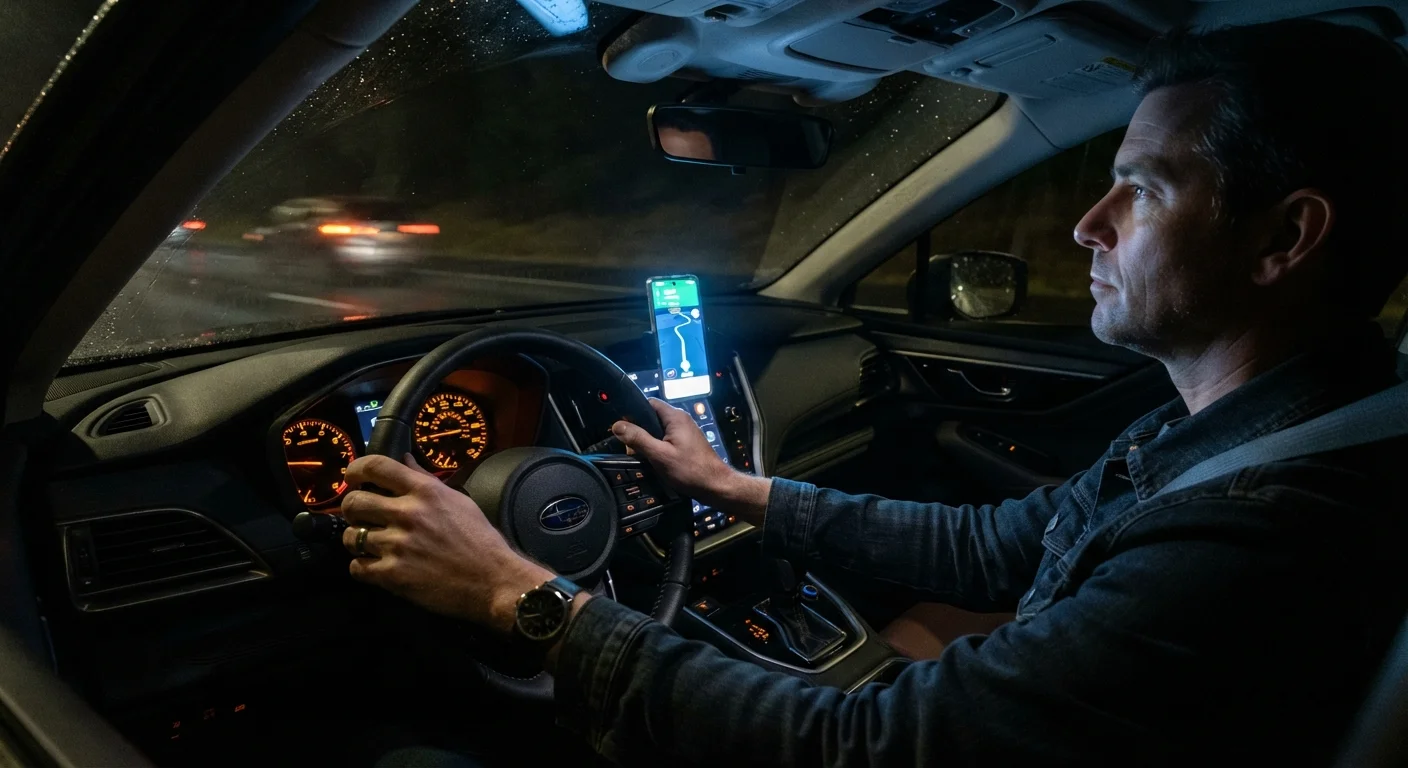
Why 'Hands-Free' Became Synonymous With 'Safe'
When hands-free phone laws began spreading across U.S. states, many drivers reasonably concluded that keeping two hands on the wheel solved the distraction problem. After all, the visible risk — a driver physically holding and looking at a device — was removed. Public messaging reinforced this: put the phone down, or at least, don't hold it.
But cognitive science tells a more complicated story. Distraction while driving isn't only physical. It operates on three dimensions: visual (eyes off the road), manual (hands off the wheel), and cognitive (mind off the task of driving). Hands-free technology addresses only the first two. The third — and arguably most dangerous — remains fully in play during any phone conversation.
Understanding this distinction is the foundation for making genuinely safer decisions behind the wheel. Just as emotional states can impair driving judgment, so too can the mental load of a conversation — even one conducted entirely by voice.
Common Myths — and What the Evidence Actually Shows
The gap between public perception and research findings on hands-free driving is significant. Below, we address the most persistent misconceptions directly.
Myth
Using a hands-free device is essentially the same as talking to a passenger — both are just conversations.
Fact
Passenger conversations are meaningfully less distracting because passengers adapt to traffic conditions, warn drivers of hazards, and pause when driving demands increase.
Research from the University of Utah and other institutions has documented this distinction. Passengers serve as a second pair of eyes — they notice congestion, react to sudden hazards, and instinctively go quiet when the driving situation becomes demanding. A caller on the other end of a phone has no access to the road environment and continues speaking regardless of what the driver is navigating.
This difference in conversational dynamic makes phone calls — even hands-free ones — a categorically different cognitive load than passenger dialogue.
Myth
Hands-free calling is legal in most states, so it must be safe enough for everyday driving.
Fact
Legality reflects legislative compromise, not a safety endorsement. Laws often lag behind emerging research.
Traffic laws are shaped by enforcement practicality, political compromise, and public acceptability — not solely by safety data. Many hands-free exemptions were written before robust cognitive distraction research was available. The National Safety Council and multiple traffic safety researchers have called for broader restrictions, noting that legal does not equal safe.
Treating the legal threshold as a safety ceiling is a reasoning error. A driver can be fully compliant with the law and still be meaningfully impaired by a phone conversation.
Myth
Voice-activated systems, like asking your car's assistant to send a message, are distraction-free because you don't touch anything.
Fact
Studies have found that interacting with voice-based systems creates measurable cognitive distraction lasting several seconds after the interaction ends.
Research commissioned by the AAA Foundation for Traffic Safety found that some in-vehicle voice systems produce high levels of mental distraction — in some cases more than handheld tasks — depending on system error rates and complexity. When a voice system misunderstands a command and requires correction, distraction compounds.
Critically, cognitive distraction doesn't stop the moment the interaction ends. Studies have measured residual distraction lasting up to 27 seconds after completing a voice task, meaning a driver can still be impaired well after the interaction appears finished.
Myth
Experienced drivers can handle phone conversations because they have better driving instincts.
Fact
Driving experience does not eliminate cognitive distraction; experienced drivers are just as affected by divided attention during phone calls.
Routine driving tasks — lane keeping, speed maintenance — do become more automatic with experience. However, hazard detection and adaptive decision-making (responding to an unexpected pedestrian, a vehicle braking suddenly) require conscious attentional resources that are directly competed for by phone conversations.
Laboratory and real-world studies consistently show that reaction times slow and hazard detection rates decline during phone calls regardless of years of driving experience. Overconfidence in one's own multitasking ability is itself a documented risk factor.
Myth
A quick, casual call — 'I'll be five minutes late' — isn't long enough to be dangerous.
Fact
Even brief cognitive distraction is dangerous because hazards are unpredictable and don't time themselves around short calls.
At 60 mph, a vehicle travels roughly 88 feet per second. A 5-second cognitive distraction — the duration of a brief exchange — covers nearly the length of a football field. Hazards such as a child running into the road, a sudden stop ahead, or debris on the road don't announce themselves in advance.
The danger of any distraction is not its average duration but its overlap with unpredictable road events. Brief calls carry proportional — not negligible — risk.
4x
Increased crash risk during phone use
The National Safety Council cites research indicating drivers using phones are approximately four times more likely to be involved in a crash.
~50%
Visual cues missed during phone calls
Studies on inattention blindness suggest drivers engaged in phone conversations can fail to process up to half of the visual information in their driving environment.
27 sec
Residual distraction after voice tasks
AAA Foundation for Traffic Safety research found cognitive distraction from in-vehicle voice systems can persist for up to 27 seconds after the task is completed.
Practical Steps That Actually Reduce Risk
Knowing the evidence is only useful if it changes behavior. Here are concrete, evidence-supported actions drivers can take:
- Enable Do Not Disturb While Driving — both iOS and Android offer automatic modes that silence calls and texts when motion is detected, sending auto-replies to contacts.
- Pull over safely to call back — if a call is urgent, find a safe stopping point. A parked car eliminates the cognitive load entirely.
- Keep conversations brief when stationary — if you must talk while driving, shorter conversations in lower-complexity driving conditions (steady highway) carry less risk than multistep discussions in city traffic.
- Never use hands-free for emotionally charged calls — arguments, stressful news, or complex decisions dramatically amplify cognitive distraction. Just as fatigue degrades judgment and reaction time, so does emotional arousal combined with divided attention.
No Call Is Worth a Collision
The safest course of action during any drive is to silence your phone completely and check messages only when parked. If you must be reachable, configure an automated reply. No conversation — professional or personal — justifies the elevated crash risk documented in cognitive distraction research. Make the decision before you start the car, not while you're in traffic.
Voice-based navigation is generally lower-risk than active phone conversations because it delivers short, predictable prompts rather than requiring sustained dialogue. But even navigation systems can distract in complex traffic situations — use them with appropriate caution.
The content on this site is for informational purposes only and is not a substitute for professional advice. Always consult a qualified professional for guidance specific to your situation.