

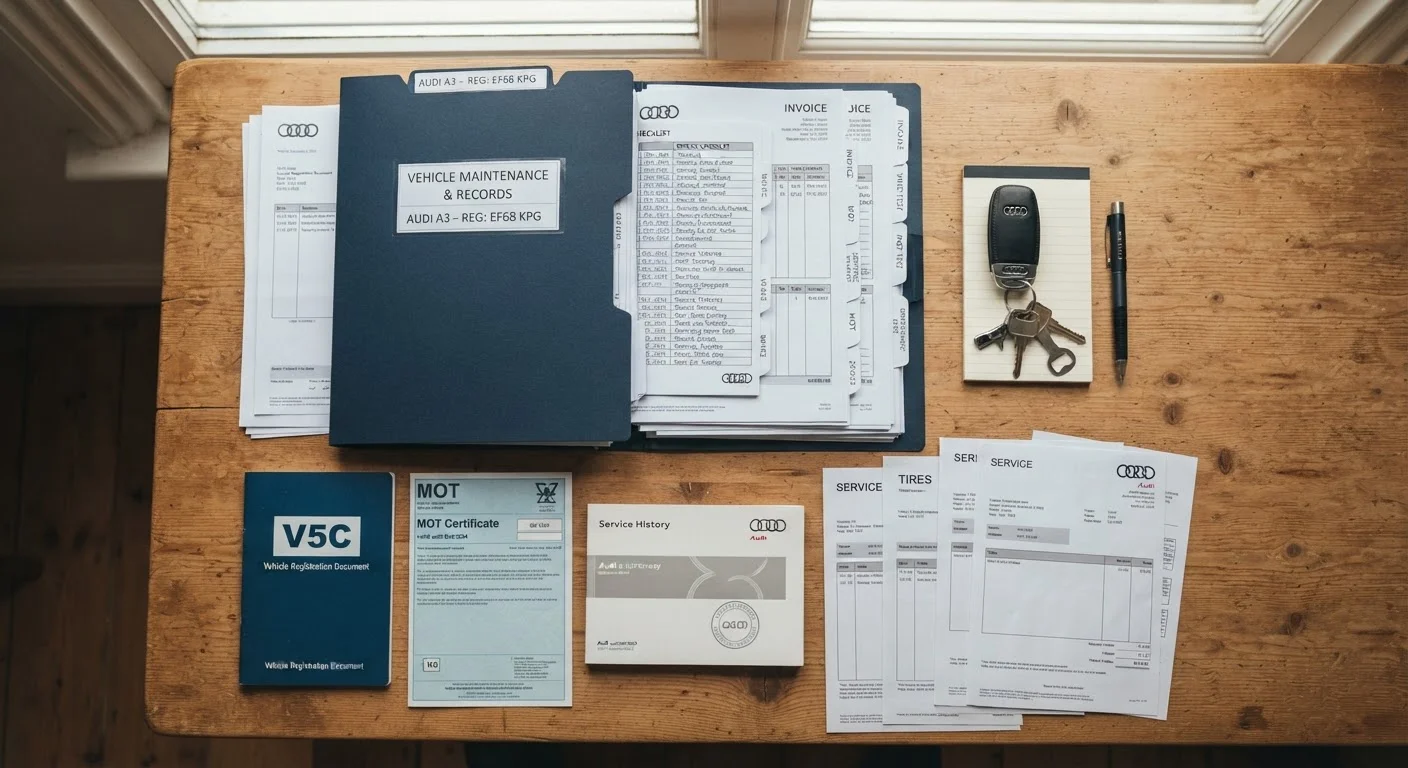
Why Vehicle Records Are Worth More Than Most Drivers Realise
When you buy a car, you're also buying its history. When you sell one, so is the next owner. A documented service history signals to buyers, insurers, and mechanics that a vehicle has been looked after — and that significantly affects how much trust they're willing to extend, and sometimes how much they're willing to pay.
Car depreciation is influenced by many factors, but condition and provenance are among the most important. A well-documented car gives a prospective buyer or appraiser concrete evidence of how the vehicle was maintained, reducing guesswork and uncertainty. Vehicles with gaps in their records often attract lower offers or prompt buyers to walk away entirely.
Beyond resale, records help you as the current owner: you can confirm that scheduled services were completed, track recurring issues, and verify warranty eligibility. Think of your vehicle's paperwork as a running logbook of its mechanical life.
~1 in 3
Used-car buyers who cite service history as a top purchase factor
Consumer research consistently shows that documented maintenance history is among the most influential factors in used-vehicle purchase decisions.
Up to 10%
Potential uplift in perceived resale value with full service history
Industry observers note that vehicles with complete, verifiable records frequently attract stronger offers than equivalent models with undocumented histories — though actual outcomes vary.
What Documents You Should Be Keeping
Not every slip of paper matters equally, but the following categories are worth preserving consistently:
- Service receipts: Dated invoices from every oil change, tyre rotation, brake inspection, or other scheduled maintenance. These confirm the work was done and by whom. See our guide to maintenance intervals for a full breakdown of what's typically scheduled and when.
- Repair records: Any unscheduled work — from a replaced alternator to a bodywork repair — should be documented with the date, mileage, parts used, and labour performed.
- Inspection and emissions certificates: Keep every annual or biennial inspection certificate. In the US, emissions test results and safety inspection stickers are required in many states and should be stored even after renewal.
- Warranty documentation: Manufacturer warranties and any extended coverage policies, including what's covered and for how long. Dealer-service records are often required to make a valid warranty claim.
- Recall notices and completion records: If your vehicle has been subject to a safety recall, keep both the notice and the confirmation that the repair was performed. This matters for safety and can affect liability.
- Title and registration history: Track each year's registration renewal as well as any title transfers if you've bought or sold the vehicle.
File every service receipt immediately after the appointment, not later.
Delays lead to lost documents. The longer you wait to file, the higher the chance a receipt is misplaced, left in a coat pocket, or accidentally discarded. The habit of filing on the same day removes that risk entirely.
Record the mileage alongside every service entry.
Date alone doesn't tell the full story of a vehicle's maintenance. Mileage at time of service lets you calculate intervals accurately, verify that work was done within the manufacturer's recommended schedule, and spot any anomalies.
Create a single-page summary document that lists all major work chronologically.
A summary makes it easy to review the vehicle's history at a glance without sorting through individual receipts. It's also a useful handover document when selling, saving both parties time.
Back up physical records digitally within the same week they're created.
Paper fades, gets wet, and can be destroyed in a fire or flood. A digital backup stored off-site or in the cloud ensures the record survives regardless of what happens to the original.
Retain records for at least as long as you own the vehicle, and ideally hand them over at the point of sale.
Handing over a complete history at sale builds buyer confidence and can support the asking price. It also protects you from post-sale disputes about the vehicle's pre-sale condition.
How to Organise and Protect Your Records
A consistent system matters more than a perfect one. The simplest physical approach is a dedicated accordion folder or ring binder kept in the home — not the glove box, where documents can fade, get lost, or be stolen. Separate documents by category with labelled dividers.
Store the Folder at Home, Not in the Car
It may seem convenient to keep all vehicle documents in the glove box, but this exposes them to heat, moisture, and theft risk. Store originals at home in a clearly labelled folder and keep only minimum required documents (current registration, proof of insurance) in the vehicle.
For digital protection, scan or photograph each document shortly after receiving it. A free cloud storage service or a dedicated folder on your home computer is sufficient. The goal is redundancy: if the physical copy is lost, the digital version remains readable and searchable.
The same principle applies to home records — as outlined in our article on keeping a home maintenance log. Whether you're tracking appliance warranties or vehicle service intervals, the underlying habit is identical: document it when it happens, store it somewhere reliable, and review it periodically.
Records as Part of Long-Term Ownership Strategy
The value of a paper trail compounds over time. After five or ten years of ownership, a complete record set tells a coherent story about a vehicle — one that benefits you whether you're renewing insurance, disputing a warranty claim, preparing for a long road trip, or eventually selling.
Buyers and dealers often differentiate between cars with full service histories and those without, particularly as vehicles age. An older car with a documented record of consistent maintenance can command more buyer confidence than a newer vehicle with no paper trail at all.
Records also serve as a useful prompt. Reviewing your file before a scheduled service lets you see what was done previously, identify patterns (for example, if the same component has failed more than once), and have an informed conversation with your mechanic. That's the kind of practical ownership intelligence that managing a car well over its entire lifespan is built on.
Recall Completion Records Carry Legal Weight
If your vehicle was subject to a federal safety recall and the repair was completed, keep the written confirmation from the dealer. In some dispute or liability scenarios, being able to demonstrate that a known safety issue was properly addressed matters. You can check open recalls on the NHTSA website using your vehicle's VIN at no cost.
The content on this site is for informational purposes only and is not a substitute for professional advice. Always consult a qualified professional for guidance specific to your situation.