

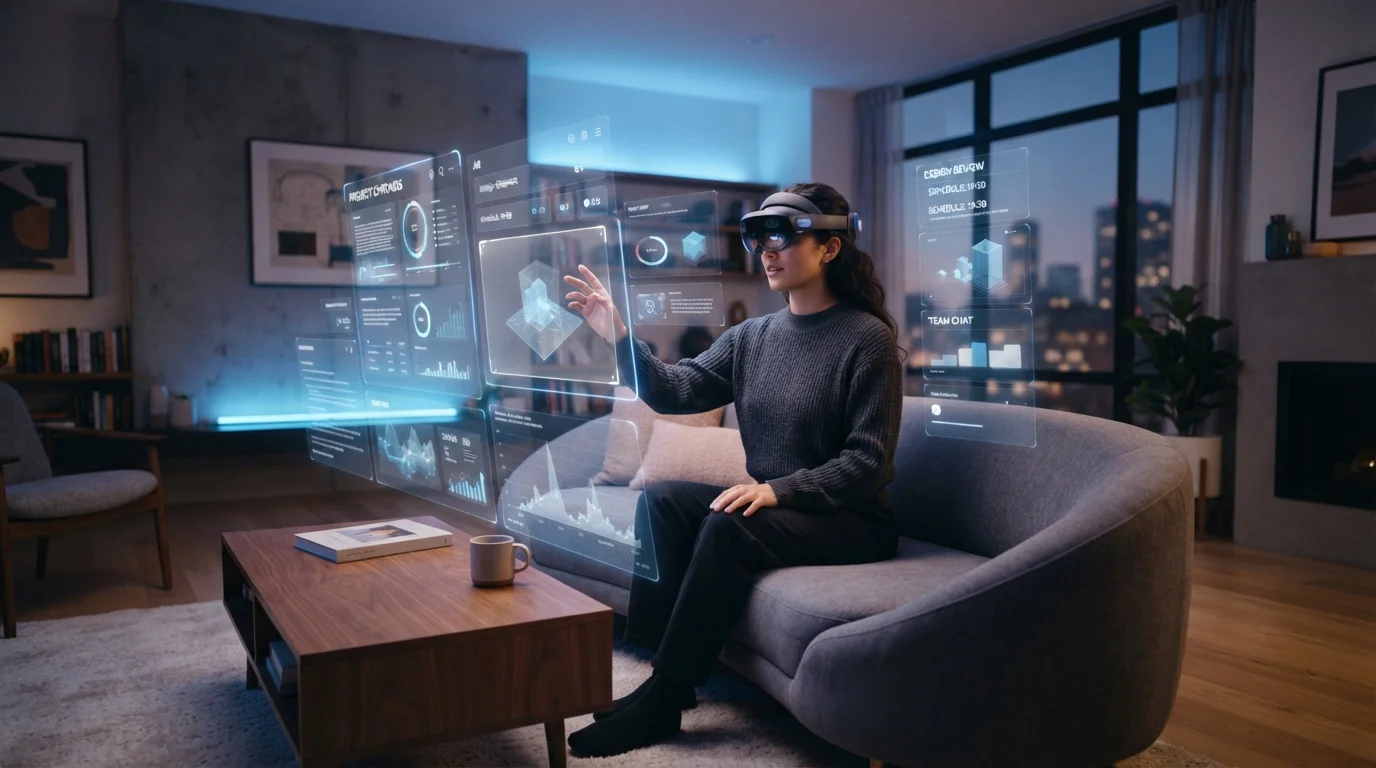
A Different Relationship Between Screens and Space
For most of computing history, interaction has followed a simple rule: you look at a screen. Whether it's a desktop monitor, a phone, or a tablet, digital content lives behind glass, and the physical world exists separately on the other side of it. Spatial computing breaks that contract.
The term describes systems that perceive three-dimensional physical environments and respond to them in real time — placing digital content not on a surface but seemingly within a room. A navigation arrow appears to float above the sidewalk. A furniture model sits on your actual floor before you buy it. A surgeon views anatomical data layered over a patient during a procedure.
Spatial computing is a broad category that includes augmented reality (AR), mixed reality (MR), and some extended reality (XR) experiences. What unites them is the ambition to make digital information context-aware and spatially grounded — part of the environment rather than a portal into a separate one. Explore more about how these and related technologies shape our connected lives in the Digital Life hub.
How the Technology Perceives Physical Space
Spatial computing requires devices to understand their surroundings the way a sighted person does — by constantly reading depth, distance, and geometry. This is accomplished through a combination of hardware and software working in tight coordination.
Depth sensors and cameras capture the environment many times per second. Algorithms then build a real-time map of surfaces, edges, and objects — a process called simultaneous localization and mapping (SLAM). Once the system knows where walls, floors, and objects are, it can anchor digital content to specific physical coordinates so that a virtual lamp, for example, stays on the table even as you walk around it.
Processing speed is critical. Any lag between physical movement and digital response creates disorientation. This is why spatial computing leans heavily on capable local processors rather than distant cloud servers — a trend explored further in Edge Computing and the End of the Cloud-First Era.
Augmented vs. Mixed Reality: A Quick Distinction
Augmented reality (AR) overlays digital content on a view of the real world, typically through a camera feed on a phone or tablet. Mixed reality (MR) goes further, allowing digital objects to interact with physical ones — a virtual ball that bounces off a real table, for instance. Both are expressions of spatial computing, with MR generally requiring more sophisticated sensing and processing.
Where Spatial Computing Is Already Being Used
Spatial computing is not a distant promise. Versions of it are operating in recognizable settings right now.
These use cases share a common thread: digital information delivered precisely where and when it is physically relevant. As hardware becomes lighter and processing more efficient, the range of practical applications is expected to widen. Related emerging hardware that could accelerate this shift is covered in Neuromorphic Chips, Photonic Computing, and Other Hardware Frontiers Worth Watching.
The Connection to Digital Twins and Broader Ecosystems
Spatial computing doesn't exist in isolation. It connects naturally to other emerging technologies that model and mirror physical reality digitally. One of the clearest intersections is with digital twins — virtual replicas of physical objects, spaces, or systems that update in real time based on sensor data.
When a factory floor has a digital twin running alongside it, spatial computing interfaces can let engineers walk through the real space while viewing live operational data overlaid on actual machines. The physical and the digital become one coherent, navigable environment. Digital Twins: The Invisible Replicas Running Alongside the Real World offers a grounded look at how that parallel digital layer is already being built.
3D + Real-Time
Core requirement of spatial computing environments
Spatial computing systems must perceive and respond to three-dimensional physical space in real time — distinguishing them from conventional flat-screen computing.
Multiple Industries
Sectors with active spatial computing deployments
Healthcare, manufacturing, logistics, architecture, and retail have all documented pilot or operational deployments of spatial computing tools, according to industry research analysts.
Understanding spatial computing as part of this larger ecosystem — alongside edge processing, advanced sensors, and AI — helps clarify why it matters well beyond consumer headsets and novelty apps.
What This Means for Everyday Life
For most people, spatial computing will arrive gradually and often invisibly. Smartphone apps that let you visualize furniture placement or measure a room are early-stage spatial computing. Navigation apps that overlay directional arrows onto a live camera view are another. These experiences normalize the concept without requiring specialized hardware.
The more immersive tier — headsets that blend rich digital overlays with a full view of the physical environment — is maturing in parallel. Whether the context is a professional workflow, a retail experience, or a social space, the underlying logic is consistent: digital content that knows where it is, responds to its surroundings, and fits into physical life rather than interrupting it.
Try Spatial Computing on a Device You Already Own
Many current smartphones support basic spatial computing experiences through their native camera and depth-sensing capabilities. Looking for apps that let you measure rooms, visualize objects in your space, or overlay information on physical environments is a practical way to encounter the technology without specialized hardware. These everyday interactions reflect the same foundational principles as more advanced headset-based systems.
Privacy and data handling are legitimate considerations as these systems become more capable and more present. Devices that continuously map physical spaces capture real information about real places. Users benefit from understanding what any spatial computing application does with that environmental data before engaging with it.
Frequently Asked Questions
No. Virtual reality replaces the physical world entirely with a digital one, while spatial computing integrates digital content with the real environment. Augmented and mixed reality fall under spatial computing; pure VR generally does not, though the boundaries can overlap.
Modern smartphones with depth cameras support basic spatial computing features. Dedicated headsets that blend digital overlays with a live view of the room represent more advanced implementations. Many operating systems now include spatial computing frameworks for developers.
Not always. Many spatial computing experiences run on smartphones and tablets using the rear camera to sense depth and place digital objects in a room. Headsets provide a more immersive and hands-free experience but are not the only entry point.
Augmented reality is one application category within the broader spatial computing umbrella. Spatial computing also includes environmental mapping, gesture and voice input, and persistent digital objects that remain anchored to locations over time.
Because spatial computing devices continuously scan and map physical environments, they can capture sensitive information about homes, workplaces, and people's movements. Understanding how that data is stored, processed, and shared is an important consideration for users.
The content on this site is for informational purposes only and is not a substitute for professional advice. Always consult a qualified professional for guidance specific to your situation.