

Why Hardware Innovation Matters Beyond Speed
For decades, the story of computing progress was simple: chips got smaller, transistors multiplied, and everything got faster. That narrative has grown complicated. Physical limits on silicon miniaturization, rising energy demands from artificial intelligence, and the sheer scale of modern data workloads are pushing engineers toward radically different architectural approaches.
The hardware frontiers described below are not science fiction — they are active areas of engineering research with working prototypes, university programs, and in some cases early commercial deployments. They won't replace your laptop tomorrow, but they are shaping the infrastructure that will underpin computing in the coming decade. For a look at how parallel shifts are changing the software and spatial experience layer, see our spatial computing overview.
Neuromorphic Chips
Neuromorphic chips are processors designed to mimic the architecture of the human brain. Rather than executing sequential instructions the way a conventional CPU does, they use networks of artificial neurons and synapses that fire asynchronously — only when relevant input arrives. This event-driven approach can be dramatically more energy-efficient for tasks like pattern recognition, sensor processing, and real-time inference.
Research institutions and technology companies have developed neuromorphic hardware in various forms, and the field has produced systems capable of running sparse neural network workloads using a fraction of the power consumed by conventional accelerators. The tradeoff is programmability: neuromorphic systems require specialized software frameworks and are optimized for specific classes of problems rather than general computing.
Neuromorphic chips fire only when needed, making them among the most energy-efficient AI processors in development.
Photonic Computing
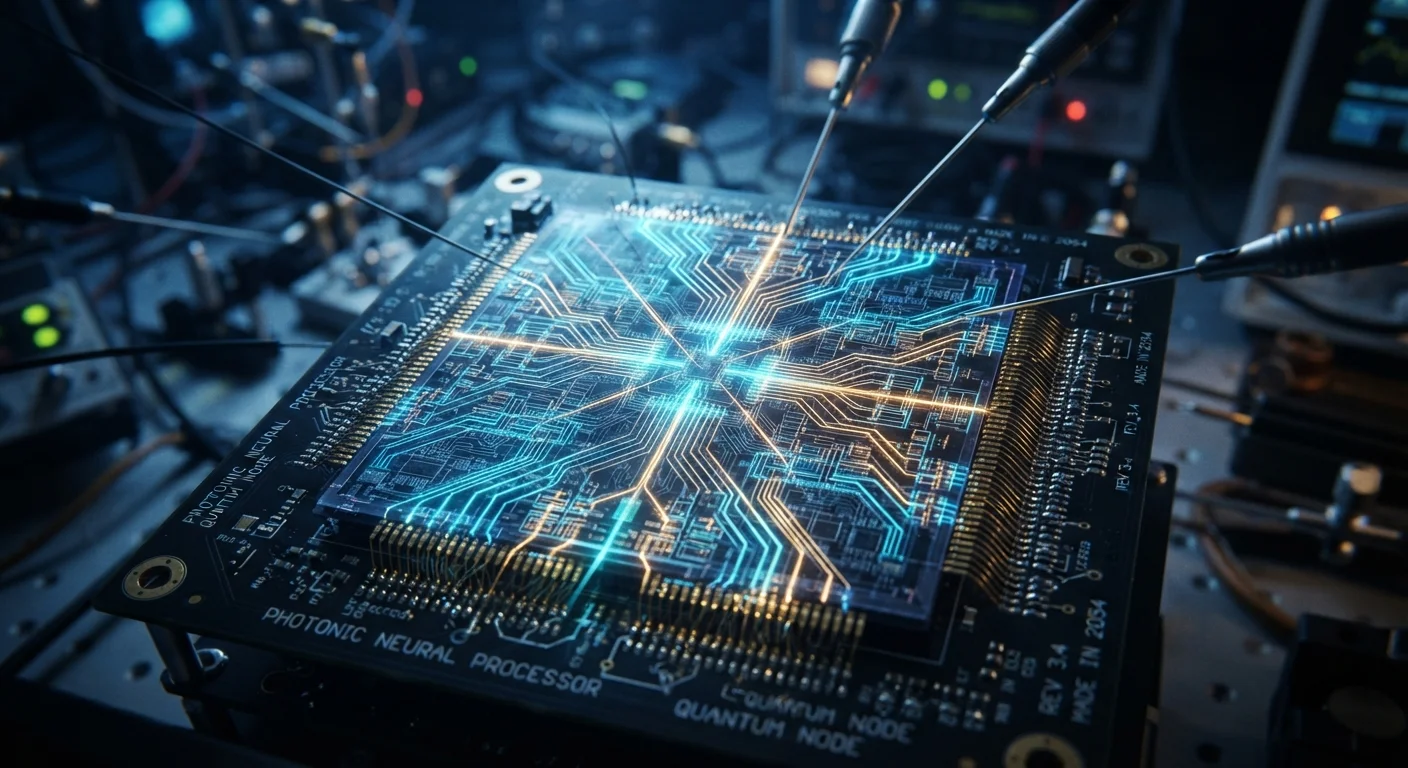
Photonic computing replaces electrical signals with photons — particles of light — to perform calculations. Because light travels faster than electrons in a wire and generates less heat, photonic systems offer theoretical advantages in both speed and energy consumption for specific workloads, particularly matrix multiplication operations that underpin modern machine learning.
Silicon photonics, which integrates optical components onto standard semiconductor wafers, is the most commercially tractable branch of this field. Photonic interconnects — using light to move data between chips rather than copper wires — are already appearing in high-performance data centers. Fully optical processors remain more experimental, but progress in integrated photonic circuits is accelerating the timeline.
Silicon photonic interconnects are already in data centers, bringing light-speed data movement closer to everyday infrastructure.
Analog AI Accelerators
Digital computers represent every value as a precise binary number. Analog hardware, by contrast, represents values as continuous physical quantities — voltage levels, for instance. For AI inference tasks, this imprecision is often acceptable: neural networks are inherently tolerant of small numerical errors, and analog circuits can perform multiply-accumulate operations (the core of neural network math) using far less energy than digital equivalents.
In-memory computing, a closely related concept, performs computation directly within memory cells rather than shuttling data back and forth between memory and a separate processor. This eliminates a major bottleneck — the so-called memory wall — that limits conventional chip performance. Several research groups and startups are developing analog and in-memory AI chips specifically for inference at the edge.
Analog AI chips exploit neural networks' tolerance for imprecision to deliver significant energy savings on inference tasks.
Compute-in-Memory Architecture
Conventional processors waste enormous energy moving data between memory and processing units. Compute-in-memory (CIM) architectures address this by integrating logic directly into memory arrays — performing operations where data already lives. Emerging memory technologies like resistive RAM (ReRAM) and phase-change memory (PCM) lend themselves naturally to CIM designs because their physical states can represent both stored values and computational operations simultaneously.
CIM is particularly compelling for AI applications where the same large model weights must be accessed repeatedly. By eliminating redundant data movement, CIM designs can reduce energy consumption significantly. Prototype CIM chips have demonstrated inference performance competitive with GPU-based approaches for certain benchmarks, at a fraction of the power draw.
Compute-in-memory cuts the costly data shuttle between processor and RAM, one of modern computing's biggest hidden inefficiencies.
DNA and Molecular Data Storage
While not a computing architecture in the traditional sense, DNA-based storage represents a frontier in data density that could complement future computing systems. DNA can theoretically store approximately one exabyte — one billion gigabytes — per cubic millimeter, and data encoded in DNA can survive for thousands of years under the right conditions. Researchers have demonstrated the encoding and retrieval of files, images, and even short videos using synthetic DNA strands.
The core challenge is read/write speed and cost. DNA synthesis and sequencing remain slow and expensive compared to conventional storage media. However, ongoing advances in sequencing technology are steadily reducing costs and improving throughput. DNA storage is unlikely to replace fast-access storage, but it has genuine long-term potential for archival use cases where density and longevity matter more than speed.
DNA storage's extraordinary density makes it a credible candidate for archival data where longevity outweighs access speed.
Optical Neural Networks
Distinct from general photonic computing, optical neural networks (ONNs) are systems where the physical propagation of light through a structured medium performs the computations of a neural network layer. Light passing through a carefully designed set of lenses, diffractive elements, or waveguides can multiply matrices and apply nonlinear transformations at the speed of light and with zero active energy for the core computation.
Researchers have built proof-of-concept ONNs capable of image classification tasks. The challenge lies in reconfigurability: changing the network's weights typically requires physically altering the optical components. Hybrid approaches — pairing optical layers with electronic control systems — are a practical middle ground that several research groups are actively pursuing to make ONNs more flexible and trainable.
Optical neural networks perform core computations at the speed of light, with zero active energy required for the optical layer itself.
The Bigger Picture: Convergence and Caution
None of these technologies operates in isolation. Photonic interconnects could accelerate neuromorphic systems; analog AI accelerators might eventually sit inside edge devices that process data locally rather than shipping it to the cloud. If you want to understand how that local-processing shift is already playing out, our article on edge computing and the post-cloud era offers useful grounding. And for a complementary look at another physics-bending computational paradigm, quantum computing explained for non-physicists covers the qubit frontier accessibly.
Most of These Are Still Pre-Commercial
It is worth being clear about where each of these technologies actually sits on the development curve. Photonic interconnects and some neuromorphic designs have reached early commercial deployment. Optical neural networks, DNA storage, and most analog AI chips remain primarily in research and prototype phases. Timelines for broad commercial availability are genuinely uncertain and should be treated as such, even when press releases suggest otherwise.
Tracking these hardware frontiers doesn't require an engineering degree — it requires curiosity about why the decisions made in research labs today will determine what your devices can do, and how efficiently they do it, years from now.
How to Follow This Space Reliably
Hardware research moves through preprint servers like arXiv and conference proceedings such as ISSCC and Hot Chips before it reaches mainstream coverage. Following academic institutions' engineering news pages and IEEE Spectrum gives you a more accurate and timely picture of what's genuinely advancing versus what's still speculative. Healthy skepticism about commercial timelines is always warranted.
The content on this site is for informational purposes only and is not a substitute for professional advice. Always consult a qualified professional for guidance specific to your situation.