

Start here
What Is a Quantum Computer, Really?
Build understanding
The Key Ideas Behind Quantum Computing
See the applications
What Problems Can Quantum Computers Actually Solve?
Check in on reality
Where Things Stand Today
Make it personal
What This Means for Everyday People
What Is a Quantum Computer, Really?
A conventional computer — your laptop, your phone, a data center server — processes information as bits: tiny switches that are either off (0) or on (1). Every calculation, every video frame, every message is ultimately a sequence of those binary states.
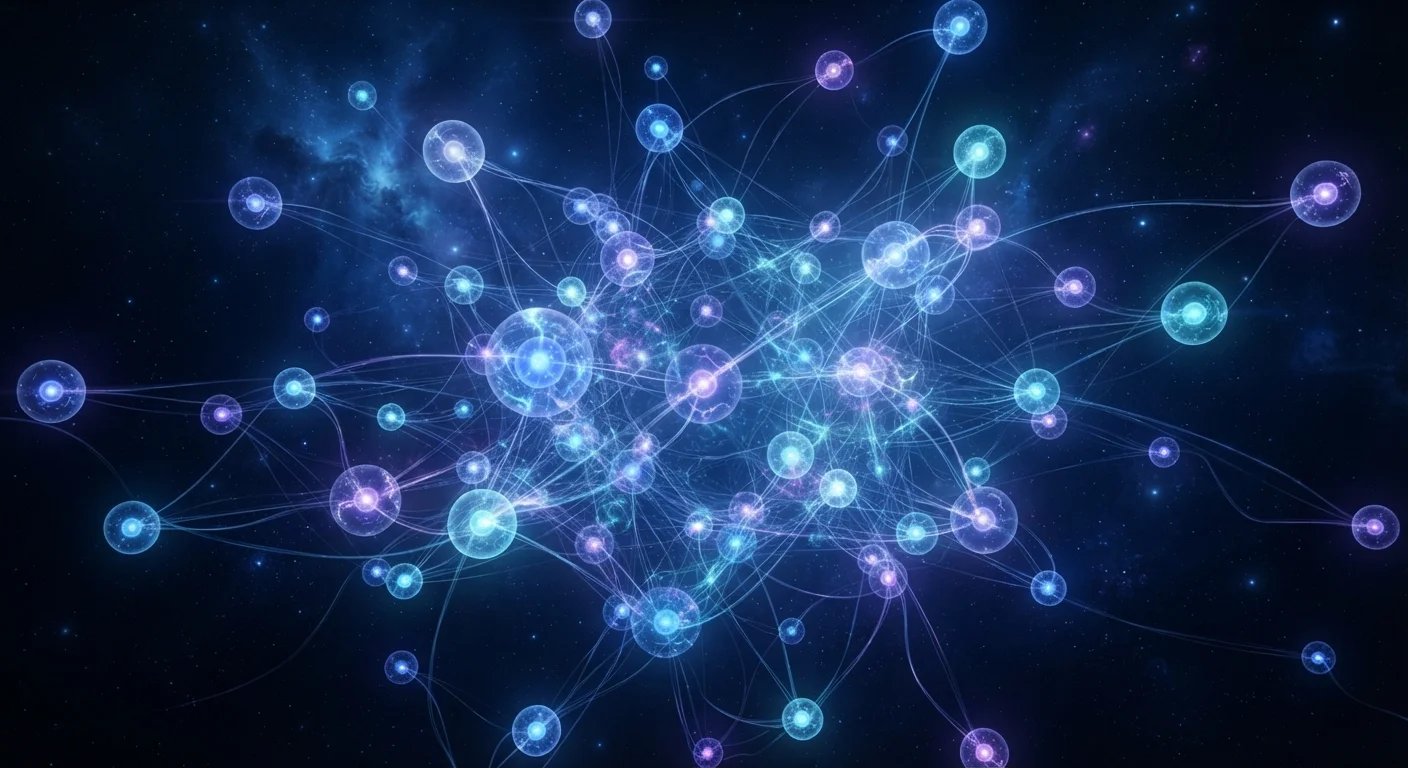
A quantum computer replaces the bit with a qubit (quantum bit). Qubits exploit the strange behavior of subatomic particles to represent and process information in fundamentally different ways. The result is a machine that isn't simply faster at the same tasks — it's architecturally suited to solving problems that are practically impossible for classical hardware, no matter how many conventional chips you throw at them.
Think of it less as a speed upgrade and more as a completely different kind of tool. A drill and a saw are both useful in a workshop, but they're not interchangeable. Quantum and classical computers have distinct strengths, and the most realistic future involves both working together.
Qubit
The basic unit of quantum information, analogous to a classical bit. Unlike a bit, a qubit can exist in multiple states simultaneously due to superposition.
Superposition
A quantum property allowing a qubit to be in a combination of 0 and 1 at the same time, rather than locked into just one value until measured.
Entanglement
A quantum link between two or more qubits where the state of one is correlated with the state of another, enabling coordinated computation.
Decoherence
The loss of a qubit's quantum state due to interference from the environment — one of the primary engineering challenges in building reliable quantum computers.
NISQ Era
Short for Noisy Intermediate-Scale Quantum: the current period of quantum computing where machines exist and function but remain error-prone and limited in scale.
Quantum Error Correction
A set of techniques that use multiple physical qubits to represent one reliable logical qubit, reducing the impact of errors during quantum computation.
The Key Ideas Behind Quantum Computing
Three concepts do most of the explanatory work when it comes to understanding what makes quantum computers different:
- Superposition: A qubit can exist in a combination of 0 and 1 simultaneously, rather than one or the other. When you scale this up to many qubits, the system can represent an enormous number of possible states at once — and explore them in parallel during computation.
- Entanglement: Two or more qubits can become correlated in such a way that the state of one instantly relates to the state of another, regardless of distance. This interconnection allows quantum computers to coordinate information across qubits in ways classical bits cannot.
- Interference: Quantum algorithms are carefully designed to amplify pathways leading to correct answers while canceling out paths leading to wrong ones — similar in concept to how noise-canceling headphones work, but applied to probability.
You don't need to understand the physics of quantum mechanics to appreciate the practical consequence: these properties let quantum systems tackle certain optimization and simulation problems with a scale and efficiency that classical machines cannot match.
A Useful Mental Model
Think of a classical computer working through a maze by trying one path at a time. A quantum computer, using superposition, can explore many paths simultaneously. It doesn't magically find every answer at once — but it can narrow possibilities far more efficiently for the right kinds of problems.
What Problems Can Quantum Computers Actually Solve?
Quantum computing isn't a universal upgrade — it excels in specific domains:
- Drug discovery and molecular simulation: Modeling how molecules interact at the quantum level is computationally brutal for classical computers. Quantum machines are naturally suited to this, potentially accelerating the development of new medications and materials.
- Optimization problems: Logistics networks, financial portfolios, supply chains — problems with vast numbers of variables and constraints could benefit significantly from quantum approaches.
- Cryptography: Quantum computers could eventually break certain encryption schemes. This has already prompted the development of new post-quantum cryptographic standards, an area governments and standards organizations are actively working on.
- Machine learning research: Some quantum algorithms may accelerate specific machine learning tasks, though this remains an active and contested area of research.
Everyday tasks like browsing the web, streaming video, or running office software are not problems quantum computers are designed to improve. That distinction matters when evaluating the hype.
For a broader look at hardware technologies that could reshape computing alongside quantum systems, see neuromorphic chips and photonic computing.
Quantum Is Not Artificial Intelligence
Quantum computing and AI are frequently mentioned together, but they are distinct fields. AI today runs almost entirely on classical hardware. While researchers are exploring potential intersections, quantum computing is not what powers current large language models or image generators. The two are separate technologies with separate development timelines.
Where Things Stand Today
The current period in quantum computing is often described by researchers as the NISQ era — Noisy Intermediate-Scale Quantum. Machines are real, functional, and being actively used in research. However, they are also error-prone. Qubits are fragile: environmental interference (heat, vibration, stray electromagnetic fields) causes what engineers call decoherence, collapsing quantum states before calculations complete.
Achieving reliable, large-scale quantum computation requires error correction — essentially using many physical qubits to reliably encode one logical qubit. This dramatically increases the hardware requirements. Most researchers consider fault-tolerant quantum computing at meaningful scale to still be in development, though timelines are debated and the field is moving quickly.
Cloud access to quantum processors is already available through several research and commercial programs, allowing developers and scientists to experiment with real hardware today — even if the systems remain limited.
Watch Out for Quantum Hype
Announcements of quantum 'breakthroughs' are frequent, and the coverage is often misleading. Terms like 'quantum supremacy' or 'quantum advantage' describe narrow, highly specific benchmarks — not general-purpose computing wins. Approach bold claims with healthy skepticism and look for what specific problem was solved under what conditions.
What This Means for Everyday People
Most people will never own or directly interact with a quantum computer. The impact will arrive indirectly: through medicines developed faster, through stronger encryption protecting their data, through logistics systems that reduce waste, or through materials science breakthroughs that improve the products they buy.
Understanding quantum computing at even a basic level matters because the technology is increasingly shaping public policy, cybersecurity standards, and research investment. Decisions about post-quantum encryption, for example, will affect every internet user — whether they've heard of qubits or not.
Quantum computing is one part of a broader frontier of hardware innovation. If you're curious how other experimental architectures might reshape digital life, spatial computing is another emerging technology worth understanding — one that's already beginning to touch everyday devices and environments.
The technology is real, the limitations are significant, and the timeline is uncertain. But the direction is clear: quantum computing is moving from theoretical physics into applied engineering, and its effects will eventually reach well beyond the laboratory.
IBM Quantum Learning
IBM offers free educational resources and tutorials explaining quantum computing concepts at beginner through advanced levels, with access to real quantum hardware for experimentation.
NIST Post-Quantum Cryptography Project
The National Institute of Standards and Technology is standardizing encryption algorithms designed to resist quantum attacks — a foundational effort relevant to long-term internet security.
Quirk: Quantum Circuit Simulator
An open-source, browser-based quantum circuit simulator that lets curious readers visualize how quantum gates and operations work without needing physical hardware.
Frequently Asked Questions
No. Quantum computers are specialized tools suited to specific problem types, not general-purpose replacements for everyday devices. Your laptop handles email, video, and web browsing far more efficiently than any quantum system could. The two technologies are complementary, not competing.
Sufficiently powerful quantum computers could, in principle, break widely used encryption methods. Cryptographers are already developing 'post-quantum' encryption standards to address this before such hardware matures. Governments and standards bodies are actively working on the transition.
Most current quantum computers based on superconducting qubits operate near absolute zero — colder than outer space. This extreme cooling is necessary to eliminate interference that would disrupt quantum states. It's one reason these machines remain large and expensive to operate.
Estimates vary widely, and the field is advancing rapidly. Many researchers describe the current period as the 'NISQ era' — Noisy Intermediate-Scale Quantum — where machines are real but limited. Broadly useful, fault-tolerant quantum computing may still be years to a decade or more away.
Yes, in a limited way. Several technology organizations offer cloud-based access to quantum hardware for researchers, students, and developers. These are real quantum processors, though with modest qubit counts and significant error rates.
A classical bit holds either a 0 or a 1 at any given moment. A qubit can exist in a superposition of both states simultaneously until it is measured. This property, combined with entanglement, allows quantum systems to process certain kinds of problems in ways classical computers cannot efficiently replicate.
The content on this site is for informational purposes only and is not a substitute for professional advice. Always consult a qualified professional for guidance specific to your situation.