

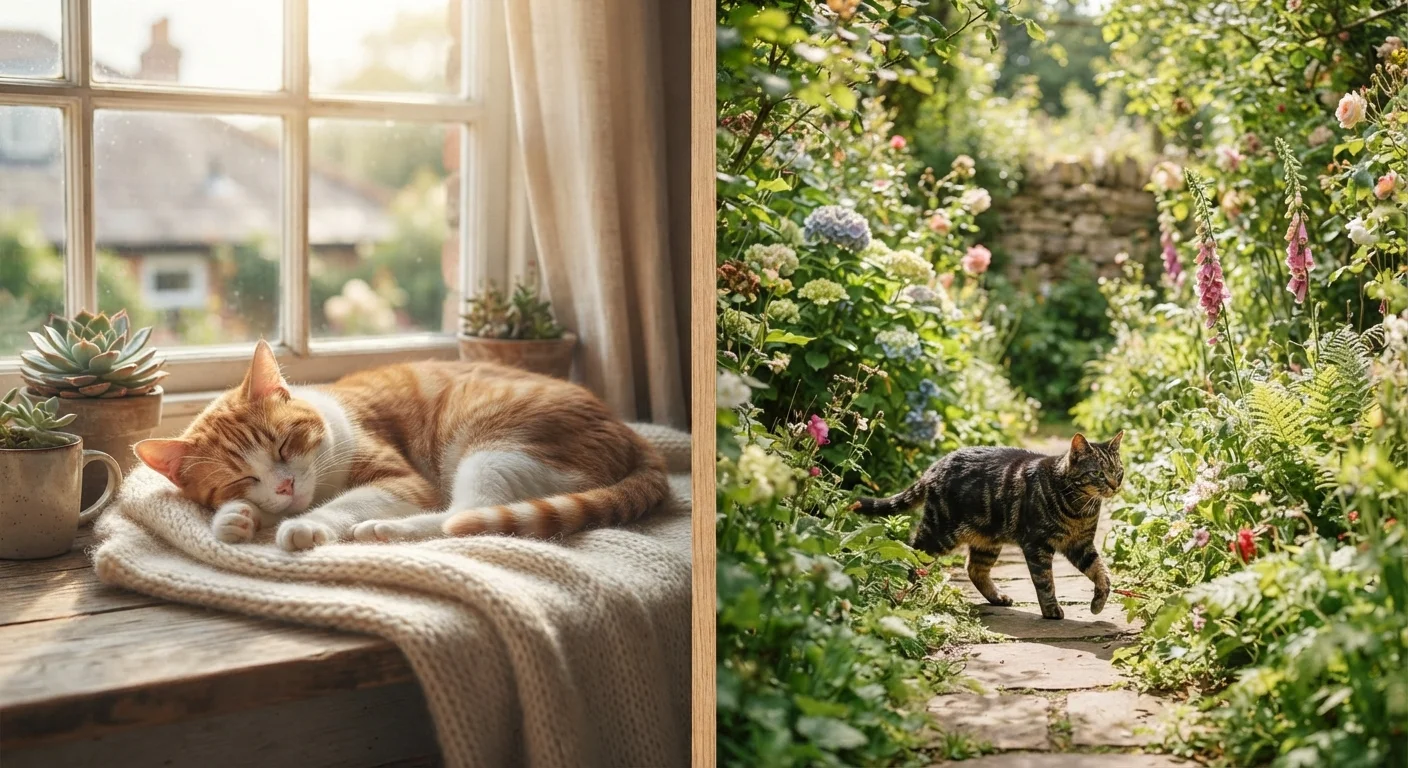
Option A
Indoor Cats
The protected, environment-controlled lifestyle.
Best for: Owners who prioritize minimizing injury, infectious disease, and predation risks in their cat's daily life.
Option B
Outdoor Cats
The enrichment-rich, freedom-forward lifestyle.
Best for: Owners in low-traffic, low-predator areas who can maintain robust parasite and vaccination protocols.
Lifespan and Physical Safety
One of the most consistent findings in feline veterinary research is that indoor cats tend to live significantly longer than their outdoor counterparts. Estimates from veterinary sources suggest indoor cats live an average of 12–18 years, while outdoor cats may average 2–5 years in some studies — though figures vary considerably based on environment and methodology. The gap is driven primarily by external threats.
Outdoor cats face risks that are largely absent indoors: vehicle collisions, dog attacks, exposure to toxins such as antifreeze and rodenticides, falls from unstable surfaces, and encounters with other cats leading to bite wounds. Bite wounds are particularly concerning because they can introduce bacteria deep into tissue, causing abscesses that, if untreated, become serious infections.
Indoor cats, while safer from these acute hazards, are not risk-free. Falls from high-rise windows — a phenomenon veterinarians sometimes call high-rise syndrome — and accidental ingestion of toxic houseplants represent genuine indoor dangers that owners should actively manage.
| Criterion | Indoor Cats | Outdoor Cats |
|---|---|---|
| Average lifespan | 12–18 years (estimated) | 2–10 years (varies widely) |
| Trauma risk | Low (falls, toxins) | High (traffic, animals, toxins) |
| Infectious disease exposure | Low | High (FIV, FeLV, rabies) |
| Parasite burden | Low to moderate | High (fleas, ticks, worms) |
| Obesity risk | Higher without enrichment | Lower due to activity levels |
| Behavioral enrichment | Requires active management | Naturally higher |
| Stress from territory | Lower (defined space) | Higher (competition, unknown cats) |
| Vaccination needs | Core vaccines required | Core + lifestyle vaccines needed |
Infectious Disease and Parasite Exposure
Outdoor cats encounter a much wider infectious disease landscape. Feline immunodeficiency virus (FIV) and feline leukemia virus (FeLV) spread primarily through bites and close contact with infected cats — both far more likely outdoors. Upper respiratory infections, feline panleukopenia, and rabies exposure are also significantly elevated risks for cats that roam freely.
Parasite burden is similarly higher outdoors. Fleas, ticks, ear mites, and intestinal worms such as roundworms and hookworms are endemic in many outdoor environments. Cats that hunt are also at risk of Toxoplasma gondii infection through prey consumption. Robust, year-round parasite prevention is non-negotiable for outdoor cats and should be discussed with a veterinarian to match the regional risk profile. For more on building a proactive health plan, see preventive vs. reactive pet care.
Indoor cats are not entirely parasite-free — fleas can enter on clothing or other pets — but their overall exposure is substantially reduced, often allowing for less intensive prevention schedules.
2–3×
Higher FIV risk for outdoor cats
Outdoor and stray cats are estimated to have significantly higher rates of FIV infection than strictly indoor cats, according to general veterinary epidemiology literature.
~50%
US cats estimated to be overweight
The Association for Pet Obesity Prevention has reported that approximately half of domestic cats in the US are classified as overweight or obese, a condition closely linked to indoor sedentary lifestyles.
12–18 yrs
Typical indoor cat lifespan
Veterinary sources commonly cite this range for well-cared-for indoor cats, compared to notably shorter estimates for free-roaming outdoor cats.
Behavioral Health and Mental Stimulation
Physical safety is only one dimension of feline wellbeing. Behavioral health matters equally, and this is where indoor environments require deliberate management. Cats are obligate hunters with strong drives to stalk, chase, and explore. Without outlets, these instincts can generate stress, frustration, and what behaviorists describe as redirected aggression or inappropriate elimination.
Obesity is one of the most documented health consequences for indoor cats. Reduced activity combined with ad-libitum feeding creates caloric surplus. Understanding how diet affects indoor cats is worth exploring — see common pet nutrition myths for evidence-based guidance on feline feeding.
Outdoor cats generally maintain a leaner body condition through constant movement and hunting behavior. However, they also experience social stressors — territorial disputes, competition for resources, and chronic stress from unpredictable environments. Territorial behavior in cats is a powerful instinct, and outdoor cats defending large ranges can experience sustained physiological stress responses.
For indoor cats, enrichment strategies — puzzle feeders, vertical climbing structures, scheduled interactive play, and window access — are supported by behavioral science as effective tools for reducing stress and maintaining healthy activity levels.
The Catio: A Middle-Ground Solution
Enclosed outdoor structures, commonly called 'catios,' allow cats to experience fresh air, sunlight, and sensory stimulation without free-roaming risks. They can be window-mounted boxes or full enclosures attached to a home. Many veterinarians and animal behaviorists consider them a practical compromise for owners who want to balance safety with enrichment. Always ensure the structure is escape-proof and free of toxic plants.
Tailoring Care to the Lifestyle You Choose
Neither lifestyle is inherently right or wrong. The evidence points not to one universal answer but to the importance of matching your cat's environment to a thoughtful, consistent care plan. For a broader look at how the indoor-outdoor debate intersects with welfare and community concerns, the welfare debate around indoor vs. outdoor cats is worth reading alongside this comparison.
Whatever lifestyle your cat lives, regular veterinary checkups, age-appropriate vaccinations, dental monitoring — see what most owners overlook about dental health — and parasite prevention form the non-negotiable foundation. Hybrid solutions such as leash-trained walks, enclosed catios, and supervised yard time are increasingly recommended by veterinarians as ways to provide environmental enrichment without full free-roaming exposure.
This article is intended for general educational purposes only and is not a substitute for personalized veterinary advice. Always consult a licensed veterinarian regarding your individual cat's health needs.
The content on this site is for informational purposes only and is not a substitute for professional advice. Always consult a qualified professional for guidance specific to your situation.