

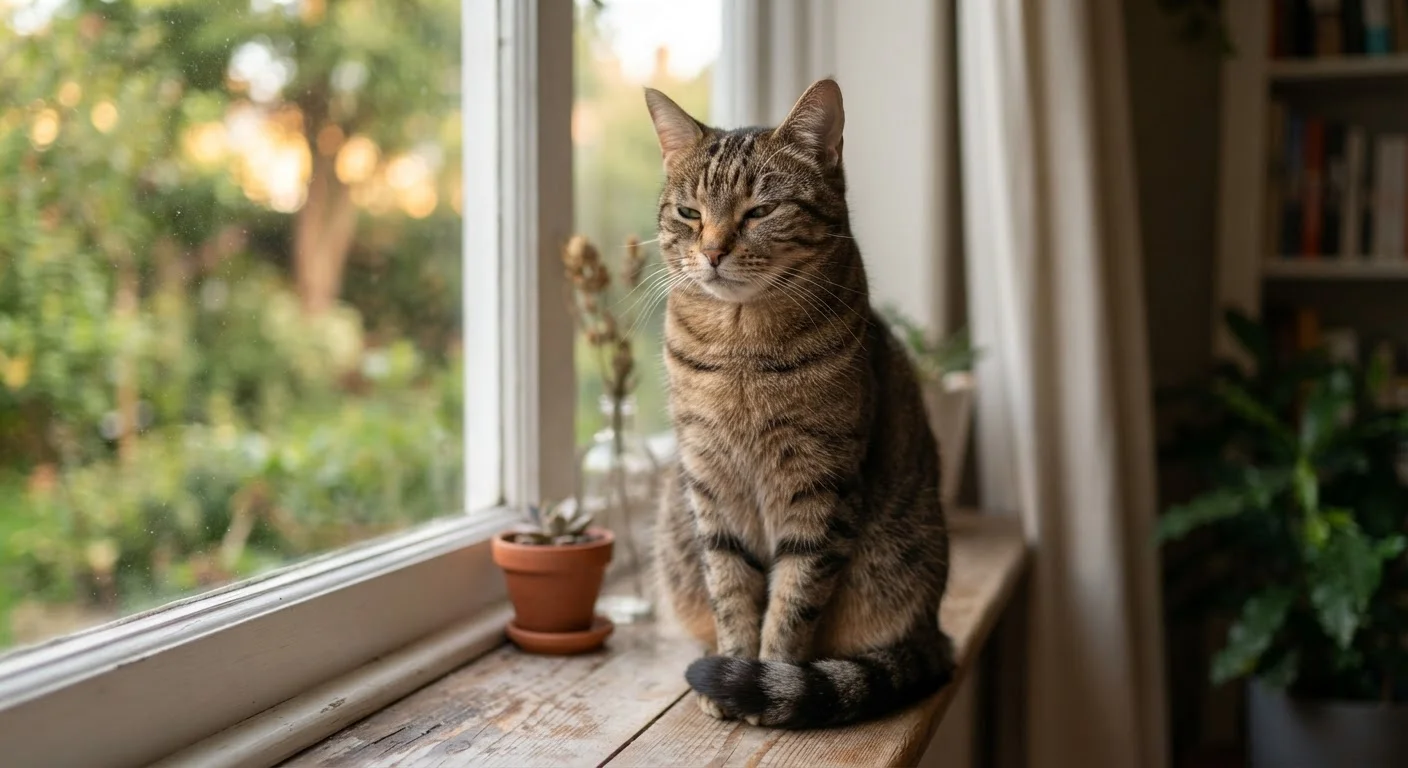
Why Cats Communicate Through Posture
Cats are notably quieter communicators than dogs, relying heavily on posture, subtle movement, and visual signals rather than vocalizations to express their inner state. This makes sense from an evolutionary perspective: as solitary hunters, cats benefited from silence, so a rich system of body language evolved to handle social interactions efficiently and quietly.
Understanding that system puts you at a significant advantage as an owner. Rather than guessing why your cat is hiding, swatting, or suddenly pressing against your legs, you can read the posture and respond appropriately. As outlined in our primer on animal communication, posture is just one layer of a multi-channel system — but in cats, it is often the loudest channel of all.
The Tail: Your Cat's Mood Barometer
The tail is one of the most expressive parts of a cat's anatomy, and its position shifts rapidly with emotional state:
- Tail held high, sometimes with a slight curl at the tip: A greeting signal associated with confidence and friendly intent. Cats approaching humans or other cats this way are generally comfortable and sociable.
- Tail low or tucked: Signals anxiety, submission, or discomfort. A cat moving with its tail close to its body is likely feeling uncertain about its environment.
- Slow, wide tail lash: Often misread as happiness (as a dog's wagging might be), this actually signals increasing arousal or irritation. If petting triggers this response, it is time to pause.
- Puffed or bottlebrush tail: The hair stands on end (piloerection) when the cat is startled or highly threatened. Combined with an arched back, this is a classic defensive display designed to make the cat appear larger.
For a useful comparison, dogs use tail signals very differently — direction and speed carry distinct meanings across species.
When meeting a cat for the first time, slow-blink and then look slightly away rather than holding direct eye contact. This combination signals non-threat and frequently prompts the cat to approach on its own terms.
Direct sustained eye contact is a challenge signal in feline communication; breaking it after a slow blink removes the perceived threat and gives the cat agency in the interaction.
Watch the base of the tail, not just the tip — a tail held high but with a stiff, vibrating base signals high arousal that may tip into overstimulation, even during what looks like a friendly greeting.
Overstimulation bites and redirected aggression are among the most commonly misunderstood cat behaviors; early tail-base signals give owners a reliable heads-up before the threshold is crossed.
Ears, Eyes, and the Slow Blink
Facial signals pack an enormous amount of information into a small space. Ears act like directional antennas:
- Ears forward and slightly outward: Alert and engaged — the cat is interested in something and not alarmed.
- Ears rotated back or flattened sideways ("airplane ears"): Indicate growing irritation or mild fear.
- Ears pressed flat against the skull: A clear defensive signal. The cat is either frightened or preparing to protect itself.
Eyes add another dimension. Dilated pupils in a bright room suggest high arousal — fear, excitement, or aggression. Constricted pupils in low light can indicate focused aggression. A soft, relaxed gaze with half-closed lids is a signal of contentment and safety.
The slow blink deserves special attention. Research published in peer-reviewed ethology journals has shown that cats are more likely to approach an unfamiliar person who has slow-blinked at them. It functions as a trust signal — sometimes called a "cat kiss" — and can be reciprocated deliberately to reinforce the bond with your own cat.
Body Position and What It Signals
How a cat holds its entire body reveals whether it feels safe, curious, or on guard:
- Loaf position (paws tucked under body, upright): A resting but alert posture indicating comfort and mild relaxation. The cat is not fully letting its guard down but is at ease.
- Fully stretched out on the side or back: Maximum vulnerability display. A cat exposing its belly is expressing deep trust — though this does not necessarily mean it wants a belly rub, which can trigger a defensive reflex.
- Crouched low, weight forward: Predatory focus or, depending on context, apprehension. Look to the ears and tail to distinguish between hunting intent and fear.
- Body angled away, head turned: A de-escalation signal. The cat is communicating non-threat and may be trying to reduce tension in an interaction.
Context always matters. Subtle stress signals like yawning or lip-licking often accompany postural cues and can help clarify ambiguous body language.
Fear and Defensive Postures
Fear postures exist on a spectrum, and recognizing where a cat sits on that scale helps owners intervene before the cat feels forced into aggression:
- Mild anxiety: Crouched body, slow movement, frequent scanning with ears back slightly.
- Moderate fear: Low crouch, flattened ears, tail tucked or wrapped tightly around body, pupils dilated.
- High fear or defensive threat: Arched back, puffed tail, piloerection along the spine, hissing, and direct eye contact as a warning.
A frightened cat is not an aggressive cat — it is a cat that feels it has no options left. Providing an escape route (never cornering a fearful cat) and reducing environmental pressure are the most effective responses.
Never Punish Fear-Based Postures
Spraying water, raising your voice, or physically restraining a frightened cat does not reduce fear — it escalates it and damages trust. A cat displaying defensive postures needs space and a perceived escape route, not correction. If fear responses are frequent or severe, a certified applied animal behaviorist can help identify triggers and develop a desensitization plan.
Persistent hiding or a sudden shift to low, guarded postures that lasts more than a day or two can signal underlying illness rather than behavioral stress. Understanding why pets hide when unwell is an important extension of body language literacy — when in doubt, consult your veterinarian.
Using Posture Literacy to Strengthen Your Bond
Reading posture is not just diagnostic — it is relational. When owners respond appropriately to what a cat is communicating, the cat learns that its signals are being respected. This builds the trust that underpins a strong human-cat bond.
Practical steps include:
- Observe before interacting. Spend a few seconds reading your cat's tail, ears, and body before reaching to pet or pick it up.
- Match your energy to the cat's state. A tense, crouched cat does not want enthusiastic interaction.
- Use the slow blink intentionally, especially with shy or newly adopted cats.
- Respect postural warnings. A tail lash or flattened ear is a clear request for space — honoring it prevents escalation.
Posture literacy also connects to broader body language guidance that veterinarians emphasize, particularly around identifying pain or discomfort early. And because territorial instincts shape how cats carry and present themselves, understanding how territorial behavior differs between cats and dogs adds useful context.
This article is for general informational and educational purposes only. If your cat shows sudden or persistent behavioral changes, consult a licensed veterinarian or a certified animal behaviorist for professional guidance.
The content on this site is for informational purposes only and is not a substitute for professional advice. Always consult a qualified professional for guidance specific to your situation.