

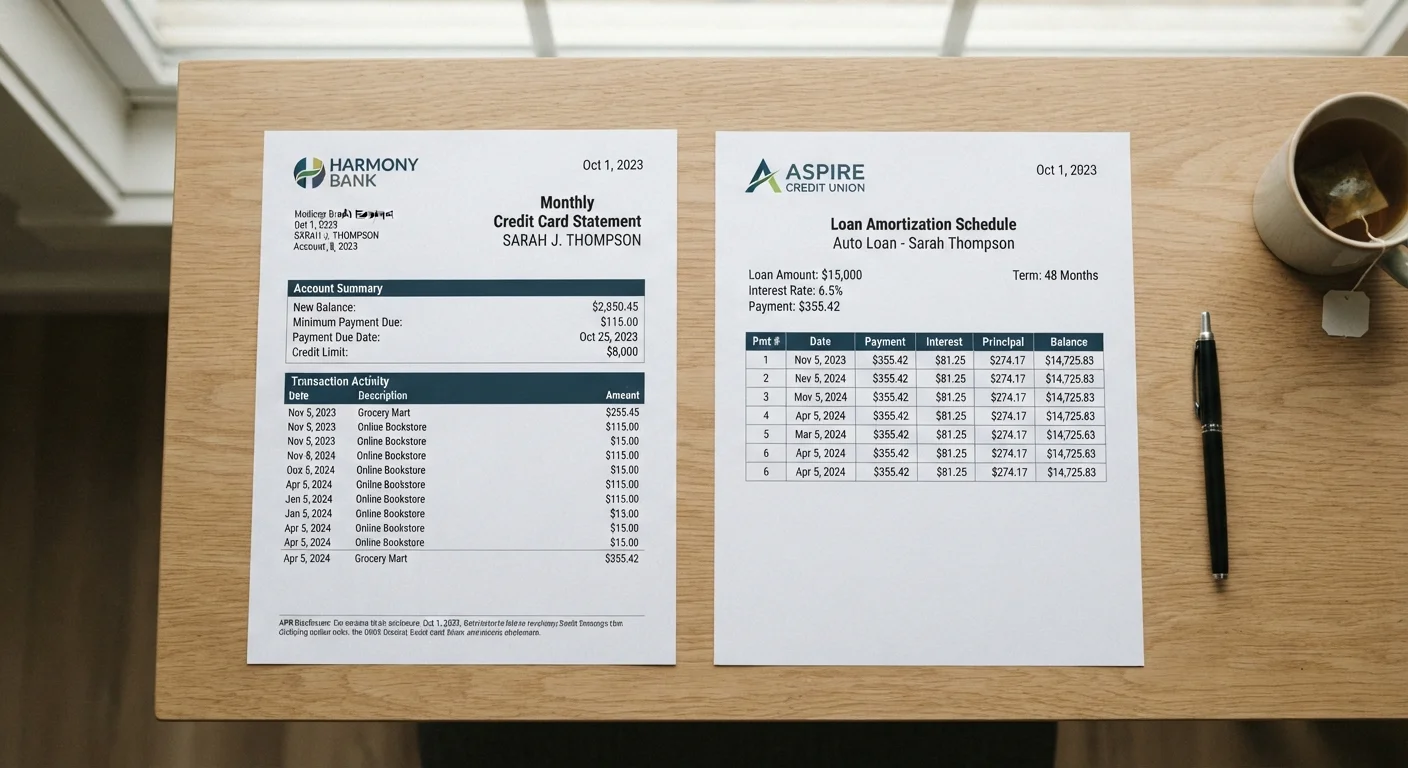
Option A
Revolving Credit
The flexible, reusable borrowing line.
Best for: Ongoing or variable expenses where you want the flexibility to borrow, repay, and borrow again up to a set limit.
Option B
Instalment Loans
The structured, fixed-payment borrowing tool.
Best for: One-time, defined purchases or expenses that you repay in equal, scheduled payments over a set term.
How Each Type of Credit Works
Understanding the structural difference between revolving credit and instalment loans is the first step toward managing them effectively. Before diving in, our plain-language debt and credit glossary covers foundational terminology if any terms feel unfamiliar.
Revolving Credit
A revolving account — most commonly a credit card or a home equity line of credit (HELOC) — gives you access to a credit limit you can draw from repeatedly. You carry a balance, make at least a minimum payment each month, and your available credit replenishes as you pay down what you owe. There is no fixed end date; the account stays open as long as it remains in good standing.
Instalment Loans
An instalment loan delivers a fixed lump sum upfront — a mortgage, auto loan, student loan, or personal loan, for example. You then repay that amount plus interest through equal, scheduled payments (instalments) over a defined term, such as 36 months or 30 years. Once fully repaid, the account is closed.
| Criterion | Revolving Credit | Instalment Loans |
|---|---|---|
| Structure | Reusable credit up to a set limit | Fixed lump sum, repaid over a term |
| Repayment | Variable minimum payments monthly | Equal scheduled payments (fixed) |
| Account lifespan | Open-ended; stays open when active | Closed when fully repaid |
| Interest rate type | Typically variable; often higher | Often fixed for the loan term |
| Credit utilisation impact | Yes — affects utilisation ratio directly | No — not counted in utilisation ratio |
| Common examples | Credit cards, HELOCs | Mortgages, auto loans, student loans |
| Credit mix contribution | Yes — counts as revolving credit | Yes — counts as instalment credit |
How Each Appears on Your Credit Report
Both account types are reported to the major credit bureaus (Equifax, Experian, and TransUnion) and show up in distinct sections of your credit file. Reading your credit report closely will help you verify that each account is listed correctly and that balances reflect what you actually owe.
For revolving accounts, your report shows your credit limit, current balance, payment history, and the account status. For instalment loans, it shows the original loan amount, remaining balance, payment history, and term. Both contribute to your payment history — the single largest factor in most scoring models — so on-time payments matter enormously for either type.
Credit Utilisation Only Applies to Revolving Accounts
Your credit utilisation ratio is calculated by dividing your total revolving balances by your total revolving credit limits. Instalment loan balances — like the remaining principal on a car loan — are not included in this calculation. This means that paying down an instalment loan, while positive overall, will not directly reduce your utilisation ratio the way paying down a credit card balance will.
One key difference: revolving accounts are the only accounts that feed your credit utilisation ratio (the percentage of available revolving credit you are using). Instalment loan balances do not factor into this ratio in the same way. Because utilisation can account for roughly 30% of a FICO score, keeping revolving balances low relative to your limit is a powerful lever. Learn more in our article on how credit utilisation shapes your score.
Impact on Your Overall Financial Picture
Beyond credit scoring mechanics, both debt types affect your cash flow, debt load, and long-term financial flexibility.
~30%
Share of FICO score tied to credit utilisation
According to FICO's published scoring model breakdown, amounts owed — including revolving utilisation — account for approximately 30% of a standard FICO score.
~35%
Share of FICO score tied to payment history
FICO reports that payment history is the single largest component of its widely used credit scoring model, applying equally to revolving and instalment accounts.
Revolving credit carries variable interest rates that can be substantially higher than instalment loan rates. Carrying balances month to month compounds interest costs quickly, which is why high-rate revolving debt is typically prioritized in repayment strategies. If you are weighing how to tackle multiple debts, our comparison of the debt snowball and debt avalanche methods explains which approach may fit your situation.
Instalment loans are generally amortized, meaning each payment covers both interest and principal. Early payments are weighted more toward interest, and later payments chip away more at the principal balance. Missing a payment triggers the same negative reporting to the bureaus as a missed credit card payment — the damage to your payment history is equivalent.
Having a mix of both account types can signal to lenders that you can manage different forms of credit responsibly. Scoring models do reward credit diversity, though it is one of the smaller factors. Whether you hold one type or both, the foundation remains the same: pay on time, borrow only what you need, and keep revolving balances as low as practical. Our guide to responsible borrowing habits offers durable principles for doing exactly that.
For a fuller picture of how all these factors combine, see how credit scores are calculated and what lenders are actually evaluating when they pull your file.
This article is for general informational and educational purposes only and does not constitute personalised financial or credit advice. Consult a qualified financial professional for guidance specific to your situation.
The content on this site is for informational purposes only and is not a substitute for professional advice. Always consult a qualified professional for guidance specific to your situation.