

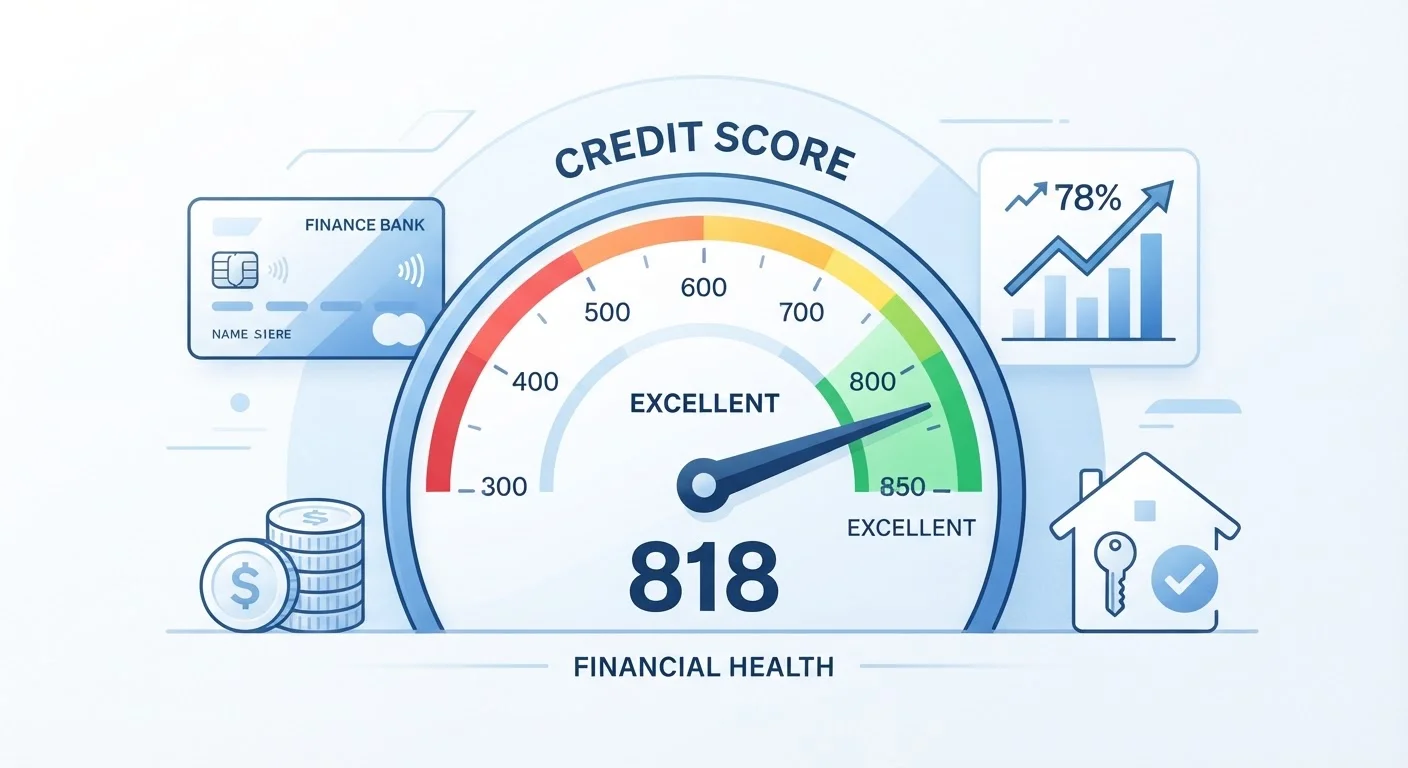
The Five Factors Behind Your Number
A credit score is not a judgment call — it is a mathematical output. Scoring models analyze the data in your credit report and weight specific categories to produce a number. Under the FICO model, the most widely referenced framework, five categories determine your score:
- Payment history (35%): Whether you pay on time is the largest single input. Even one missed payment can cause a noticeable drop.
- Amounts owed / credit utilization (30%): This measures how much of your available revolving credit you are currently using. Lower is generally better. See how utilization shapes your score for a deeper look at this factor.
- Length of credit history (15%): Older accounts and a longer average account age signal experience managing credit over time.
- Credit mix (10%): Having both revolving accounts (credit cards) and installment loans (mortgages, auto loans) can benefit your score. Revolving credit and installment loans affect your profile differently.
- New credit (10%): Opening several new accounts in a short window signals higher risk and can cause a modest, temporary score decrease.
35%
Weight of payment history in FICO score
According to FICO's published scoring criteria, on-time payment behavior is the single largest factor in the standard FICO Score model.
~200M
Americans with a scoreable credit file
The Consumer Financial Protection Bureau has estimated that the vast majority of U.S. adults have enough credit history to generate a score under standard models.
7 years
How long most negative items remain on file
Under the Fair Credit Reporting Act, most adverse information — including late payments and collections — must be removed from credit reports after seven years.
Where the Data Comes From
Your credit score is only as accurate as the credit report it is built on. Three major bureaus — Equifax, Experian, and TransUnion — collect data from lenders, credit card issuers, and public records. Scoring models then read that data and compute a number.
Because each bureau maintains its own file, your score can differ slightly depending on which bureau's data is used. A lender may pull from one bureau or all three. Understanding what each section of your credit report contains — and how to spot errors — is essential, because a mistake on your report translates directly into an inaccurate score. Our guide on reading your credit report walks through each section in detail.
Your Score Can Vary Across Bureaus
It is common to see slightly different scores when checking through different platforms or bureaus. This happens because not all lenders report to all three bureaus, and each bureau may have received slightly different information. Monitoring reports from all three periodically gives the most complete picture.
For plain definitions of terms like delinquency, charge-off, and utilization ratio, see the plain-language debt and credit glossary.
How Lenders Actually Use Your Score
Lenders use credit scores to make faster, more consistent decisions about risk. A score does not guarantee approval or denial — it is one input among several, alongside income, employment status, existing debt load, and the type of credit being requested.
In practice, a higher score tends to unlock lower interest rates, higher credit limits, and more favorable loan terms. A lower score may result in higher rates, smaller limits, or a requirement for a co-signer or collateral. Some lenders set minimum score thresholds for certain products entirely.
“Credit scores are tools designed to predict the probability of default — they are not measures of financial virtue or intelligence. Understanding what goes into the model is the first step to working with it strategically.”
— Consumer Financial Protection Bureau, U.S. federal agency overseeing consumer financial products and education
It is worth noting that different lenders use different scoring models and versions. A mortgage lender may rely on an older FICO model, while a credit card issuer uses a newer one. This is why your score can appear different across platforms — and why understanding the underlying factors matters more than fixating on a single number.
Persistent misconceptions about how scores work can lead to counterproductive decisions. Credit score myths worth fact-checking addresses some of the most common misunderstandings.
Focus on the Factors You Can Control
Payment history and credit utilization together account for roughly 65% of a standard FICO score — and both are directly within your control. Setting up autopay for minimum payments and keeping revolving balances low relative to your limits are the two highest-leverage habits for score improvement. Results build gradually with consistent behavior.
This article provides general financial education and is not personalized financial advice. For guidance specific to your situation, consult a licensed financial professional.
Frequently Asked Questions
Most scoring models rate scores from 300 to 850. Generally, 670–739 is considered 'good,' 740–799 'very good,' and 800 and above 'exceptional.' Scores below 580 are typically classified as poor and may limit borrowing options or result in higher interest rates.
Credit scores are recalculated whenever a lender or bureau processes updated information, which can happen monthly or more frequently. Any new payment, balance change, or account opening can shift your score up or down.
No. Checking your own score is a 'soft inquiry' and has no effect on your credit score. Only 'hard inquiries' — initiated by lenders when you apply for credit — can cause a small, temporary dip.
Yes. Different scoring models (FICO, VantageScore) and different model versions produce different numbers. Your score can also vary across the three major credit bureaus — Equifax, Experian, and TransUnion — if they hold slightly different data.
Most negative items, such as late payments and collections, remain on your credit report for seven years. Chapter 7 bankruptcy can stay for up to ten years. Their impact on your score diminishes over time as newer, positive information accumulates.
The most impactful steps are paying all bills on time and reducing revolving balances to lower your credit utilization ratio. There are no legitimate shortcuts — meaningful improvement requires sustained, on-time payment behavior over months.
The content on this site is for informational purposes only and is not a substitute for professional advice. Always consult a qualified professional for guidance specific to your situation.