

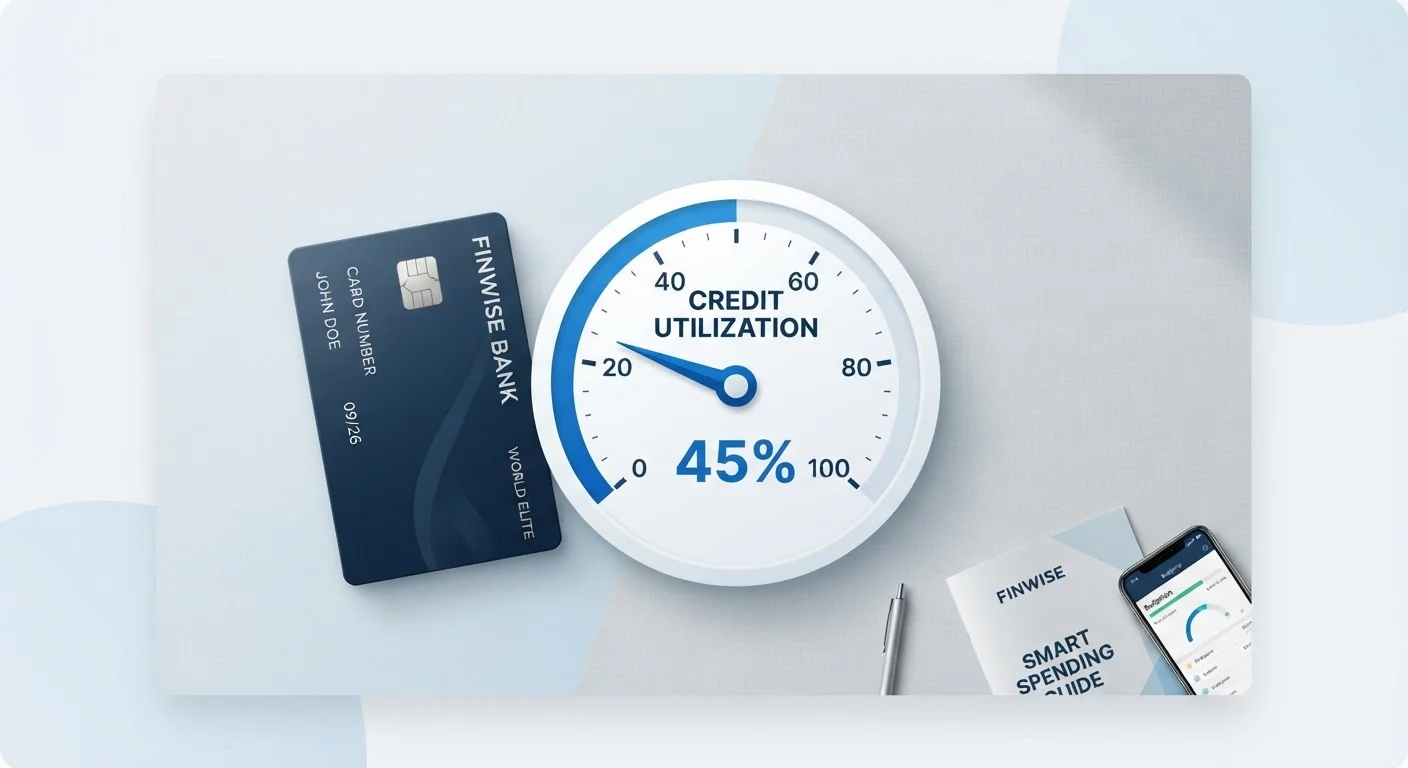
Why Utilisation Carries So Much Weight
Payment history is the single largest factor in most credit scoring models, but credit utilisation — the share of your revolving credit you're actively using — runs a close second. Under the FICO scoring framework, amounts owed (of which utilisation is the primary component) accounts for roughly 30% of your score. That makes it one of the fastest-moving and most actionable levers available to you.
Lenders interpret high utilisation as a sign of financial stress or over-reliance on credit. A borrower carrying balances close to their limits can appear riskier, even if they've never missed a payment. Conversely, low utilisation signals that you're managing credit responsibly and aren't stretched thin. For a deeper look at how individual factors combine to build or damage your score, see our credit score myth-busting guide.
~30%
FICO score weight from amounts owed
According to FICO's publicly disclosed scoring methodology, amounts owed — dominated by credit utilisation — is the second-largest factor in a consumer's credit score.
<10%
Utilisation common among top scorers
Consumer finance research has consistently found that borrowers with scores above 800 typically report very low credit utilisation, often in the single digits.
30%
Widely cited utilisation threshold
Financial educators broadly recommend keeping credit utilisation below 30% per card and in total as a baseline for protecting your credit profile.
How the Calculation Actually Works
The basic formula is straightforward: divide your total outstanding revolving balances by your total revolving credit limits, then multiply by 100 to get a percentage. If you have three credit cards with limits of $4,000, $3,000, and $3,000 — totalling $10,000 — and carry balances of $1,200, $800, and $500, your overall utilisation is 25%.
What many people miss is that scoring models also evaluate per-card utilisation. A card maxed out at $2,000 on a $2,000 limit can drag your score down even if your combined ratio across all cards looks fine. This is why spreading balances across multiple cards rather than concentrating debt on one can sometimes be beneficial — though the most effective approach remains simply reducing what you owe.
For plain-language definitions of related terms like revolving credit, credit limit, and charge-off, our debt and credit glossary is a useful reference.
Pay Before Your Statement Closes
If you want your credit report to reflect a lower balance, make your payment before your statement closing date — not just before the due date. The closing date is typically when your issuer reports your balance to the bureaus. Even partial early payments can reduce the utilisation figure that appears on your report for that cycle.
Practical Steps to Lower Your Ratio
The most direct path to lower utilisation is paying down balances — ideally ahead of your statement closing date, since that's typically when issuers report your balance to the credit bureaus. Paying only the minimum keeps your ratio high and costs you more in interest over time.
If you can't pay down balances quickly, two other strategies may help. First, request a credit limit increase from your issuer. A higher limit with the same balance reduces your ratio immediately — though this requires a hard inquiry in some cases, and issuers may not approve all requests. Second, consider whether keeping accounts open (even cards you rarely use) makes sense, since open accounts contribute their limits to your total available credit.
These habits fit naturally into broader spending discipline. Our budgeting basics hub covers how to align everyday spending with your longer-term financial goals, which in turn makes it easier to keep balances manageable. And once you've got utilisation under control, responsible borrowing habits can help you maintain that progress over the long term.
Keeping an Eye on Your Reported Balances
One underappreciated aspect of utilisation is the gap between what you owe and what's actually reported. Your issuer reports a snapshot of your balance on a specific date — usually your statement closing date — not on the day you pay. If you charge $2,000 to a card and pay it in full on the due date, your credit report may still show a $2,000 balance for that cycle.
Monitoring your credit report regularly lets you verify what balances are being reported and catch errors that might be inflating your apparent utilisation. Our guide on reading your credit report walks through what to look for and how to dispute inaccuracies. Understanding the full picture — not just your balance but your reported balance — puts you in a much stronger position to manage this critical score factor.
This article is for general informational and educational purposes only and does not constitute personalised financial or credit advice. Consult a qualified financial professional for guidance specific to your situation.
Frequently Asked Questions
Most credit experts suggest staying below 30%, though borrowers with the strongest scores tend to use 10% or less of their available credit. The lower your utilisation, the more positively it tends to affect your score, assuming other factors are in good standing.
It depends on timing. Card issuers typically report your balance to credit bureaus on your statement closing date, not your payment due date. If you pay in full after the statement closes, you may still show a balance during the reporting window. Paying before your statement closes can help keep the reported balance low.
Yes. Closing a card removes that card's limit from your total available credit, which can raise your overall utilisation ratio even if your balances stay the same. This is one reason financial educators generally advise against closing old accounts unnecessarily.
Credit utilisation is recalculated every time issuers report new balance and limit data to the bureaus, typically monthly. Unlike missed payments, high utilisation does not leave a lasting mark — once the lower balance is reported, your score can reflect the improvement relatively quickly.
Carrying a $0 balance on all cards can sometimes be treated differently than carrying a very small balance, depending on the scoring model. Some models may view no reported activity as a neutral or slightly less favorable signal, though this effect is generally minor compared to the benefit of low balances.
The content on this site is for informational purposes only and is not a substitute for professional advice. Always consult a qualified professional for guidance specific to your situation.