

Start here
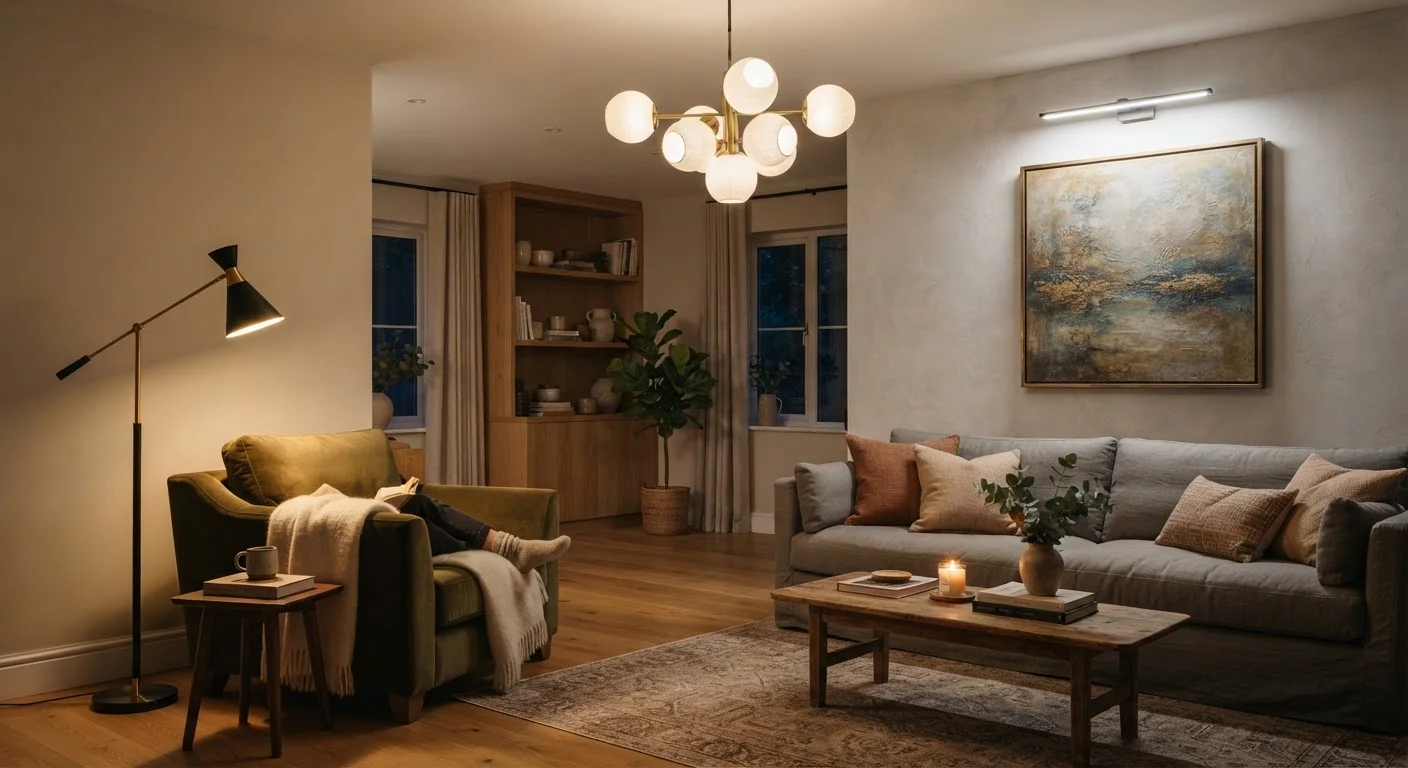
Why One Light Source Is Never Enough
Next
Ambient Lighting: The Foundation Layer
Then
Task Lighting: Precision Where You Need It
Continue
Accent Lighting: Drama and Dimension
Apply it
Putting the Three Layers Together
Why One Light Source Is Never Enough
Walk into a room lit only by a single ceiling fixture and you will notice it immediately: flat shadows, harsh overhead glare, and a space that feels more like a waiting room than a home. Good interior lighting is rarely one source doing all the work — it is a deliberate layering of different light types, each serving a distinct purpose.
Professional designers organize this approach into three layers: ambient, task, and accent. Understanding what each layer does — and why all three are needed — is the foundational skill behind every interior that feels effortlessly well-lit. It also connects directly to broader design principles; see the principles behind rooms that always feel right for context on how light relates to proportion and flow.
Ambient lighting
The general, room-wide illumination that forms the base layer of a lighting scheme. It allows you to move through and use a space without relying on focused or decorative sources.
Task lighting
Focused, directional light positioned close to a specific activity area — such as a desk, countertop, or reading chair — to reduce eye strain and improve visibility for that task.
Accent lighting
Decorative or architectural lighting used to highlight a specific feature, object, or surface. It creates visual contrast and depth rather than functional brightness.
Color temperature
A measure of the warmth or coolness of a light source, expressed in Kelvins (K). Lower numbers (around 2700K) produce warm, yellowish light; higher numbers (4000K+) produce cooler, bluer light.
Dimmer switch
An electrical control that allows you to adjust a light source to varying brightness levels, giving flexibility to shift a room's mood and function without changing fixtures.
Layered lighting
A design approach that combines ambient, task, and accent light sources in a single room so each serves a different purpose and the overall effect is balanced and flexible.
Ambient Lighting: The Foundation Layer
Ambient lighting is the base level of illumination in a room — the general brightness that allows you to navigate and use the space safely. It is not meant to be dramatic or focused; its job is to raise the overall light level evenly.
Common sources include ceiling-mounted fixtures, recessed downlights, flush mounts, and chandeliers. In rooms with low ceilings, wall sconces and torchiere floor lamps that bounce light upward can serve the same function without crowding the overhead plane.
Two practical guidelines apply here. First, always put ambient sources on a dimmer. The same room needs very different brightness at noon versus 9 p.m., and a dimmer costs far less than installing additional fixtures. Second, pay attention to color temperature — the warmth or coolness of the light, measured in Kelvins (K). A reading around 2700K produces warm, incandescent-like light suited to living and sleeping areas, while 3500K–4000K gives kitchens and workspaces the clean clarity they need.
Start with Dimmers Before Adding Fixtures
Before buying new fixtures, add dimmer switches to your existing ambient sources. This single change gives you more control over mood and function than almost any fixture upgrade. Many homes have hardwired switches that can be swapped for dimmers by a qualified electrician for a relatively modest cost.
Task Lighting: Precision Where You Need It
Task lighting delivers focused, brighter illumination to a specific area where an activity demands it: reading, cooking, applying makeup, or working at a desk. The key distinction from ambient light is directionality — task sources aim light precisely where the work happens rather than flooding a whole room.
Typical task fixtures include under-cabinet strip lights above kitchen countertops, adjustable desk lamps, pendant lights hanging over an island, and bathroom vanity lights positioned at eye level on either side of a mirror (not above it, which creates unflattering downward shadows).
When positioning task lighting, the goal is to illuminate the work surface without the source itself entering your line of sight. A lamp placed behind and slightly to the side of your dominant shoulder generally avoids glare while keeping the working area shadow-free.
Task lighting choices ripple into color decisions too — a cool-temperature task light above a kitchen counter can clash with warm ambient tones in the same space. For guidance on how light temperature interacts with wall colors, see choosing the right undertone for your walls.
Accent Lighting: Drama and Dimension
Accent lighting exists almost entirely for visual effect. Its purpose is to draw the eye toward something worth noticing — a piece of art, a textured wall, a bookcase, an architectural detail — by making it noticeably brighter than the surrounding ambient level. The general rule is that accent sources should deliver roughly three times the brightness of the ambient layer to create readable contrast.
Common accent fixtures include adjustable track lighting, picture lights mounted above frames, in-cabinet lighting inside glass-front cabinetry, and small directional spotlights on a ceiling track. LED strip lights tucked along the underside of a floating shelf or inside a tray ceiling are increasingly popular and can add a sense of height to a room.
Because accent lighting is about contrast and composition, it connects directly to how color behaves under directed light. A warm accent beam on a terracotta wall will look very different from the same beam on a cool grey surface. Understanding colour theory in interior spaces is a useful companion when planning which surfaces to highlight.
Don't Overdo the Accent Layer
Highlighting too many surfaces or objects in one room dilutes the effect and creates visual noise instead of drama. Limit strong accent sources to one to three focal points per room. If everything is lit equally, nothing stands out — and the room will feel busy rather than curated.
Putting the Three Layers Together
Designing with all three layers means thinking about a room as a composition rather than a checklist. Start by deciding what the ambient sources will be and where they will sit. Then identify every activity that happens in the room and make sure each one has a dedicated task source close enough to be useful. Finally, choose one to three accent points — not everything deserves a spotlight — and position fixtures to create pools of interest that draw the eye around the space.
A few practical principles hold across all room types:
- Vary fixture heights. A mix of ceiling, mid-height (table and wall), and low (floor) sources removes the flat, institutional quality of top-down-only light.
- Layer dimmers throughout. Being able to dial down the ambient layer while the task and accent sources remain on gives enormous flexibility for different moods and times of day.
- Keep color temperatures consistent within a room. Mixing a 2700K ambient fixture with a 5000K task lamp creates a jarring mismatch that no amount of good fixture selection will fix.
For outdoor spaces, many of the same layering principles apply — explore outdoor lighting principles for safety and ambience to extend this thinking beyond your interior walls.
Interior Design Terminology Reference
A plain-language glossary of interior design vocabulary, useful for understanding fixture descriptions and lighting specifications. See Interior Design Terminology Every Homeowner Should Know.
Colour in Interior Spaces Guide
A thorough reference on hue, temperature, and contrast that helps you predict how your chosen light sources will interact with wall and surface colors.
Frequently Asked Questions
Ambient lighting provides general illumination for a whole room. Task lighting focuses brighter, directed light on a specific activity area like a desk or countertop. Accent lighting highlights architectural features or decorative elements to add depth and visual interest.
Most rooms benefit from at least three to five light sources working across the three layers. A single overhead fixture typically creates flat, unflattering light and harsh shadows. Distributing sources at different heights and intensities makes a space feel more dynamic and comfortable.
Warm white light (roughly 2700K–3000K) suits living rooms and bedrooms, creating a relaxed, cozy atmosphere. Neutral white (3500K–4000K) works well in kitchens and home offices where clarity matters. Avoid mixing very warm and very cool temperatures in the same room.
Not always. Plug-in floor lamps, table lamps, and battery-operated accent lights can all add layers without any wiring. For recessed fixtures, new circuits, or dimmer switches tied to hardwired lights, consulting a licensed electrician is the safest and often code-required approach.
Dimmers require compatible bulbs — most LED bulbs are now labelled 'dimmable,' but not all are. Check the bulb packaging and the dimmer switch specifications before combining them to avoid flickering or shortened bulb life.
Light color and wall color influence each other significantly. A warm-toned bulb will intensify warm wall hues and muddy cool ones. Testing paint colors under the actual lighting conditions in a room — rather than in a store — gives a far more accurate result.
The content on this site is for informational purposes only and is not a substitute for professional advice. Always consult a qualified professional for guidance specific to your situation.