

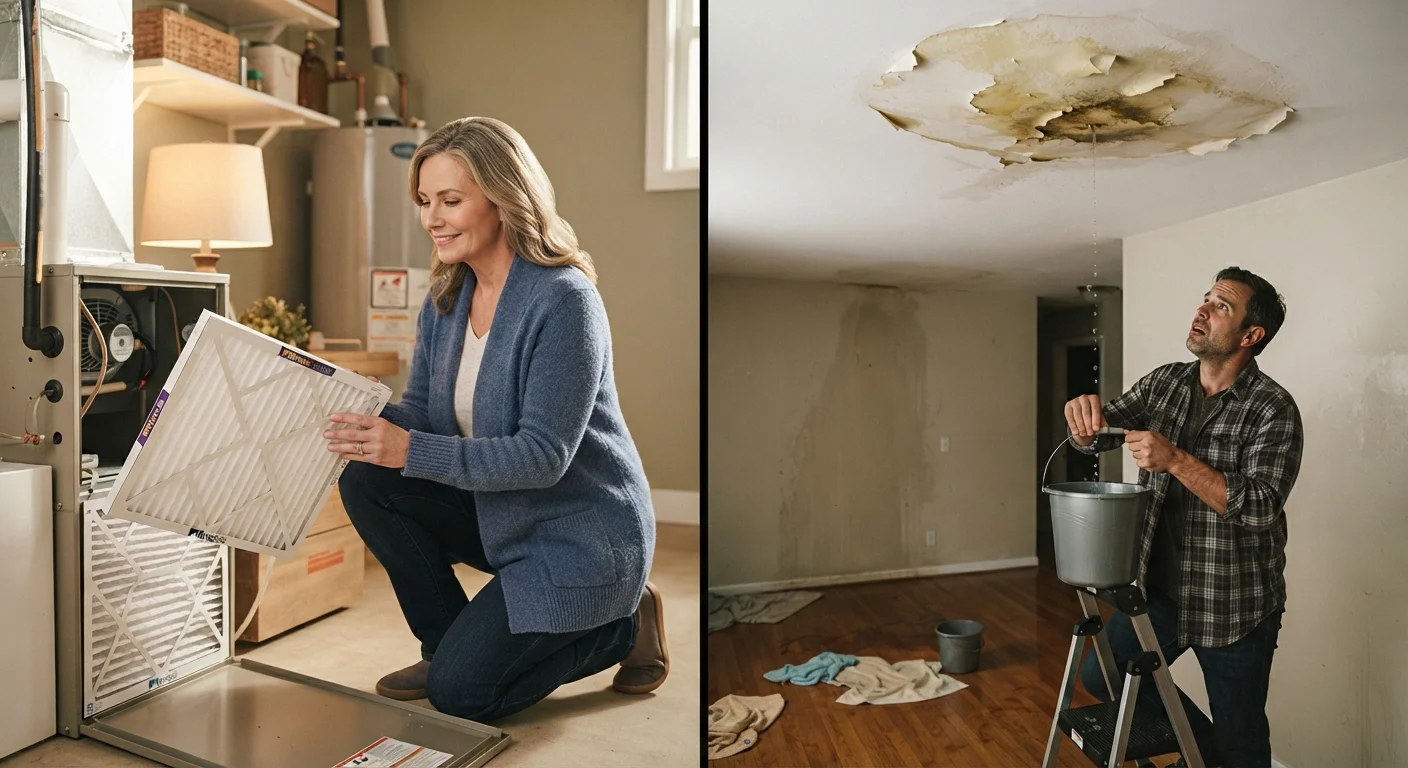
Option A
Preventive Maintenance
The scheduled, forward-looking approach to protecting your home.
Best for: Homeowners who want to avoid costly breakdowns by staying ahead of wear and deterioration.
Option B
Reactive Repairs
The necessary response when something has already gone wrong.
Best for: Addressing unexpected failures or damage that couldn't be avoided through routine upkeep.
Defining the Two Approaches
At its core, preventive maintenance is any planned action taken to keep home systems running before a problem occurs. Think annual HVAC servicing, clearing gutters each fall, caulking windows before winter, or testing smoke detectors on a schedule. These tasks are predictable, budgetable, and largely within a homeowner's control.
Reactive repairs, by contrast, happen in response to something that has already failed or broken. A burst pipe, a failed water heater, a cracked furnace heat exchanger — these demand immediate attention and often arrive without warning, disrupting both routines and finances.
Neither approach exists in isolation. Even the most diligent homeowner will face reactive repairs occasionally. The realistic goal isn't to eliminate them entirely, but to reduce their frequency and severity through consistent preventive habits. See our seasonal home maintenance guide for a practical task-by-task breakdown organized by time of year.
| Criterion | Preventive Maintenance | Reactive Repairs |
|---|---|---|
| Timing | Scheduled in advance | Unplanned, after failure |
| Cost predictability | Budgetable, lower variance | Unpredictable, often higher |
| Urgency | Low — done on your timeline | High — immediate action needed |
| Disruption to household | Minimal, planned around schedule | Significant, often sudden |
| Long-term outcome | Extends system lifespan | Restores function after failure |
| Homeowner control | High — proactive decisions | Low — reactive to events |
| Risk of secondary damage | Lower — problems caught early | Higher — damage may spread first |
The True Cost Comparison
One of the most common reasons homeowners skip preventive maintenance is the upfront cost. Paying for an inspection or service visit when nothing appears wrong can feel unnecessary. However, research across facility management and home services industries consistently suggests that preventive maintenance saves money over the long term — though exact ratios vary by system, home age, and region.
Consider a few concrete examples. Replacing an HVAC air filter regularly is a low-cost task; ignoring it can lead to a dirty coil, reduced efficiency, and ultimately compressor failure — a repair that can run into the thousands. Similarly, small roof leaks caught during an inspection cost far less to patch than the structural damage, mold remediation, and insulation replacement that follow a prolonged, undetected leak.
3–4×
Cost multiplier for reactive vs. preventive repairs
Industry estimates across facilities management suggest reactive repairs can cost three to four times more than equivalent preventive work, accounting for emergency labor and secondary damage.
1–4%
Of home value: typical annual maintenance cost range
Housing and financial advisers commonly cite this range as a planning benchmark, with older homes and those in harsher climates trending toward the higher end.
35%
Of homeowners who budget specifically for maintenance
Surveys by home services organizations have found that a minority of US homeowners set aside a dedicated fund for routine maintenance before problems arise.
Reactive repairs also carry hidden costs: emergency service premiums, rushed material sourcing, and the potential for secondary damage while waiting for a fix. These costs rarely appear in a budget until they land unexpectedly. Our article on home maintenance myths that cost money explores several common misconceptions that lead homeowners to underinvest in upkeep.
When Reactive Repairs Are Unavoidable
It would be misleading to suggest that preventive maintenance eliminates all failures. Mechanical and structural components have finite lifespans. Even well-maintained appliances eventually fail. Weather events, aging infrastructure, and unpredictable accidents create situations where reactive repairs are simply unavoidable.
The key distinction is this: homeowners who maintain their properties tend to face fewer reactive repairs, and the ones they do face are often less severe. A homeowner who regularly services their water heater may still need to replace it eventually — but they're less likely to face a sudden flood from a neglected unit that failed catastrophically.
Safety First on Certain Repairs
Some reactive repairs — including anything involving electrical panels, gas lines, structural components, or roofing at height — should always be handled by a licensed professional. Attempting these without proper training or permits can create serious safety hazards and may violate local building codes. When in doubt about the scope of a repair, consult a qualified contractor before proceeding.
Tracking both maintenance activities and repairs over time is one of the most underused tools available to homeowners. Patterns often emerge — a drain that clogs every six months, a circuit breaker that trips repeatedly — that point toward a root cause before it becomes a crisis. Our guide to keeping a home maintenance log explains how to set up a simple system that pays dividends over time.
Building a Balanced Home Care Strategy
A practical home care approach combines both philosophies. Preventive maintenance should anchor the strategy, with scheduled tasks across all major systems: roofing, HVAC, plumbing, electrical, foundation drainage, and appliances. A seasonal checklist — reviewed in spring and fall — covers most critical items for the majority of US climates.
Alongside that, a dedicated repair reserve fund helps absorb reactive costs without financial stress. Financial guidance commonly suggests setting aside a percentage of a home's value annually for maintenance and repairs, though the appropriate amount varies considerably depending on home age, condition, and local market. Consulting a financial adviser can help determine what makes sense for your situation.
For those wondering where reactive repairs most often sneak up on homeowners, our article on overlooked maintenance tasks highlights the systems most commonly neglected until failure forces action.
The balance isn't about perfection — it's about intention. Homeowners who treat maintenance as an ongoing responsibility, rather than something to address only when things break, consistently fare better in both cost and home condition over the long term.
The content on this site is for informational purposes only and is not a substitute for professional advice. Always consult a qualified professional for guidance specific to your situation.