

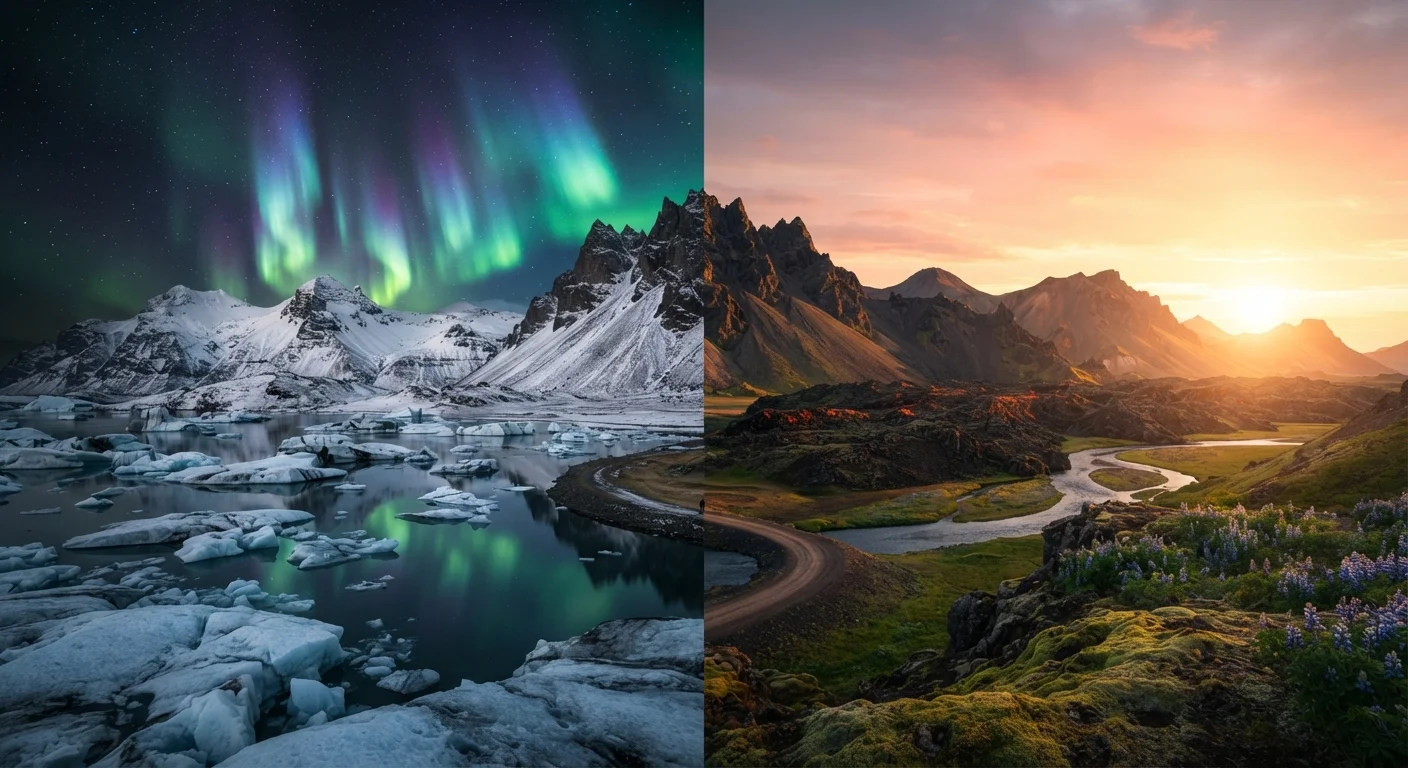
Option A
Iceland in Winter
The aurora-chasing, snow-draped dramatic season.
Best for: Travelers prioritizing northern lights, cozy hot spring soaks, and uncrowded landscapes despite challenging road conditions.
Option B
Iceland in Summer
The midnight-sun, open-road season of maximum access.
Best for: Road-trippers and hikers who want full access to the Highlands, puffin colonies, and 24 hours of daylight for exploring.
Light, Darkness, and What They Mean for Your Trip
Iceland's seasonal extremes are unlike anywhere else in the Northern Hemisphere. In late June, Reykjavik sees roughly 22 hours of daylight — the sun barely dips below the horizon. By contrast, December brings as few as four hours of usable daylight. This single variable reshapes everything about how you experience the country.
Summer's midnight sun is genuinely disorienting in the best possible way. You can hike Landmannalaugar at 10 p.m. under full sunlight, or watch the sky glow pink over Skógafoss at midnight. The extended light compresses no activities into a strict window — your itinerary breathes. Winter demands the opposite discipline: you front-load your sightseeing into those precious daylight hours and accept that evenings are for hot pots, hearty lamb soup, and scanning the sky for green ribbons of aurora.
Shoulder Seasons: A Middle Ground Worth Considering
September and October, as well as April and May, offer genuine advantages. Aurora chances emerge as darkness returns in autumn, while spring brings melting snow and increasingly accessible roads without peak-summer crowds. Iceland's waterfalls run at their most powerful during spring snowmelt. These shoulder windows suit travelers who want to hedge their bets across multiple experiences.
Neither season is a consolation prize. Experienced Iceland travelers often say winter's drama — frozen waterfalls, steam rising from geothermal pools against black skies — is visually unmatched. Equally, summer's lush, lupine-covered valleys look nothing like the Iceland most people picture.
Road Conditions and Getting Around
Iceland's road network is the backbone of independent travel, and the seasons reshape it completely. The Ring Road (Route 1) remains open year-round, but winter driving on it is a genuine commitment. Ice, black ice, sudden blizzards, and high winds are all plausible. Four-wheel drive and winter tires are essential, not optional extras. If you're unfamiliar with winter driving technique, our guide on adjusting your driving habits for snow, fog, and ice covers the fundamentals worth revisiting before you go.
Summer driving is broadly straightforward on paved routes, though gravel roads to remote sites still demand attention. Critically, the Highlands — accessed via F-roads that require high-clearance 4WD vehicles — only open between roughly late June and early September. Destinations like Landmannalaugar, Askja, and the Kjölur route are simply off the table in winter, regardless of vehicle.
| Criterion | Winter (Nov–Mar) | Summer (Jun–Aug) |
|---|---|---|
| Daylight hours | 4–6 hours per day | Up to 22 hours per day |
| Northern lights visibility | Excellent (dark skies) | Not possible |
| Highland F-road access | Closed | Open (late June–Sept) |
| Ice cave access | Yes (Vatnajökull caves) | No (unsafe ice) |
| Puffin sightings | Not present | May–mid-August |
| Road conditions | Ice, snow, closures possible | Generally passable |
| Crowd levels | Low to moderate | High |
| Typical accommodation availability | Easier to book | Book well in advance |
The takeaway: summer offers freedom and access; winter demands preparation and flexibility.
Iconic Experiences That Shift With the Season
Several of Iceland's headline attractions are seasonal by nature, not just by preference.
- Ice caves: Natural ice caves within Vatnajökull glacier are exclusively a winter phenomenon, generally accessible from November through March when low temperatures keep the ice structurally stable.
- Puffins: These beloved seabirds are present only from May to mid-August, nesting on sea cliffs at places like Látrabjarg and Westman Islands.
- Lupine fields: The purple-blooming nootka lupine that carpets Iceland's lowlands appears in June and July — a distinctly summer spectacle.
- Frozen waterfalls: Seljalandsfoss and Skógafoss take on entirely different characters in winter, sometimes partially or fully freezing into sculptural formations.
- Northern lights: Impossible to see in summer due to continuous daylight. Peak viewing windows are October through March, ideally away from city lights on a clear, moonless night.
For travelers debating between two very different landscape experiences within North America, the contrast here mirrors broader seasonal travel trade-offs — much like those explored in our piece on coastal Maine vs. the White Mountains.
~2.3M
Annual visitors to Iceland (pre-pandemic peak)
According to Iceland's Directorate of Immigration and tourism industry data, summer months account for the majority of arrivals.
4 hrs
Minimum daylight in Reykjavik in December
The Icelandic Meteorological Office confirms the winter solstice period delivers just over four hours of daylight at Iceland's latitude.
26+
F-roads closed in winter months
The Icelandic Road and Coastal Administration (Vegagerðin) restricts access to all major Highland F-roads outside the summer season.
Crowds, Costs, and Practical Considerations
Summer is unambiguously Iceland's high season. July and August see the highest visitor volumes, which translates to fuller car rental lots, advance-booked accommodations, and longer queues at Geysir and Gullfoss. Planning further ahead — and booking accommodations well in advance — is not optional during peak months.
Winter travel is quieter, though the Christmas and New Year window does attract travelers specifically chasing the northern lights. Outside that period, January and February represent the lowest-traffic window of the year. Some smaller guesthouses and rural services do reduce hours or close entirely in the deep off-season, so confirming availability before you arrive is always worth doing.
Weather forecasting in Iceland is genuinely unpredictable in both seasons, but winter introduces more serious safety implications — road closures, flight delays, and sudden storms. Always check the Icelandic Road and Coastal Administration (Vegagerðin) road conditions website and the Icelandic Meteorological Office before setting out, whatever time of year you visit.
This article provides general travel information. Conditions, road access dates, and attraction availability change from year to year. Always verify current status with official Icelandic authorities and your accommodation providers before traveling.
The content on this site is for informational purposes only and is not a substitute for professional advice. Always consult a qualified professional for guidance specific to your situation.