

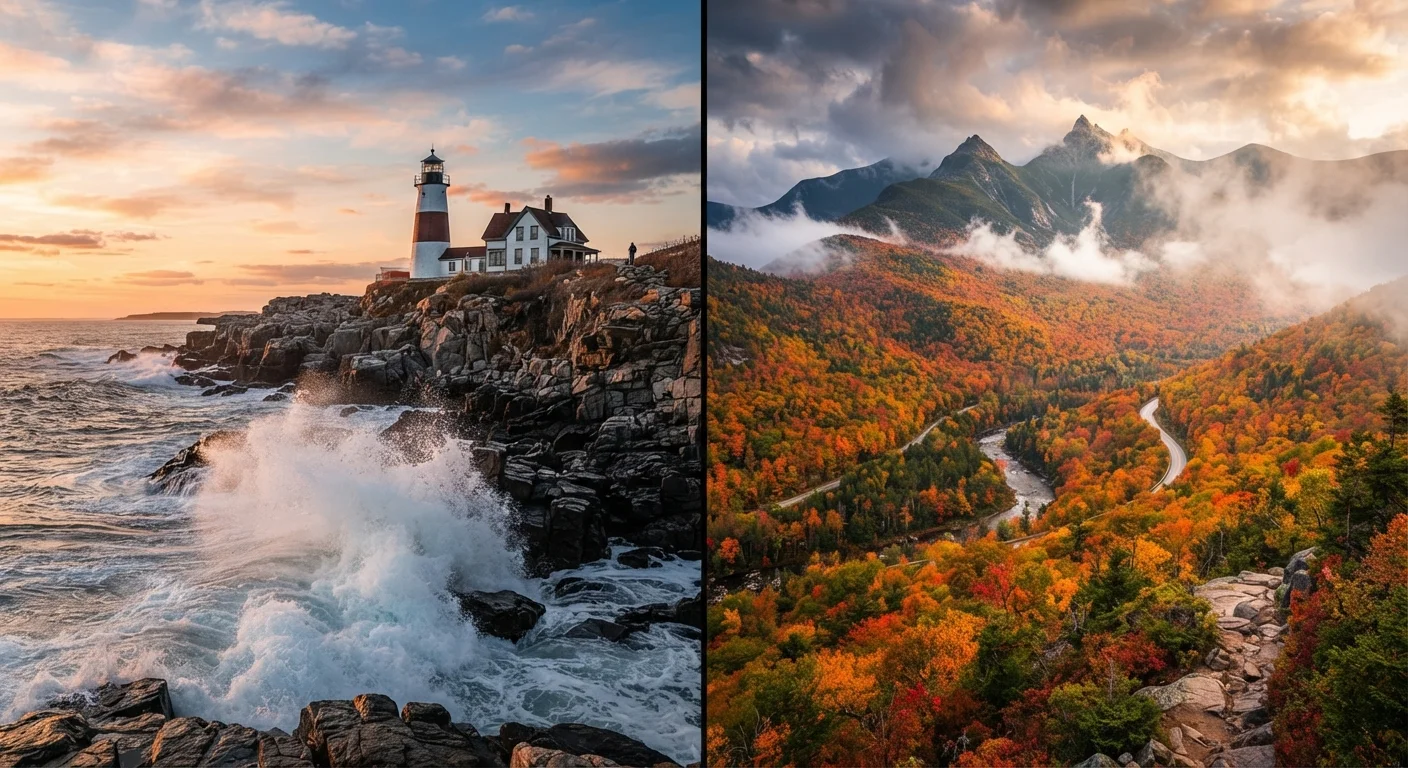
Our Verdict
Coastal Maine and New Hampshire's White Mountains are equally compelling but fundamentally different New England experiences. The coast excels at slow, sensory travel — tidal pools, lobster shacks, and salt air — while the mountains deliver physical challenge and dramatic elevation. Your ideal destination hinges on whether you crave the rhythm of the sea or the pull of the summit.
| Best for | Recommended |
|---|---|
| Travelers who prioritize seafood, scenic harbors, and relaxed coastal culture | Coastal Maine |
| Hikers, skiers, and foliage chasers seeking alpine terrain and active adventure | White Mountains |
| Families looking for mild outdoor activity mixed with cultural stops | Coastal Maine |
| Peak-baggers, winter sports enthusiasts, and serious outdoor recreationists | White Mountains |
The Lay of the Land
Coastal Maine stretches roughly 3,500 miles of tidal shoreline — far more than its straight-line distance suggests — from Kittery at the New Hampshire border north to Eastport near Canada. The terrain is defined by rocky headlands, sheltered coves, working fishing harbors, and island-dotted bays. Towns like Kennebunkport, Rockland, and Bar Harbor each carry their own distinct character, ranging from upscale resort communities to working waterfront villages.
The White Mountains occupy a large swath of northern New Hampshire, anchored by Franconia Notch and the Presidential Range. Mount Washington, the highest peak in the Northeast at 6,288 feet, sits at the center of one of the most dramatic alpine environments in the eastern United States. The region's valleys funnel travelers between ski resorts, hiking trailheads, and classic New England towns like North Conway and Lincoln.
Both destinations are well within reach of Boston — coastal Maine in roughly 90 minutes to Portland, the White Mountains in about two hours to the Kancamagus Highway. For anyone planning a New England regional road trip, either makes a superb anchor destination.
Season by Season: When to Go and Why
Timing your visit changes everything in New England, and these two destinations peak at different moments.
Summer (June–August): Coastal Maine hits its stride in summer — lobster pounds open, boat tours fill up, and Acadia National Park buzzes with activity. Expect crowds in Bar Harbor and along Route 1, especially in July and August. The White Mountains are also popular in summer, offering cooler hiking conditions than lowland alternatives, but trails on the Presidential Range can still be challenging and weather volatile at elevation.
Fall (September–October): This is perhaps the White Mountains' defining season. The Kancamagus Highway becomes one of the most photographed drives in the country as hardwoods explode with color, typically peaking in early to mid-October. Coastal Maine also puts on an impressive foliage show, but the mountain backdrop amplifies the effect considerably in the White Mountains.
Winter (November–March): The coast largely quiets — many seasonal businesses close — making it ideal for solitude seekers but limiting options. The White Mountains come alive with skiing at Bretton Woods, Loon Mountain, and Cannon Mountain, drawing winter sports enthusiasts from across the Northeast.
Spring (April–May): Mud season in the mountains can close higher trails; coastal Maine sees the return of migratory seabirds and uncrowded beaches, making it a quieter but rewarding shoulder-season option.
Combine Both on One Trip
A loop itinerary that begins in Portland, Maine, travels north along the coast to Acadia, then swings west through the White Mountains back toward Boston covers both destinations in five to seven days comfortably. The two regions are roughly 150 miles apart at their closest points, making a combined trip entirely practical rather than ambitious.
Activities and Experiences Compared
| Coastal Maine | White Mountains | |
|---|---|---|
| Signature activity | Sea kayaking, whale watching, tidal exploration | Peak hiking, skiing, scenic drives |
| Best season | Summer and early fall | Fall foliage and winter ski season |
| Family accessibility | High — beaches, tide pools, easy trails | Moderate — many trails require fitness |
| Culinary culture | Strong — lobster, clam chowder, craft food scene | Moderate — comfort food, maple products |
| Wildlife viewing | Seabirds, seals, whales offshore | Moose, black bear, raptors |
| Crowd levels (peak) | High July–August in Bar Harbor | High October foliage and ski weekends |
| Drive from Boston | ~90 min to Portland | ~2 hrs to North Conway |
The comparison above captures the key differences, but a few points deserve emphasis. Coastal Maine's Acadia National Park offers the rare combination of ocean and mountain in one place — its carriage roads and summit hikes are legitimately alpine in feel. However, the White Mountains' sheer concentration of challenging terrain, including 48 peaks over 4,000 feet, draws dedicated hikers from across the country in a way the coast simply cannot match.
On the cultural side, Maine's coastal towns offer a richer texture of working-harbor life, seafood traditions, and art communities (Portland's Old Port and Rockland's Farnsworth Art Museum are standouts). The White Mountains' towns are charming but more oriented toward outdoor recreation logistics than cultural depth.
For those who love the freedom of open roads, both regions reward choosing scenic routes over highways — Route 1 along the coast and the Kancamagus Highway through the mountains are among New England's finest drives.
Practical Considerations Before You Go
Accessibility: Coastal Maine is generally more accessible for travelers with mobility considerations — flat harbor walks, paved carriage roads in Acadia, and waterfront dining are all manageable. The White Mountains demand more physical fitness for signature experiences; many trailheads involve significant elevation gain on uneven terrain.
Accommodation range: Both destinations offer everything from rustic campgrounds to upscale inns. Maine's coast has a stronger bed-and-breakfast culture in historic sea captains' homes; the White Mountains offer classic ski-lodge and resort-style lodging, particularly around Bretton Woods and Waterville Valley.
Weather and safety: Mount Washington holds world records for surface wind speeds and is notoriously unpredictable — hikers should always check conditions via the Mount Washington Observatory before ascending above treeline. Coastal Maine's weather is milder but fog is common, and tidal awareness is essential near rocky shores. Always verify current conditions and trail status with official sources before setting out.
Whichever destination calls to you, the journey itself is part of the experience — New England's back roads are worth lingering on as much as any single destination.
The content on this site is for informational purposes only and is not a substitute for professional advice. Always consult a qualified professional for guidance specific to your situation.