

Our Verdict
Smart speakers deliver meaningful convenience for hands-free tasks, home automation, and quick information lookups — but they come bundled with real trade-offs around privacy, ecosystem dependency, and reliability. Neither universally essential nor inherently risky, they reward users who go in with clear expectations and take a few minutes to review privacy settings.
Households already invested in a compatible smart home ecosystem who value voice-driven convenience and are comfortable reviewing and managing their data-sharing preferences.
What Smart Speakers Actually Do
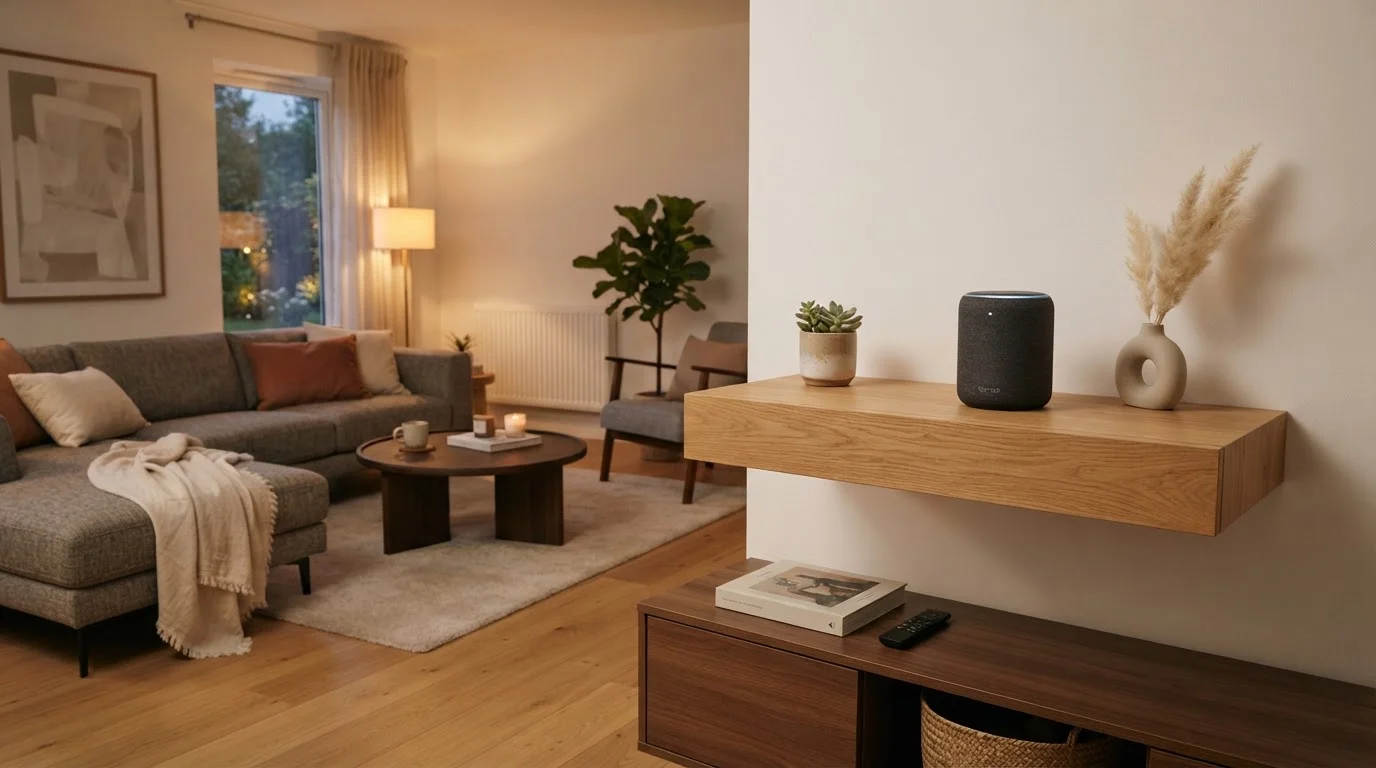
Smart speakers combine a wireless audio device with a voice-activated digital assistant. When you say a wake word — a short phrase the device monitors for continuously — it activates, sends your spoken query to cloud servers, processes it, and returns a response, often within seconds. Beyond answering questions, most models can control compatible smart home devices, stream music, set timers, manage calendar reminders, and place calls.
They sit at the intersection of the digital life most households already lead and the emerging promise of ambient computing. Understanding their mechanics is the first step to evaluating whether they fit your home — and your comfort level with the trade-offs involved.
The Genuine Advantages
Smart speakers earn their place in millions of homes for practical reasons, not just novelty.
Hands-free control for multitasking situations
Voice commands let users manage timers, music, or smart home devices without stopping what they're doing, which is particularly useful while cooking or exercising.
Accessible interface for diverse users
For people with limited mobility or visual impairments, voice interaction can offer a more accessible alternative to screens and keyboards.
Centralised smart home automation hub
Compatible smart speakers can coordinate multiple devices — lights, thermostats, locks — through a single voice command, simplifying routines.
Instant information and reminders
Quick queries, calendar management, and weather or news briefings are handled rapidly, often faster than manually searching a phone.
Improving accuracy over time
Voice recognition systems are trained on large datasets and continue to improve, meaning command accuracy generally gets better with regular use.
35%+
US adults with a smart speaker at home
Edison Research's Infinite Dial reports have consistently tracked smart speaker ownership above one-third of US adults in recent years.
~30
Average accidental activations per day
A study published by Northeastern University and Imperial College London found smart speakers triggered unintentionally roughly 1.5 times per hour of household activity.
Voice control is especially useful in hands-busy situations — cooking, caring for young children, or during accessibility needs. Users who find touchscreens or keyboards difficult to navigate may find voice interaction genuinely empowering. Home automation is another strong suit: when devices are compatible, a single spoken command can adjust lighting, thermostat settings, or door locks simultaneously.
The Real Limitations to Know
The same always-on microphone that enables convenience is also the feature most scrutinised from a privacy standpoint. Smart speakers are designed to listen for their wake word at all times, which means the microphone is active even when you haven't intentionally engaged the device. Accidental activations — triggered by similar-sounding words in conversation or TV audio — do occur, and short audio clips may be stored or reviewed by the platform to improve accuracy.
Always-on microphone raises privacy concerns
The microphone monitors for the wake word continuously, meaning accidental activations can capture unintended conversations that may be processed remotely.
Cloud dependency limits offline functionality
Most smart speakers require an active internet connection to process commands; a router outage or cloud service disruption renders many features unusable.
Ecosystem lock-in restricts device choice
Deep integration typically works best within a single platform's ecosystem, which can constrain which appliances, apps, or services you can realistically use.
Variable accuracy with accents and noise
Voice recognition performs inconsistently for users with regional accents or in noisy environments, leading to misunderstood commands and frustration.
Data storage and review practices vary
Platforms differ in how long they retain voice recordings and whether human reviewers may access clips to improve accuracy — policies that deserve careful reading.
Limited utility for complex or nuanced queries
Smart speakers handle transactional tasks well but often struggle with multi-step reasoning, ambiguous questions, or tasks requiring contextual memory.
For a deeper look at how connected devices handle your personal data, the checklist for evaluating AI app privacy applies similar principles worth reviewing before setup.
Ecosystem Lock-In and Interoperability
One of the most practical limitations of smart speakers is ecosystem dependency. Each major platform ties its voice assistant tightly to its own suite of services and preferred device partners. A speaker from one ecosystem may handle commands for some third-party smart home products flawlessly while ignoring others entirely.
The Matter interoperability standard — a cross-industry initiative backed by major tech companies — aims to reduce these fragmentation problems, but adoption is still uneven across device categories and price points. For a fuller explanation of why connected devices don't always communicate cleanly, see why your smart home devices don't always talk to each other.
What the Matter Standard Changes
Matter is a connectivity protocol designed to let smart home devices from different manufacturers work together without platform-specific workarounds. Devices certified for Matter can, in principle, be controlled by multiple ecosystems simultaneously. However, Matter support must be built into each individual device, so older hardware and many budget products are not covered. Checking a device's certification status before purchasing remains important.
Practical Steps Before You Plug One In
If you're weighing whether a smart speaker fits your household, a few considerations help frame the decision honestly. First, audit the devices and services you already use — a speaker from an ecosystem you're already embedded in will generally perform better than one chosen at random. Second, review the privacy settings available before or shortly after setup: most platforms allow you to disable voice-history storage, mute the microphone physically, or opt out of human review of audio clips. Third, consider placement: a smart speaker in a bedroom raises different comfort questions than one in a kitchen or living room.
Smart speakers are one of several connected devices that blur the line between useful tool and data-collection endpoint — a dynamic also worth examining if you use fitness wearables, as explored in what wearable tech data can and cannot tell you.
The content on this site is for informational purposes only and is not a substitute for professional advice. Always consult a qualified professional for guidance specific to your situation.