

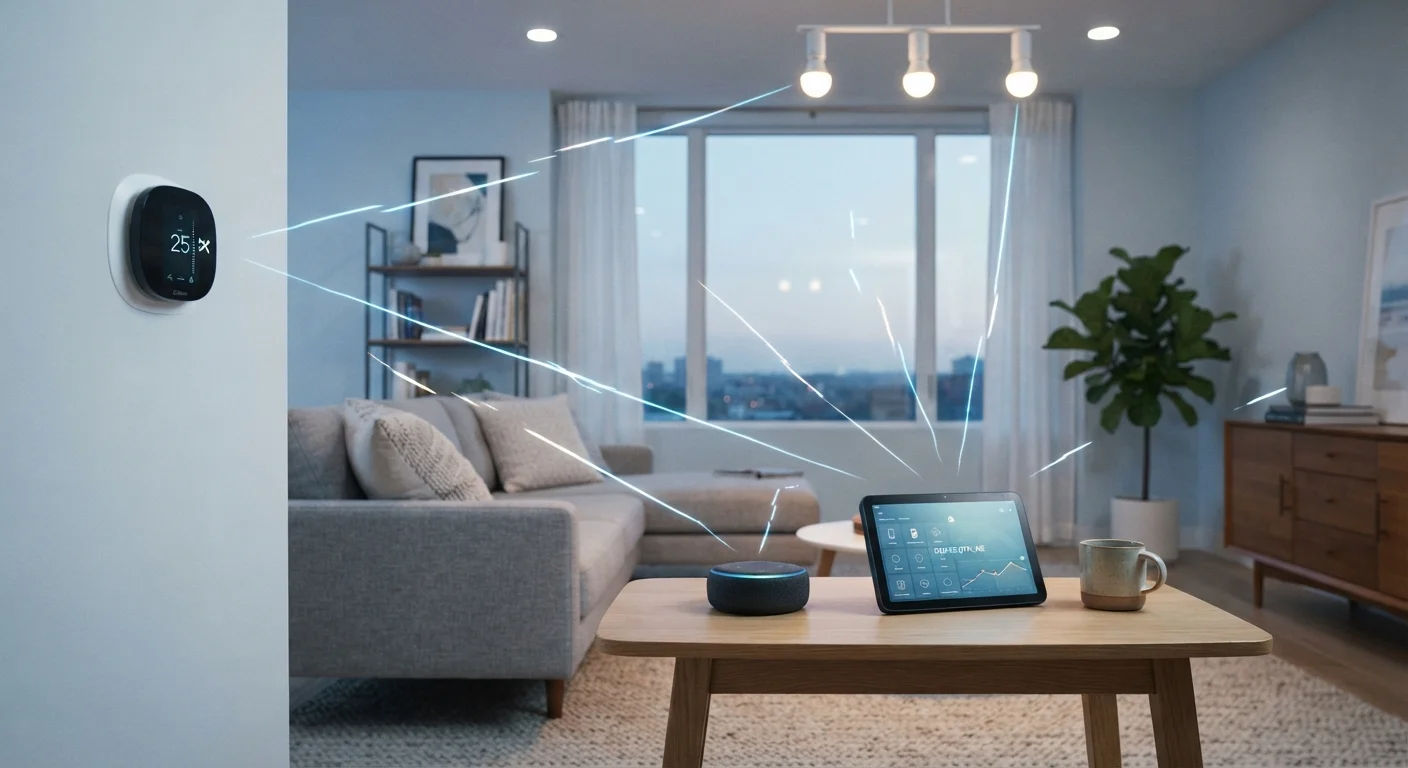
The Fragmented Reality of the Connected Home
The idea of a smart home — lights that respond to voice commands, a thermostat that adjusts to your schedule, locks that notify your phone — is compelling. The reality, for many households, is a collection of apps, incompatible hubs, and devices that stubbornly ignore one another.
This fragmentation is not accidental. It is the product of an industry that developed rapidly, with dozens of competing manufacturers each building products around proprietary ecosystems. A smart plug designed for one platform may be invisible to a speaker from another brand, even when both are connected to the same Wi-Fi network. The problem is not the internet connection — it is the language each device speaks.
For a broader look at managing multiple connected devices in your daily life, see our guide to managing your digital life across multiple devices.
300M+
Smart home devices shipped globally per year
Industry analyst estimates place annual global smart home device shipments above 300 million units, underscoring the scale at which interoperability problems affect consumers.
4+
Major competing wireless protocols in common use
Wi-Fi, Zigbee, Z-Wave, Bluetooth, and Thread each have meaningful market share, meaning many homes contain devices that speak fundamentally different wireless languages.
2022
Year Matter standard version 1.0 was released
The Connectivity Standards Alliance released Matter 1.0 in October 2022 after several years of development involving Apple, Google, Amazon, Samsung, and hundreds of other companies.
Why Devices Can't Always Communicate: Protocols and Ecosystems
Two distinct forces drive incompatibility in smart homes: differing wireless protocols and closed commercial ecosystems.
Wireless protocols are the communication standards that determine how a device transmits data. Common protocols include:
- Wi-Fi — high bandwidth, high power consumption, works directly with home routers
- Bluetooth — short range, low power, common in personal devices
- Zigbee — low power, mesh networking, widely used in smart bulbs and sensors
- Z-Wave — mesh network, low interference, common in security devices
- Thread — a newer low-power mesh protocol designed for reliability and local control
A Zigbee light bulb cannot natively communicate with a Z-Wave sensor. They operate on different radio frequencies using different rules. Bridging them requires a hub that understands both languages — adding cost and a potential single point of failure.
Closed ecosystems compound the problem. Historically, Amazon Alexa, Google Home, and Apple HomeKit each maintained their own certification requirements, APIs, and device registries. A device approved for one platform was not guaranteed to work with another. Manufacturers sometimes chose a single platform for strategic or cost reasons, limiting consumer choice after purchase.
Platform Ecosystems Are Opening — Slowly
As Matter adoption grows, the walled-garden approach of major platforms is gradually becoming less absolute. Amazon, Apple, and Google have all committed to Matter support, meaning their platforms can serve as Matter controllers. However, some advanced or proprietary features of specific devices may still only be accessible through a manufacturer's native app, even on Matter-compatible hardware.
What Matter Is — and What It Isn't
The Matter standard, overseen by the Connectivity Standards Alliance (CSA), represents the most significant industry-wide attempt to solve the interoperability problem. It defines a common application-layer protocol that sits atop existing network technologies — primarily Wi-Fi and Thread — and allows certified devices to be discovered and controlled across different platforms simultaneously.
In practical terms, a Matter-certified smart plug could be set up through a Google Home app and still be controllable through Apple HomeKit or Amazon Alexa without any additional configuration. The device itself communicates using a shared language that all participating platforms understand.
“The goal of Matter is to make it so that consumers don't have to think about what works with what — they just buy a device, and it works.”
— Tobin Richardson, President and CEO, Connectivity Standards Alliance
Crucially, Matter enables local control — devices can communicate with each other and with a home hub without routing commands through a manufacturer's cloud server. This reduces latency, improves reliability during internet outages, and limits the exposure of home activity data to third-party servers.
What Matter is not: a retroactive fix for every existing device. Devices built before Matter's release in late 2022 require firmware updates to gain compatibility, and many will never receive them. Consumers with large existing installations should check manufacturer documentation carefully before assuming compatibility.
Smart speakers are a central part of most smart home setups, and their platform affiliations directly affect interoperability. Our article on smart speaker trade-offs worth knowing covers how these devices fit — and sometimes don't — into broader home ecosystems.
Making Smarter Decisions Before You Buy
Understanding the underlying reasons for incompatibility changes how you approach purchasing smart home devices. A few practical considerations can prevent frustration later.
Before You Buy: A Quick Compatibility Check
Look for the Matter logo on device packaging or in product listings, as this is the clearest signal of broad cross-platform support. If a device predates Matter, check whether it supports the same protocol (Zigbee, Z-Wave, Wi-Fi) as your existing hub or gateway. Taking five minutes to verify compatibility before purchase can prevent hours of troubleshooting afterward.
Check protocol and platform support explicitly. A product listing that says "works with Alexa" does not guarantee compatibility with Google Home or Apple HomeKit. Read the technical specifications, not just the marketing summary.
Prioritise Matter-certified devices where available. As the standard matures and adoption widens, devices bearing Matter certification offer the most flexibility for future-proofing a home setup. The CSA maintains a public listing of certified products.
Consider hub strategy early. If your home already contains Zigbee or Z-Wave devices, a compatible hub that also supports Matter can bridge older and newer equipment, extending the useful life of existing hardware.
Interoperability in the smart home space is improving, but it remains a work in progress. Matter narrows the gap considerably, but the full vision of a seamlessly unified home — regardless of brand — will depend on sustained manufacturer participation and consumer pressure for open standards.
Frequently Asked Questions
Most likely, your bulbs use a communication protocol or ecosystem that your voice assistant does not natively support. For example, a bulb tied to one manufacturer's app may not be discoverable by a competing platform without a compatible bridge or hub. Checking protocol and platform compatibility before purchasing is the most reliable solution.
Matter is an industry-wide connectivity standard designed to allow smart home devices from different manufacturers to work together reliably. It was developed by the Connectivity Standards Alliance with participation from major technology companies. Devices certified under Matter can communicate locally — meaning they don't always need an internet connection to function.
Not necessarily. Some existing devices have received or are expected to receive firmware updates that add Matter support. However, many older devices will not be updated and would need to be replaced. Checking the manufacturer's support page is the best way to find out whether your device is eligible.
The most common protocols include Wi-Fi, Bluetooth, Zigbee, and Z-Wave, each with different range, power, and compatibility characteristics. Matter itself runs over Wi-Fi and Thread, a low-power mesh networking protocol. Different devices in the same home can use different protocols, which is a primary source of incompatibility.
A hub can help by acting as a translator between different protocols, enabling devices that would not otherwise communicate to work together. However, hubs add cost and complexity, and they are not universal — each hub supports a specific set of protocols and platforms. Matter aims to reduce the need for such workarounds over time.
The content on this site is for informational purposes only and is not a substitute for professional advice. Always consult a qualified professional for guidance specific to your situation.