

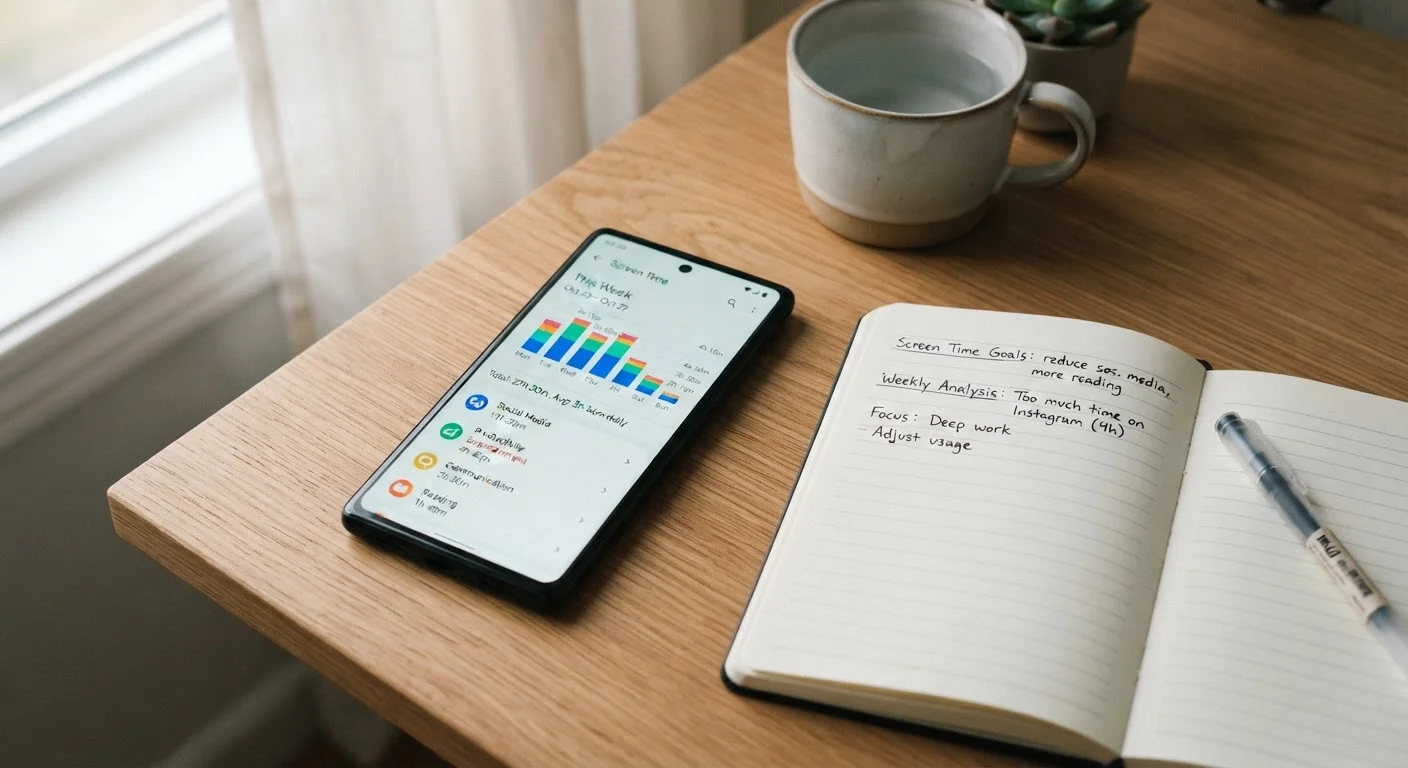
Why the Number on Your Dashboard Can Mislead You
Most major smartphone platforms now offer built-in screen time dashboards that deliver a weekly total: four hours, seven hours, eleven hours. These numbers feel authoritative. They look like a verdict. But researchers who study digital media use have raised consistent concerns about treating raw time as the primary measure of whether device use is healthy or problematic.
The core issue is that a screen time total makes no distinction between a video call with a family member, a work spreadsheet, a guided meditation app, and two hours of late-night social media scrolling. Those experiences differ in purpose, emotional engagement, and physical context — yet they collapse into a single figure. Using that figure as a health proxy is roughly as useful as judging a meal purely by its calorie count, without considering nutrients, hunger levels, or what you were doing when you ate it. Much like reading a nutrition label, context shapes what a number actually means.
Myth
More screen time always means worse mental health outcomes.
Fact
Research shows the relationship is far more nuanced — content type, context, and what screen time displaces matter significantly more than total hours.
Several large-scale studies, including analyses of datasets with hundreds of thousands of participants, have found that the association between screen time and well-being is often statistically small when measured by total hours alone. Researchers such as those publishing in Nature Human Behaviour have argued that the effect sizes are frequently comparable to trivial everyday behaviors. The type of use — passive scrolling versus active communication — and whether device use is displacing sleep or exercise are consistently stronger predictors of outcomes than the raw total.
Myth
There is a universally safe daily screen time limit for adults.
Fact
No scientific consensus exists on a single numeric daily limit for adults; guidelines typically focus on context, sleep displacement, and behavioral patterns instead.
Unlike some pediatric guidelines that address young children's developmental needs, adult screen time lacks an evidence-backed universal threshold. Professional health organizations generally encourage adults to notice whether device use interferes with sleep, physical activity, work, or relationships — not to stay under a fixed hour count. Individual variation in work demands, caregiving roles, and recreational preferences makes a one-size number impractical and potentially misleading.
Myth
A screen time app gives you an accurate picture of your digital habits.
Fact
Built-in screen time tools measure active display time but miss context — they cannot distinguish purposeful use from compulsive use, or work from entertainment.
Platform screen time tools typically track when a screen is on and an app is foregrounded. They do not capture whether you were engaged, distracted, or multitasking. They also tend to miss background audio, casting content to a TV, or time spent thinking about content after putting the phone down. Research comparing self-reported and device-logged usage has found meaningful discrepancies, suggesting neither source alone paints a complete picture of digital behavior.
Myth
Cutting screen time significantly will automatically improve your well-being.
Fact
Reductions in screen time show inconsistent effects in studies; the quality of what replaces that time tends to determine whether well-being improves.
Experimental studies that have asked participants to reduce social media or overall screen time have produced mixed results. Some participants report improved mood; others report increased boredom or feelings of social disconnection — particularly when screen use served as their primary source of social contact. The research suggests that replacing screen time with meaningful offline activity (movement, in-person connection, rest) is associated with benefit, while simply removing screen time without replacing it is less reliably positive.
What Research Actually Suggests
A meaningful body of work — including studies published in journals examining adolescent and adult well-being — points to displacement and subjective experience as more informative lenses than raw hours. Displacement refers to what screen time crowds out: physical activity, face-to-face interaction, adequate sleep. When heavy device use replaces those activities, outcomes tend to be more negative. When it supplements or enables them, the picture looks different.
Subjective experience also carries weight. Users who describe their device use as intentional and satisfying tend to report better well-being than those who describe it as compulsive or regret-laden — even at similar hour counts. This is sometimes called the distinction between active and passive use: creating, communicating, and learning versus scrolling without a clear goal.
~2x
Gap between perceived and logged screen time
Studies comparing self-reported device use to platform-logged data have found people frequently underestimate their actual screen time by roughly half.
< 0.5%
Variance in well-being explained by screen time alone
A widely cited 2019 analysis in Nature Human Behaviour estimated screen time explained less than half a percent of adolescent well-being variance — comparable to mundane daily factors.
It's also worth noting that self-reported screen time and platform-measured screen time frequently diverge, complicating research findings. The science here is evolving, and sweeping causal claims in either direction should be treated with caution.
For a complementary example of how raw data can mislead without context, see what wearable health data can and cannot tell you.
Practical Ways to Reframe Your Relationship With the Dashboard
Rather than chasing an arbitrary daily hour target, consider auditing your screen use by type and feeling. After a session, ask: Did I choose this deliberately? Do I feel better or worse than before? Did it displace sleep, movement, or conversation I wanted to have?
Platform tools can still be useful — not as absolute limits, but as prompts to pause and reflect. Setting app-category limits on passive entertainment is more targeted than a blanket daily cap. Reviewing which apps consume the most time relative to the value you get from them is a more actionable exercise than simply trying to reduce a total.
Understanding what your apps are actually collecting alongside your time is another layer worth exploring — what your apps actually know about you breaks down the data dimension of that same relationship.
When Screen Use Feels Compulsive, Seek Support
If you find yourself unable to reduce device use despite wanting to, or if screen use is consistently displacing sleep, eating, or important relationships, these patterns may warrant a conversation with a mental health professional. Screen time dashboards are not diagnostic tools, and this article is general information, not clinical guidance.
Ultimately, a screen time number is a starting point, not a conclusion. The goal isn't a lower number for its own sake — it's a more deliberate, satisfying relationship with the devices that are now central to everyday life. Explore more on everyday device habits for practical guidance.
The content on this site is for informational purposes only and is not a substitute for professional advice. Always consult a qualified professional for guidance specific to your situation.