

Why Pet Identification and Registration Matter
Owning a pet in the United States comes with a set of legal responsibilities that vary by state, county, and municipality. At their core, these requirements exist to protect animals, reunite lost pets with their owners, and help communities manage public health concerns such as rabies. Failing to meet them can result in fines, impoundment of your animal, or additional legal complications.
Three overlapping systems form the legal backbone of pet identification in the U.S.: ID tags, microchipping, and municipal licensing and registration. Each serves a distinct purpose, and in many jurisdictions, more than one is legally required. Understanding how they work together is a core part of responsible community pet ownership.
| Who requires dog licensing | Most U.S. cities and counties (Requirements vary by jurisdiction; check with local animal control) |
| Typical license renewal period | Annual |
| Microchip size | Approximately 12mm (grain of rice) (American Veterinary Medical Association (AVMA)) |
| What a microchip stores | A unique ID number only — not GPS or owner data |
| Rabies tag requirement | Required in public in most U.S. jurisdictions |
| Common license fee range | $10–$50+ per year (Varies by location, species, and spay/neuter status) |
Municipal Licensing: What Most Jurisdictions Require
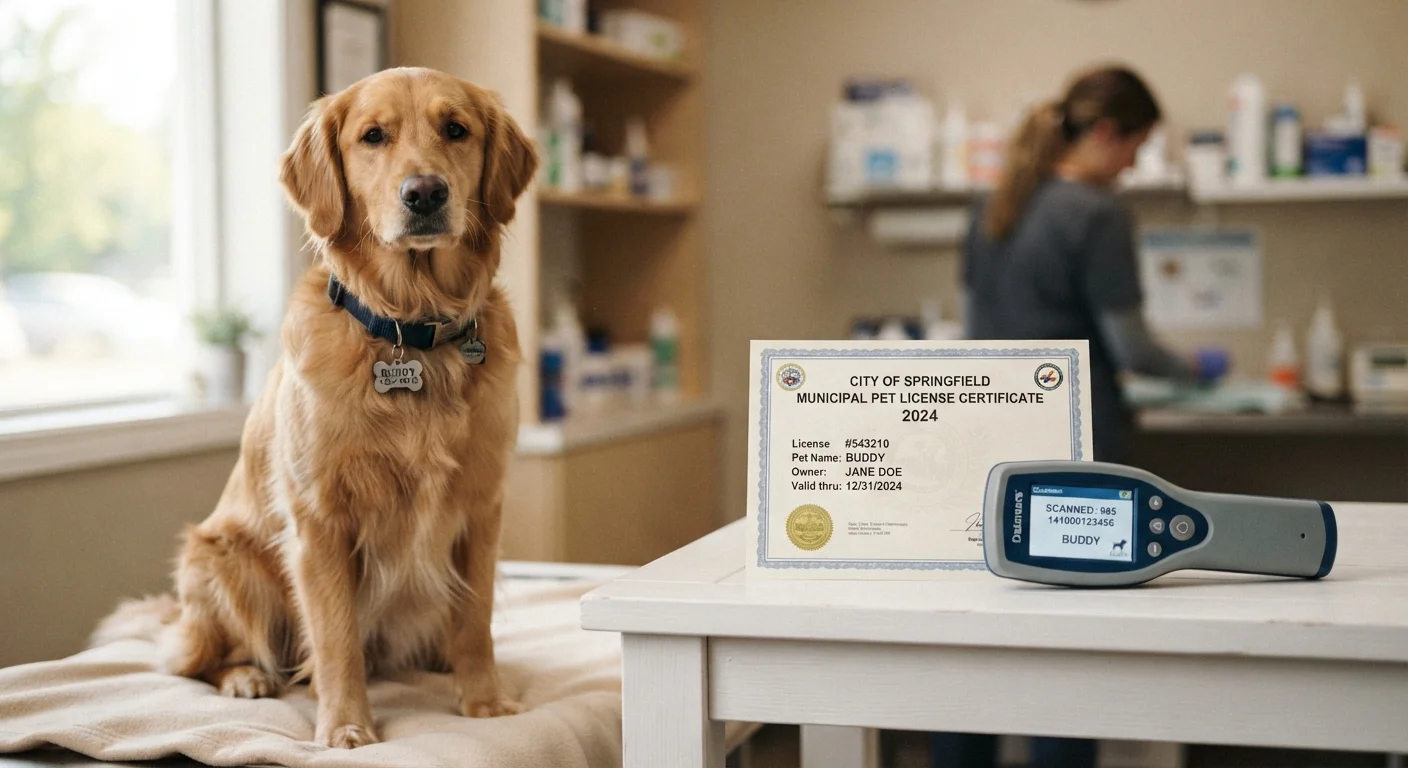
Most U.S. cities and counties require dogs — and in some areas, cats — to be licensed annually with the local government. A pet license is typically issued by animal control or a local shelter and is tied directly to proof of rabies vaccination. Without a current vaccine record, a license generally cannot be issued.
License fees vary widely: some municipalities charge as little as $10–$15 per year, while others charge considerably more. Many jurisdictions offer reduced fees for spayed or neutered animals, senior pet owners, or service animals. Revenue from licensing fees commonly funds local animal control services and shelters.
When a licensed pet is picked up as a stray, animal control can contact the registered owner directly — often before the animal is moved to a shelter. Unlicensed pets face a higher risk of being held longer or, in some cases, not returned without penalty. Licensing requirements also apply to renters; for more on how pet rules interact with lease agreements, see navigating pet policies as a renter.
Pet License
A locally issued permit, typically renewed annually, that registers a pet with the municipal government. Usually requires proof of current rabies vaccination and is associated with a metal tag the pet must wear.
Microchip (RFID)
A small passive radio-frequency identification device implanted under a pet's skin that stores a unique ID number. It is read by a handheld scanner and linked to owner information in a recovery database.
Rabies Tag
A metal tag issued by a licensed veterinarian at the time of rabies vaccination. It typically displays a serial number and the year of vaccination, serving as public proof of immunization.
Animal Control
A local government agency responsible for enforcing animal-related ordinances, managing stray animals, and operating or coordinating with shelters. They are often the entity that issues pet licenses.
Pet Recovery Database
A registry — operated by private organizations or shelters — that links a microchip's unique ID number to the owner's current contact information. Keeping this record updated is the owner's responsibility.
Breed-Specific Legislation (BSL)
Local or state laws that restrict or ban ownership of specific dog breeds, typically based on perceived public safety risk. Enforcement and definitions vary significantly by jurisdiction.
Microchipping: Permanent Identification Explained
A microchip is a passive radio-frequency identification (RFID) device, roughly the size of a grain of rice, implanted beneath a pet's skin — typically between the shoulder blades. It does not use a battery or transmit actively. Instead, a handheld scanner passes radio waves over the chip, which responds with a unique identification number.
That number is linked to owner contact information in a pet recovery database. The chip itself stores only the ID number — the database holds the actual contact details. This is a critical distinction: a microchip provides no benefit if the owner's information is not registered, or if records become outdated after a move or phone change.
Microchipping is now mandatory for dogs in several U.S. states and many municipalities, and is standard practice recommended by veterinary organizations including the American Veterinary Medical Association (AVMA). Unlike a collar and tag, a microchip cannot fall off or be removed unintentionally, making it a reliable form of permanent identification.
Note: Microchip implantation is a veterinary procedure. Discuss timing, cost, and any pet-specific considerations with your veterinarian.
ID Tags, Rabies Tags, and What They Each Communicate
Physical tags attached to a collar remain the fastest form of identification for a found animal. Most jurisdictions require dogs to wear a current rabies vaccination tag in public — this tag is issued by the veterinarian at the time of vaccination and typically displays a tag number, the year of vaccination, and the clinic's information.
In addition to the rabies tag, a personal ID tag engraved with the pet's name and owner contact information dramatically increases the chance of a quick reunion if a pet goes missing. Some owners also include a secondary phone number or city, particularly if they travel with their pet.
Keep in mind that tags complement — rather than replace — microchipping. A collar can be removed or lost; a microchip cannot. For a broader look at the missteps new owners commonly make around identification and beyond, see common new pet owner mistakes.
Keep Your Database Records Current
A microchip is only as useful as the contact information linked to it. If you move, change your phone number, or transfer ownership of a pet, update the record with your chip's registry immediately. Most national databases allow updates online for a small fee or no cost at all. Failing to update is one of the most common reasons microchipped pets are not reunited with their owners.
Exotic and Non-Traditional Pets: Additional Legal Layers
The licensing and registration framework described above applies primarily to dogs and cats. Owners of reptiles, birds, rabbits, ferrets, and other non-traditional animals face a different — and often more complex — legal landscape. Certain species may be prohibited outright under state wildlife laws or local ordinances, while others require permits or documentation proving legal acquisition.
Federal law also plays a role: the Endangered Species Act and the Convention on International Trade in Endangered Species (CITES) regulate the ownership and transport of protected wildlife and their offspring, even when bred in captivity. Anyone considering a non-standard pet should research applicable laws at the federal, state, and local level before acquiring an animal. The ethical and legal considerations around exotic pets are substantial and worth careful review.
Breed-specific legislation (BSL) adds another layer for some dog owners, restricting or banning certain breeds in specific municipalities. Understanding these rules before relocating with a pet is essential. For a detailed overview, see our article on how breed-specific legislation works.
The content on this site is for informational purposes only and is not a substitute for professional advice. Always consult a qualified professional for guidance specific to your situation.