

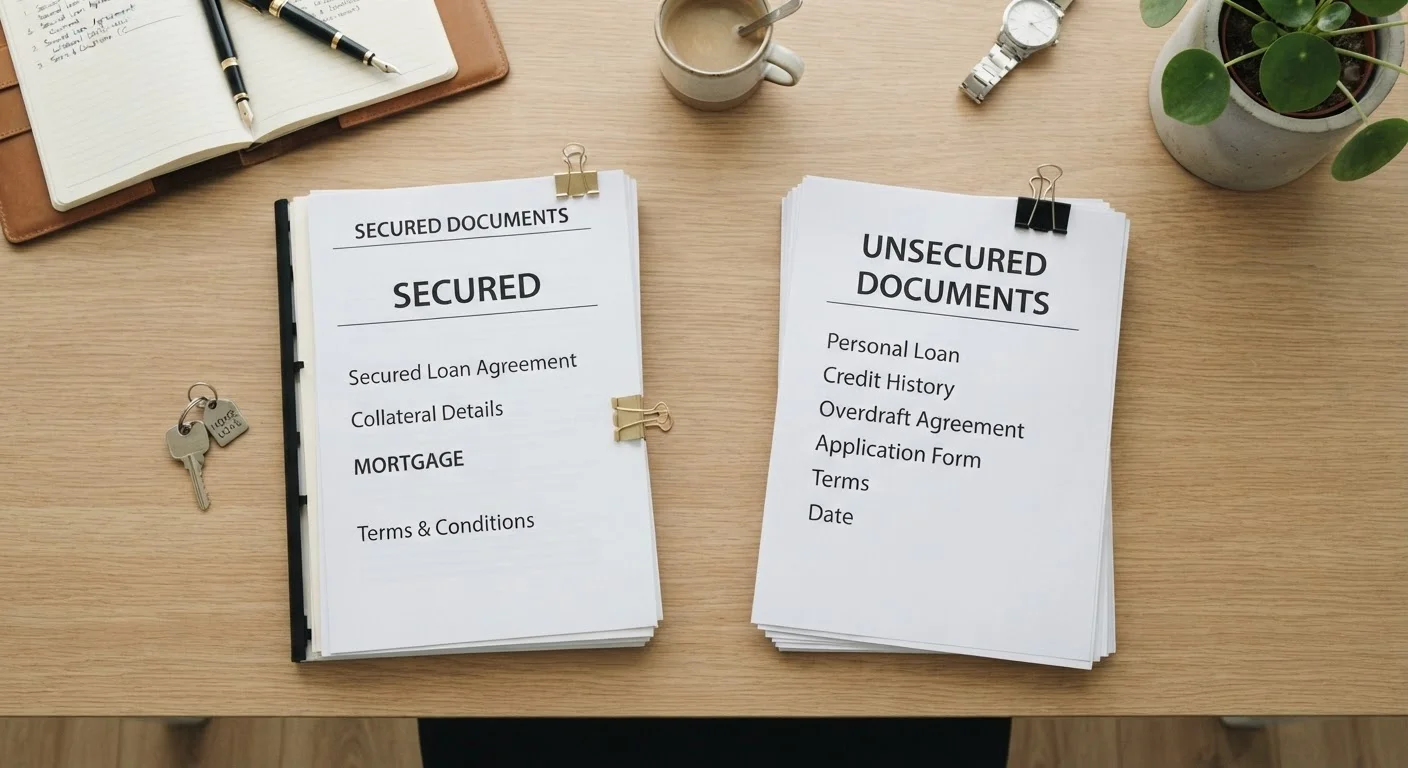
Option A
Secured Debt
The collateral-backed borrowing arrangement.
Best for: Borrowers seeking lower interest rates who are comfortable pledging an asset — such as a home or vehicle — as collateral.
Option B
Unsecured Debt
The promise-based borrowing arrangement.
Best for: Borrowers who need flexible credit without pledging assets, and who qualify based primarily on creditworthiness.
What Makes a Debt 'Secured' or 'Unsecured'?
The single most important structural distinction in consumer borrowing is whether a loan is secured or unsecured. The difference shapes your interest rate, your lender's recourse if you default, and the stakes you carry as a borrower.
A secured debt is tied to a specific asset — called collateral — that the lender has a legal claim on. If you stop making payments, the lender can repossess or foreclose on that asset to recover what it is owed. Common examples include mortgages (where the home is the collateral) and auto loans (where the vehicle secures the loan).
An unsecured debt is backed solely by your promise to repay and your creditworthiness at the time you applied. No single asset is pledged. Credit cards, most personal loans, medical bills, and student loans (in most cases) are unsecured. If you default, the lender cannot immediately claim property — instead, it typically pursues collections, reports the delinquency to credit bureaus, or sues for a court judgment.
Before diving deeper, it helps to have solid footing on core terminology. Our plain-language debt and credit glossary covers essential terms like APR, charge-off, and delinquency.
| Criterion | Secured Debt | Unsecured Debt |
|---|---|---|
| Collateral required | Yes — asset pledged to lender | No — creditworthiness only |
| Typical interest rate | Generally lower | Generally higher |
| Common examples | Mortgage, auto loan, HELOC | Credit card, personal loan, medical bill |
| Default consequence | Repossession or foreclosure | Collections, credit damage, possible judgment |
| Lender's primary recourse | Seize and sell collateral | Sue for judgment; garnish wages or accounts |
| Typical loan amounts | Larger (often tens of thousands+) | Smaller to mid-range |
| Credit score impact on default | Severe, plus asset loss | Severe, no direct asset loss |
Risk, Rates, and Consequences of Default
The collateral requirement in secured debt is not just a formality — it fundamentally changes the risk equation for both parties.
~7–10%
Typical unsecured personal loan APR spread over mortgages
Federal Reserve consumer credit data consistently shows unsecured personal loan rates averaging significantly above secured mortgage rates for similar credit profiles.
1 in 5
US adults carrying past-due unsecured debt
The Consumer Financial Protection Bureau has reported that a significant share of American adults have had a debt in collections at some point, the majority being unsecured obligations.
Because lenders on secured loans can recover value by seizing and selling the collateral, they accept lower interest rates. Mortgages, for example, routinely carry rates well below those of unsecured personal loans or credit cards for the same borrower. This makes secured debt a cost-efficient tool when the underlying asset is something you genuinely need and plan to maintain.
The downside is direct and serious: defaulting on a secured debt puts the collateral itself at risk. Miss enough mortgage payments and you face foreclosure. Fall behind on your car loan and the vehicle may be repossessed — often without prior court action, depending on your state.
With unsecured debt, there is no immediate asset on the line, but that does not mean consequences are mild. Default triggers late fees, sharply elevated interest (in the case of credit cards), negative credit bureau reporting, and potentially a lawsuit resulting in wage garnishment or bank account levies if a judgment is obtained. The absence of collateral shifts the risk timeline — it is slower, but it compounds. Borrowers who carry balances across many unsecured accounts can find themselves overwhelmed; our article on why responsible borrowers still end up in deep debt explores how that pattern develops.
How Debt Type Affects Your Repayment Strategy
Recognising which of your debts are secured versus unsecured should inform how you prioritise repayment. The general principle is that secured debts protecting essential assets — your home, your primary vehicle — warrant priority because the consequence of default is immediate and tangible.
High-interest unsecured debt, especially revolving credit card balances, often carries the heaviest long-term cost and deserves aggressive attention once secured obligations are current. Structured payoff methods can help here — the debt snowball and avalanche comparison outlines two evidence-backed approaches and which personality types tend to benefit from each.
If you are holding multiple debt types and considering simplification, debt consolidation can restructure unsecured balances into a single payment — but it does not erase the underlying obligation, and it does not always reduce total cost. Evaluate it carefully.
Building durable habits around both types of debt — staying current on secured loans, keeping unsecured utilisation low, and avoiding new obligations without a clear repayment plan — is the foundation of long-term credit health. For practical principles, see our guide on responsible borrowing habits that hold up over time.
This article is for general informational and educational purposes only and does not constitute personalised financial, legal, or investment advice. Consult a qualified financial professional for guidance specific to your situation.
The content on this site is for informational purposes only and is not a substitute for professional advice. Always consult a qualified professional for guidance specific to your situation.