

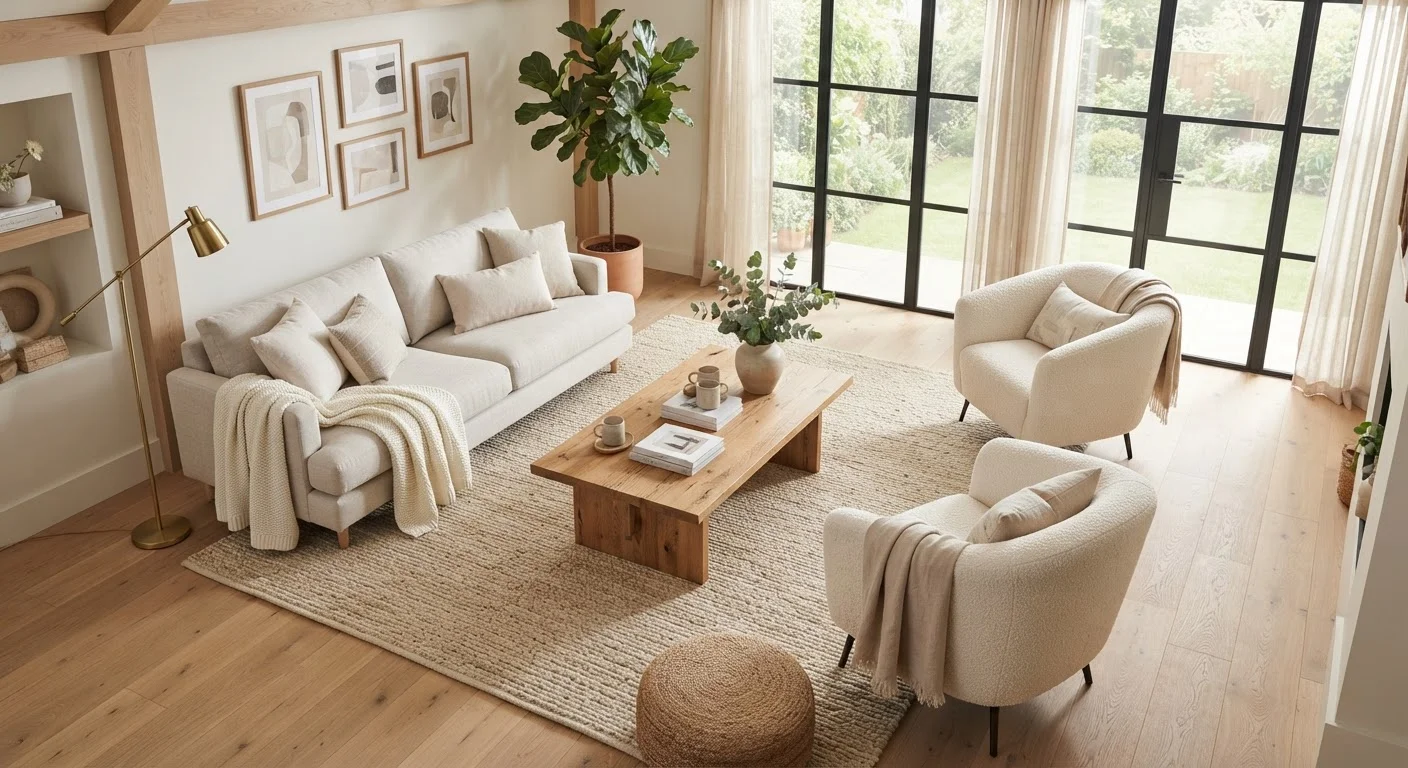
Why Rug Size Is a Design Fundamental
Walk into a room with an undersized rug — the kind where the furniture floats around a small island of pattern — and something feels immediately off, even if you can't name it. Scale is the culprit. A rug that barely covers the space beneath a coffee table doesn't anchor anything; it just adds a spot of color.
The foundational rule: a rug should be large enough to sit beneath the primary furniture grouping, visually tying those pieces into a unified zone. This is what designers mean when they call a rug a room anchor. Understanding this principle connects directly to the broader ideas explored in our guide to core design principles — specifically, how scale and proportion shape the way a space feels.
5x8
Most common too-small rug size bought for living rooms
Interior designers widely note that the 5x8 rug is frequently purchased for spaces that require at least an 8x10 to properly anchor a standard seating arrangement.
24 inches
Minimum rug overhang needed on each side of dining table
This is a broadly accepted rule of thumb in interior design guidance, ensuring chairs remain on the rug when pulled out during use.
18 inches
Ideal floor border between rug edge and wall
Leaving roughly 18 inches of exposed flooring around the perimeter of a rug is a commonly recommended proportion for standard-sized rooms.
Sizing by Room Type
Living Rooms
For most living rooms, an 8x10 or 9x12 rug is the appropriate starting point. The practical test: all front legs of major seating — sofa, chairs, loveseat — should rest on the rug. This connects the furniture visually without requiring wall-to-wall coverage. If the room is large enough to fit all legs on comfortably, that's even better.
Dining Rooms
Here the sizing rule is non-negotiable: the rug must extend at least 24 inches beyond every side of the table so that chairs remain fully on the rug when pulled out. A chair that scrapes off the rug edge as someone sits down defeats the purpose and wears the rug unevenly.
Bedrooms
The two most common approaches: a large rug (ideally 9x12 or larger) that extends roughly 18–24 inches beyond the sides and foot of the bed, or two matching runners placed on either side. Both work — the key is that bare floor shouldn't dominate the visible space around the bed.
Test Before You Buy
Use painter's tape on your floor to outline the exact dimensions of any rug you're considering. Arrange your furniture as normal and live with the taped outline for at least a day. This low-cost step reveals sizing and positioning issues before you commit to a purchase.
Placement and Positioning
Centering a rug in a room's geometric middle is rarely the right move. Instead, position it to align with the furniture arrangement, not the room's walls. In an open-plan space, a rug defines the living zone by sitting under the seating group, separate from the dining zone which has its own rug.
Leave a consistent border of bare floor visible around the rug — typically 12 to 18 inches from the walls. This breathing room makes the rug look intentional rather than like it almost fit. In smaller spaces, this approach also reinforces the illusion of proportion, a topic covered in depth in our furniture arrangement strategies for small spaces.
Layering Rugs: The How and the Why
Layering rugs — placing a smaller, more decorative rug on top of a larger base rug — has moved from designer shorthand into mainstream home decorating for good reason. It adds texture, depth, and personality while letting you introduce pattern without committing a whole floor area to it.
The formula that works reliably: start with a large, low-texture neutral — jute, sisal, a flatweave wool — as your base layer. The base rug should be the anchor rug for the room, sized per the rules above. Then layer a smaller, more expressive rug on top: a vintage-style kilim, a Moroccan shag, or a bold geometric. Keep the bottom layer visible by at least 12–18 inches on all sides.
Avoid layering two rugs of similar size, similar pile height, or competing patterns. One should recede while the other draws the eye. A rug pad between the two layers prevents bunching and makes the combination safer underfoot.
Rug Pads Are Not Optional
A quality rug pad serves multiple purposes: it prevents the rug from slipping, adds cushioning, and protects the floor beneath. For layered rugs, a thin non-slip pad between the two layers keeps them from bunching or shifting underfoot. Most flooring professionals recommend pads for all area rugs, regardless of the floor type beneath.
Frequently Asked Questions
An 8x10 or 9x12 rug suits most standard living rooms. The goal is to have at least the front legs of every major seating piece resting on the rug. Always measure your furniture footprint first and work outward from there.
Not necessarily — it depends on rug size and room scale. The most widely recommended approach places front legs on the rug for sofas and chairs, which connects the furniture to the rug without requiring an oversized piece. All legs on is ideal if your rug is large enough.
At least 24 inches on every side, so chairs remain on the rug when pulled out. A round table typically works well with a round rug; rectangular tables pair with rectangular rugs of similar proportion.
Yes. A flat-weave or low-pile rug layered over carpet can define a zone and add visual interest. Use a rug pad or rug-on-carpet gripper to prevent shifting and buckling.
Use painter's tape on the floor to outline the proposed rug dimensions. Live with it for a day or two before purchasing — this simple trick reveals whether the scale feels right with your actual furniture in place.
Start with a large, low-texture neutral rug as your base — jute and flatweave styles work well. Layer a smaller, patterned rug on top at an angle or centered. Keep the bottom layer at least 12–18 inches larger on all sides so both rugs are clearly visible.
The content on this site is for informational purposes only and is not a substitute for professional advice. Always consult a qualified professional for guidance specific to your situation.