

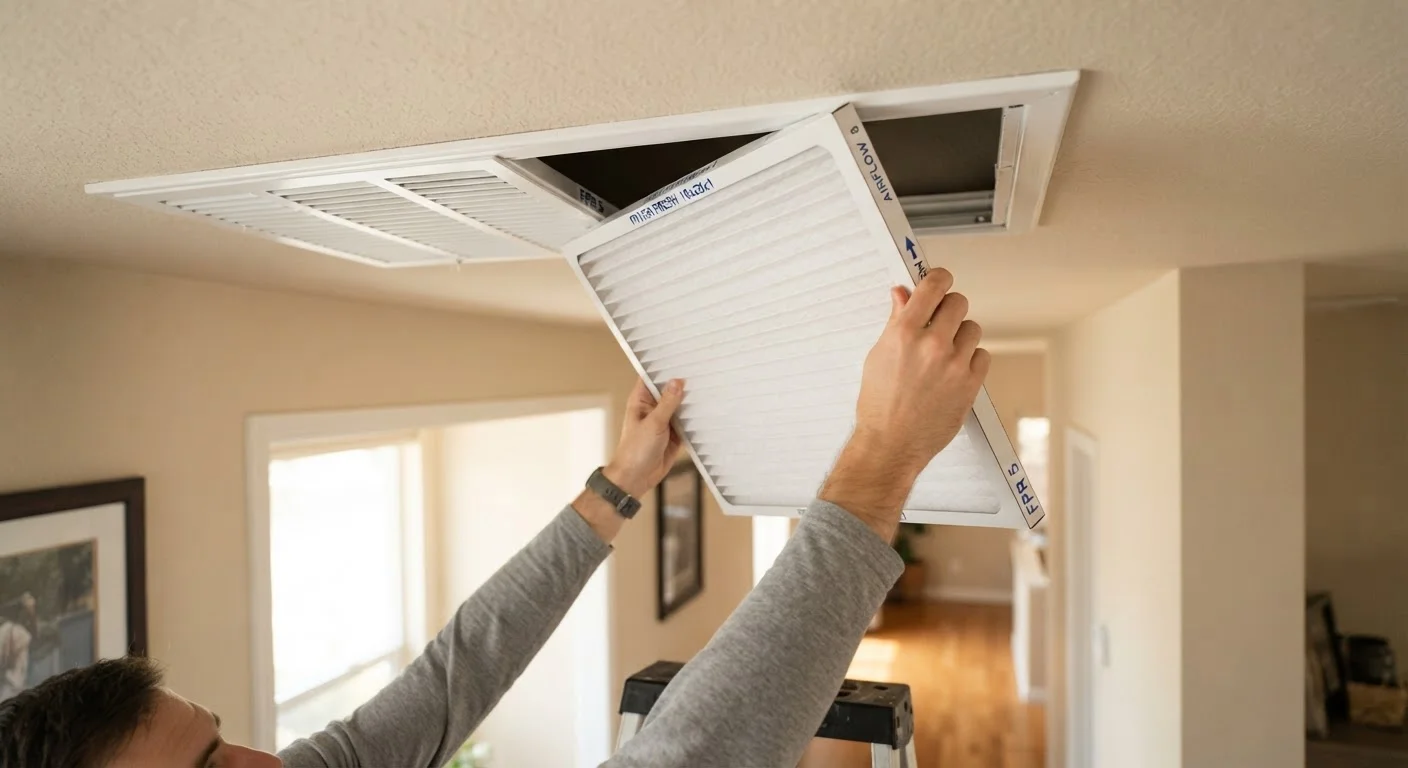
HVAC Filter Types and What They Do
Your HVAC system's filter is the first line of defense against dust, allergens, and airborne particles that would otherwise circulate through your home and coat internal components. Not all filters perform equally — understanding the main types helps you choose appropriately for your household.
MERV Rating
Minimum Efficiency Reporting Value — a standardized scale (1–20) measuring how effectively a filter captures airborne particles. Higher numbers capture smaller particles. Residential systems typically use filters rated MERV 4–13.
Static Pressure
The resistance to airflow within an HVAC duct system. A clogged filter or too many closed vents increases static pressure, which forces the blower motor to work harder and can reduce system lifespan.
Return Vent
An opening in the wall or ceiling that pulls air from rooms back to the air handler for filtering and reconditioning. Return vents should remain unobstructed to maintain balanced airflow.
Evaporator Coil
A component inside the air handler that absorbs heat from indoor air, cooling it before the air is distributed through the home. Dirty coils reduce cooling efficiency and can cause the system to freeze up.
Condensate Drain
A line that removes moisture extracted from indoor air during the cooling process. A blocked condensate drain can cause water backup, leading to water damage or system shutdown.
- Fiberglass/panel filters: The most basic option. Low cost, low resistance to airflow, and minimal particle capture. Generally suitable only where air quality is not a concern and systems require low static pressure.
- Pleated filters: Made from polyester or cotton paper, these offer a significantly larger surface area than flat filters and capture smaller particles including mold spores and pet dander. A common choice for most households.
- HEPA filters: High-Efficiency Particulate Air filters capture 99.97% of particles 0.3 microns or larger. However, most residential HVAC systems are not designed to handle the airflow restriction a true HEPA filter creates — check your system specifications before using one.
- Electrostatic filters: Use static charge to attract particles. Available in washable and disposable varieties. Washable versions reduce waste but require thorough drying before reinstallation to prevent mold growth.
Filter efficiency is commonly rated using the MERV scale (1–16 for residential use). Most households do well with MERV 8–11. Higher ratings capture more particles but can restrict airflow in systems not engineered for them, potentially straining the blower motor over time.
Replacement Intervals and Practical Guidance
| Typical Filter Replacement (1-inch pleated) | Every 60–90 days |
| Recommended MERV Range (most homes) | MERV 8–11 |
| Professional Service Frequency | 1–2 times per year |
| Max Supply Vents to Close | 10–20% of total |
| Refrigerant Handling | Licensed technician only (federally regulated) |
General guidelines for filter replacement vary based on filter type, household size, pets, and local air quality. The following serve as starting points — you may need to adjust based on observation:
- 1-inch fiberglass or basic panel filters: Every 30 days
- 1-inch pleated filters: Every 60–90 days
- 3- to 4-inch thick media filters: Every 6–12 months
- Homes with pets or allergy sufferers: Check monthly; replace more frequently than the baseline recommendation
A quick visual check tells you a lot. If you hold the filter up to light and cannot see through it, it's time to replace it regardless of schedule. A clogged filter forces your system to work harder, raising energy consumption and accelerating wear. As part of a broader seasonal home maintenance routine, checking filters at the start of each heating and cooling season is a reliable habit.
When installing a new filter, confirm the arrow on the frame points toward the air handler (in the direction of airflow). An improperly oriented filter is significantly less effective.
Vents and Registers: Maintenance Basics
Supply vents deliver conditioned air into rooms; return vents draw air back to the system for reconditioning. Both deserve regular attention.
Don't Close Vents to Save Energy
Closing supply vents in unused rooms is a widely held but counterproductive habit. Forced-air systems are designed for a specific pressure balance, and closing vents can increase static pressure, strain the blower motor, and even cause duct leakage over time. If room-by-room temperature control is a priority, speak with an HVAC technician about zoning systems designed for that purpose.
- Vacuum vent covers seasonally using a brush attachment. Dust buildup on register fins reduces airflow and can be recirculated into the home.
- Do not block return vents with furniture, rugs, or curtains. Restricted return airflow creates negative pressure that can pull unconditioned air through gaps in the building envelope.
- Avoid closing more than 10–20% of supply vents in an attempt to redirect airflow. Forced-air systems are balanced for a specific static pressure; closing too many registers can damage the blower and create comfort problems in connected rooms.
- Listen for rattling or whistling near vents, which may indicate loose covers, debris in the duct, or airflow imbalance worth investigating.
Poor vent maintenance can contribute to moisture and air quality problems. Our guide on condensation, mould, and ventilation explains how inadequate airflow contributes to household moisture issues.
Professional Servicing: What's Included and How Often
While filter replacement and vent cleaning are straightforward DIY tasks, certain HVAC maintenance work requires a qualified technician. Industry guidance generally suggests a professional inspection at least once a year — ideally twice, once before the cooling season and once before heating season begins.
5–15%
Potential energy savings from a clean filter
The U.S. Department of Energy notes that replacing a clogged filter can lower an air conditioner's energy consumption by roughly 5–15%.
2x/year
Recommended professional HVAC inspections
HVAC industry guidance generally recommends one pre-cooling and one pre-heating inspection annually to keep systems running efficiently and catch issues early.
A typical professional HVAC tune-up generally covers:
- Inspecting and cleaning the evaporator and condenser coils
- Checking refrigerant levels and looking for leaks (refrigerant handling is regulated and must be performed by a certified technician)
- Testing electrical connections and capacitors
- Lubricating moving parts in the blower assembly
- Inspecting the condensate drain line for blockages
- Verifying thermostat calibration and system controls
Any work involving gas lines, electrical panels, refrigerant, or structural ductwork should always be carried out by a licensed professional. Common maintenance misconceptions — such as believing annual servicing is optional — often lead to larger repair bills down the road. Similarly, overlooked maintenance tasks like the condensate drain and blower belt are easy to defer until they cause a system shutdown. Scheduling professional service proactively keeps those risks low.
This article is for general informational purposes only. Always consult a licensed HVAC professional for work involving electrical systems, refrigerant, gas lines, or any task beyond basic filter replacement. Verify local permit and code requirements before undertaking any HVAC-related project.
The content on this site is for informational purposes only and is not a substitute for professional advice. Always consult a qualified professional for guidance specific to your situation.