

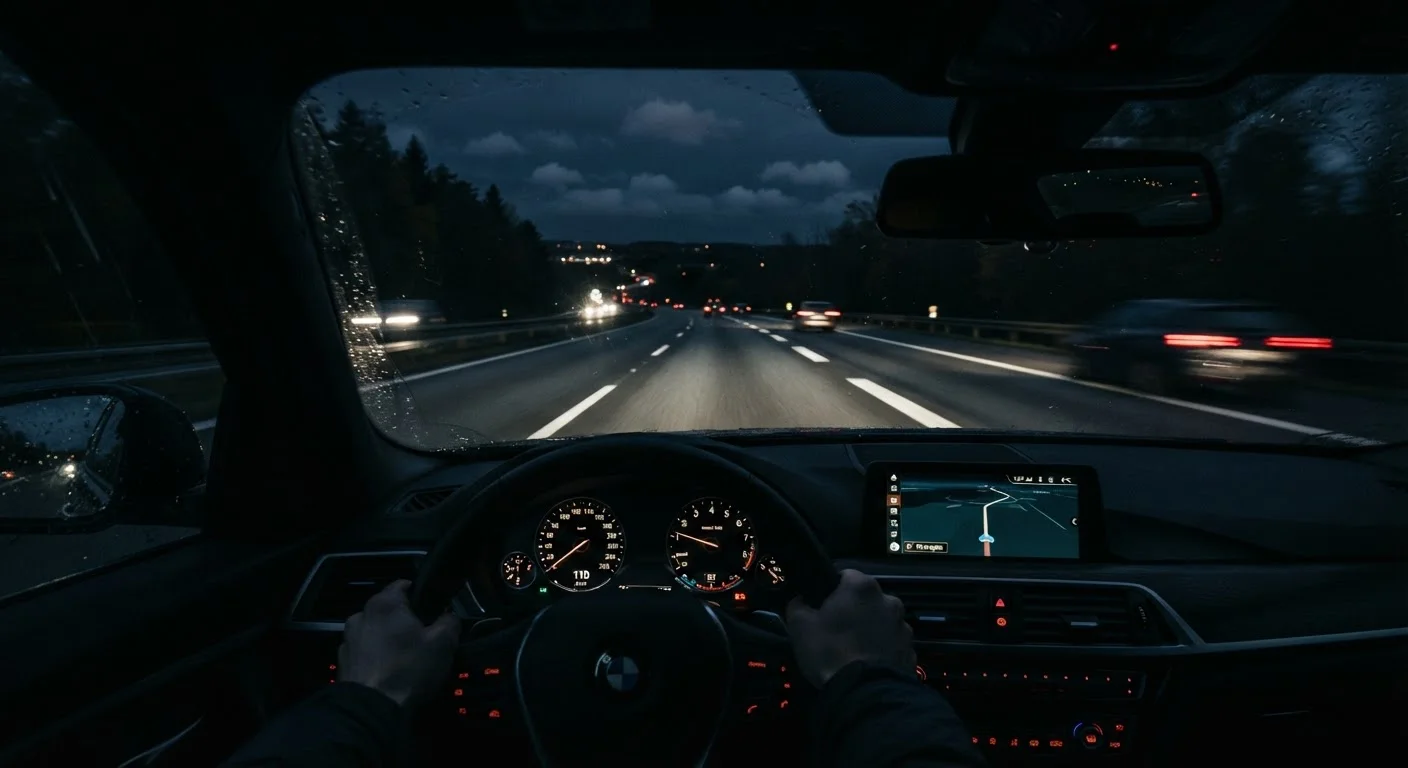
Why Night Driving Is Statistically More Dangerous
Roughly a quarter of all driving happens after dark, yet nighttime accounts for nearly half of all traffic fatalities in the United States, according to the National Highway Traffic Safety Administration. The reasons are layered: reduced ambient light shrinks the window between spotting a hazard and having enough road to react. Even high beams typically illuminate only 300–400 feet ahead, while stopping distances at highway speeds can approach or exceed that range.
Pedestrians, cyclists, and animals are far harder to detect at night, particularly on unlit rural roads. Peripheral vision — already weaker than central vision — degrades further in low-light conditions. Drivers who feel confident because a road is familiar should be aware that familiarity can breed complacency; see our related piece on why experienced drivers still have accidents.
~50%
Share of traffic fatalities occurring at night
The NHTSA reports that nighttime hours account for roughly half of all traffic deaths despite representing about 25% of driving time.
300–400 ft
Typical high-beam illumination range
Standard vehicle high beams illuminate approximately 300–400 feet ahead, while stopping distance at highway speeds can approach that range.
Best Practices for Safer After-Dark Driving
The following practices address the most commonly overlooked aspects of night driving — from vehicle preparation to in-the-moment decisions behind the wheel.
Clean your headlight lenses and aim them correctly before long night drives.
Yellowed or fogged plastic lenses can cut effective light output by more than half. Incorrectly aimed headlights — a common result of worn suspension components — can blind oncoming drivers while leaving your own road ahead underlit.
Use high beams actively on unlit roads, and dim them promptly for oncoming traffic.
Many drivers default to low beams even on dark rural roads where high beams are legal and appropriate. High beams roughly double visible stopping distance, giving you more time to react to animals, debris, or pedestrians.
Increase your following distance to at least four seconds in the dark.
The standard three-second following distance assumes daytime visibility. At night, hazards appear later, so the extra buffer is necessary to maintain the same effective reaction margin.
Dim your dashboard and disable interior lights before night driving begins.
Bright instrument panels and overhead dome lights constrict your pupils and undermine dark adaptation, reducing how much you can see outside the vehicle. The human eye needs 20–30 minutes to fully adapt to darkness, and bright interior light resets that process.
Reduce speed to match actual headlight range, not the posted limit.
Speed limits are set for optimal conditions. At night on an unlit road, driving at the daytime limit may mean you cannot stop within the distance your headlights illuminate — a concept sometimes called 'overdriving your headlights.'
Avoid looking directly at oncoming headlights — shift your gaze to the right edge of the road.
Staring at bright oncoming lights triggers temporary flash blindness lasting several seconds. Glancing toward the right road edge maintains your lane position without the recovery time.
Fatigue: The Invisible Night-Driving Hazard
Darkness and the body's circadian rhythm work against each other. Melatonin production increases after sunset, naturally pushing the body toward sleep — a process that doesn't pause because you're behind a wheel. The warning signs of fatigue are subtle at first: heavier eyelids, micro-drifts within the lane, missing an exit you know well, or difficulty recalling the last few miles driven.
Recognize Fatigue Early — Don't Bargain With It
If you notice yourself drifting within your lane, missing road signs you know well, or struggling to keep your eyes open, these are urgent signals — not minor inconveniences. The safest response is to pull off safely and rest, even briefly. Turning up the radio or rolling down a window provides only fleeting relief and does not restore driving ability.
Fatigue impairs reaction time and judgment in ways that closely parallel alcohol impairment. If you plan extended after-dark travel, our in-depth look at the hidden dangers of drowsy driving outlines specific warning signs and mitigation strategies. For a balanced view of the trade-offs involved in overnight road trips, see overnight driving: the real pros and cons.
Quick Wins You Can Apply Tonight
Not every safety improvement requires a trip to the mechanic. Several meaningful adjustments take less than a minute and make an immediate difference when driving in low-light conditions.
Night driving shares some characteristics with other low-visibility conditions. If rain, fog, or snow compound the darkness, the demands on a driver multiply — visit our guide on adjusting your habits for rain, fog, and snow for condition-specific techniques.
The content on this site is for informational purposes only and is not a substitute for professional advice. Always consult a qualified professional for guidance specific to your situation.