

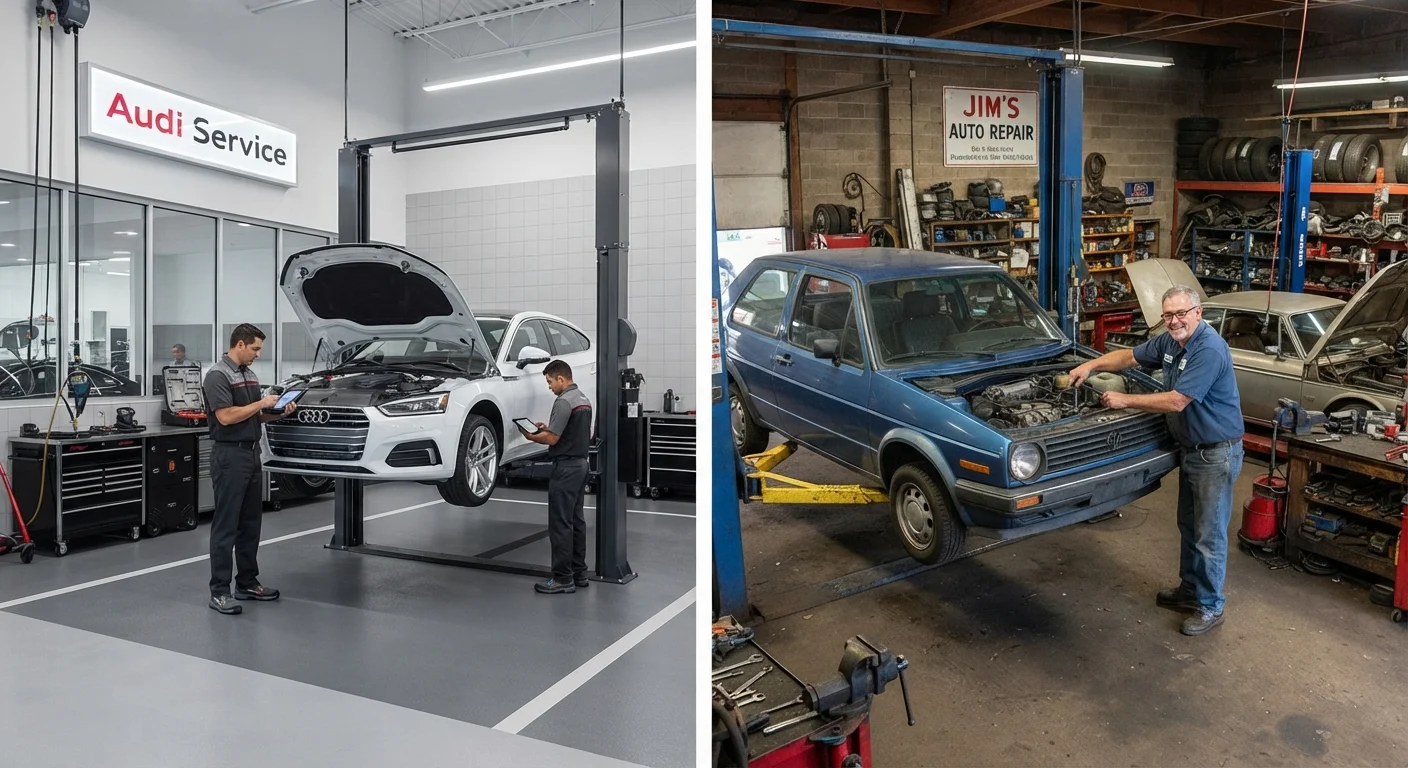
Option A
Authorized Dealer Service
The manufacturer-backed, factory-trained option.
Best for: Owners with newer vehicles under warranty, complex diagnostics, or brand-specific software needs.
Option B
Independent Garage
The flexible, often cost-effective alternative.
Best for: Owners of older or out-of-warranty vehicles seeking competitive labor rates and personalized service.
Understanding the Core Difference
When your vehicle needs service, the two primary options — an authorized dealership and an independent garage — operate under very different business models. Understanding those differences helps you make a decision grounded in your vehicle's specific needs rather than habit or assumption.
Authorized dealers are franchised by a vehicle manufacturer. Their technicians receive factory training, they stock or have direct access to OEM (Original Equipment Manufacturer) parts, and they use brand-specific diagnostic software that connects directly to a vehicle's onboard systems. Independent garages, by contrast, are privately owned businesses not affiliated with any manufacturer. They typically service multiple makes and models, source parts from a range of suppliers, and use aftermarket or multi-brand diagnostic tools.
Neither model is inherently superior. The right choice depends on your vehicle's age, complexity, warranty status, and the nature of the work needed. For a deeper look at how maintenance schedules factor into this decision, see vehicle maintenance intervals every driver should know.
| Criterion | Authorized Dealer | Independent Garage |
|---|---|---|
| Technician training | Factory-trained, brand-specific | ASE-certified, multi-brand experience |
| Diagnostic tools | Proprietary OEM software | Aftermarket or multi-platform tools |
| Parts sourcing | OEM parts standard | OEM or aftermarket options |
| Labor rates | Generally higher | Generally lower |
| Warranty work & recalls | Required for recalls; simplifies warranty claims | Cannot perform recall work |
| EV/hybrid system support | High-voltage certified staff common | Varies; may lack specialized certification |
| Scheduling flexibility | Structured, may have longer wait times | Often more flexible and personal |
Warranty, Costs, and Legal Protections
One of the most persistent misconceptions among car owners is that using an independent shop automatically voids a manufacturer's warranty. Under the Magnuson-Moss Warranty Act, a federal US law, manufacturers generally cannot void a warranty simply because an owner had their vehicle serviced somewhere other than a dealership — provided the work was performed correctly and appropriate parts were used. There are exceptions, particularly for damage directly caused by improper service, so it's worth understanding your specific warranty terms.
Cost is where independent garages often hold a clear advantage. Labor rates at dealerships tend to be higher, partly reflecting facility overhead and specialized technician training. Independent shops generally have lower rates, and because they can source parts from multiple suppliers, there may be more flexibility on parts cost as well. That said, using non-OEM parts on a vehicle still under warranty warrants caution — document everything carefully.
~30–40%
Typical labor rate difference
Industry estimates generally suggest independent shops charge 30–40% less per labor hour than franchised dealerships, though this varies significantly by region and vehicle type.
2 in 3
Owners who use independent shops
Consumer research has consistently found that the majority of US vehicle owners use independent garages for at least some of their routine maintenance needs.
For owners weighing the broader financial picture of car ownership, the complete picture of long-term car ownership covers how servicing decisions fit into overall vehicle costs across a car's lifespan.
When Dealer Access Genuinely Matters
There are scenarios where a dealership's resources are not just convenient but practically necessary. Modern vehicles — particularly electric vehicles, plug-in hybrids, and cars with advanced driver-assistance systems (ADAS) — rely heavily on proprietary software. Calibrating a front-facing camera after a windshield replacement, updating transmission control modules, or diagnosing faults in a high-voltage battery system often requires manufacturer-specific tools that independent shops may not have access to.
Recall repairs are another clear-cut case: these must always be performed at an authorized dealership, at no cost to the owner. If your vehicle has an open recall, this is non-negotiable regardless of your usual service preference.
Owners of EVs or hybrids should also consider that the skill set and safety certifications required for high-voltage systems are more commonly concentrated at dealerships, at least for now. The ownership trade-offs across powertrain types article explores how maintenance demands differ meaningfully between fuel types.
Open Recalls Always Go to the Dealer
If your vehicle has an open safety recall, the repair must be completed at an authorized dealership — it cannot be performed at an independent shop. Recall repairs are provided at no cost to the owner under federal law. You can check for open recalls on your vehicle using the NHTSA (National Highway Traffic Safety Administration) VIN lookup tool at nhtsa.gov.
Evaluating Any Shop: What to Look For
Whether you're considering a dealership or an independent garage, the quality of the individual shop matters more than the category it belongs to. Look for ASE (Automotive Service Excellence) certification for independent technicians — it signals demonstrated competence across standardized areas of automotive repair. For dealers, factory certification programs serve a similar function.
Always ask for a written estimate before work begins, and request that any replaced parts be returned to you. A reputable shop — dealer or independent — will not hesitate to comply. Check for reviews, ask for referrals, and be wary of vague diagnostics or pressure to approve large repairs immediately without time to consider a second opinion.
Understanding the difference between planned upkeep and unplanned repairs also shapes how you approach the choice. The principles behind preventive maintenance versus reactive repairs apply directly to vehicle ownership: staying ahead of scheduled service reduces the likelihood of costly, unplanned work regardless of where you get it done.
This article is for general informational purposes only. Service requirements, warranty terms, and applicable laws vary by vehicle, manufacturer, and state. Always consult your vehicle's owner manual and, where appropriate, a qualified automotive professional before making servicing decisions.
The content on this site is for informational purposes only and is not a substitute for professional advice. Always consult a qualified professional for guidance specific to your situation.