

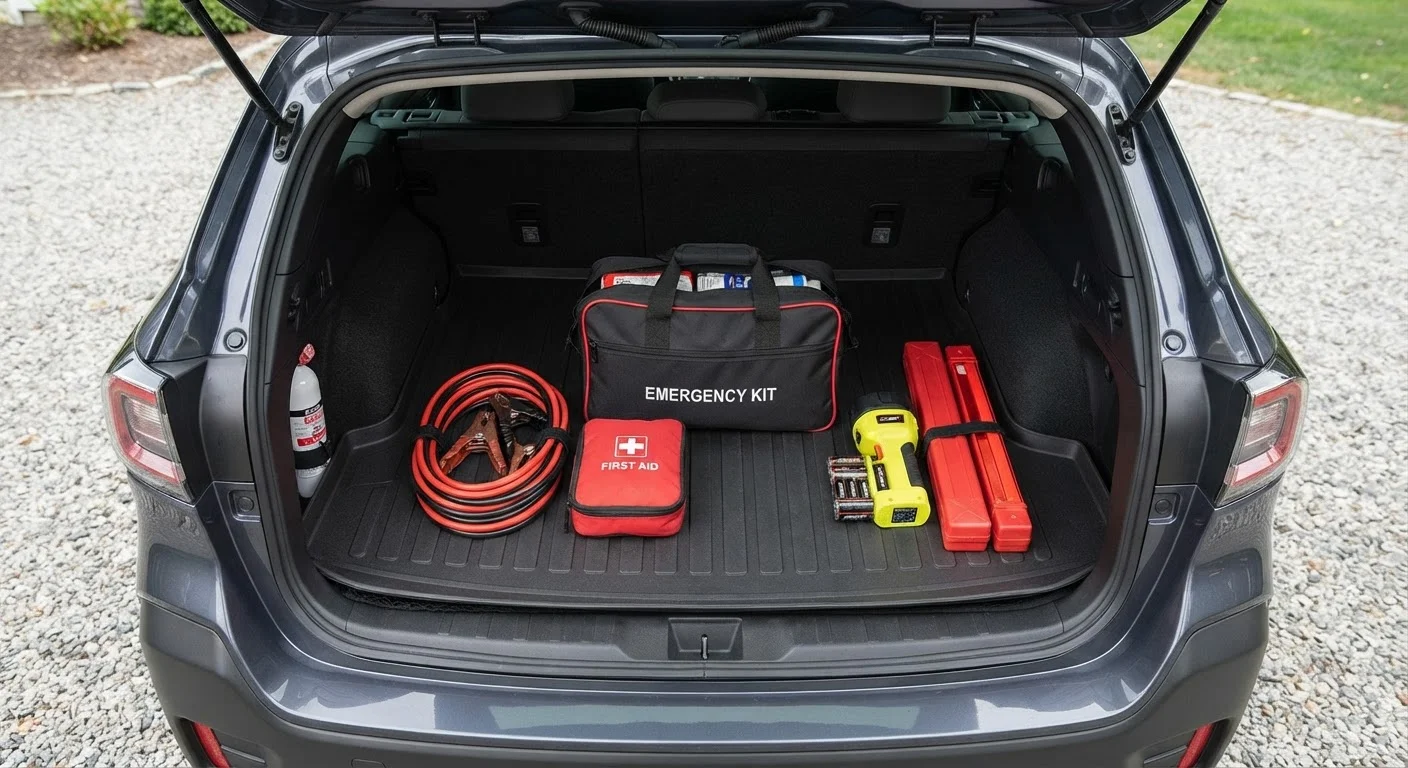
Why Most Drivers Underestimate This
The average American drives roughly 14,000 miles a year. Across that distance, a flat tire, dead battery, or minor collision is less a question of if and more a question of when. Yet most drivers head out with nothing more than a phone and a vague hope that roadside assistance will arrive quickly. Cellphone coverage is unreliable in rural areas, and wait times for roadside services can stretch well past an hour.
A properly stocked emergency kit doesn't need to be large or expensive — it needs to be targeted. The items below address the most common and most dangerous roadside situations: visibility failures, battery failures, tire failures, and injuries. If you're heading out on a longer drive, pair this list with a broader pre-trip check — our pre-trip vehicle checklist covers fluids, lights, and tire condition before you leave home.
Warning triangles or LED road flares
Visibility is your first priority after a breakdown. Warning triangles — the collapsible reflective type required in many countries — should be placed 100 to 300 feet behind your vehicle to alert approaching traffic, especially on high-speed roads. LED road flares are a durable, weather-resistant alternative that don't require replacement and are highly visible even in daylight. Carry at least three so you can create a proper warning sequence. This single item has the greatest potential to prevent a bad situation from becoming a fatal one.
Visibility is your first priority — warning triangles can prevent a breakdown from becoming a fatal collision.
Jumper cables or a portable jump starter
A dead battery is the most common reason drivers call for roadside assistance. A set of heavy-gauge jumper cables (at least 10 to 12 feet long, 4–6 gauge wire) lets you accept a jump from another vehicle. A lithium-ion portable jump starter is an even more self-sufficient option — compact enough to fit in a glovebox, capable of starting most passenger vehicles without a second car present. Whichever you carry, know how to use it correctly before you need it. If you're unfamiliar with your dashboard warning symbols that might indicate battery issues, reading your dashboard warning lights is a useful companion read.
A portable jump starter lets you restart most passenger vehicles without needing another car nearby.
Tire inflation kit or spare tire equipment
Many newer vehicles ship without a full-size spare, substituting either a compact spare (often called a "donut") or a tire inflation/sealant kit. Know which your vehicle has before you need it. If you carry a spare, also carry a lug wrench that actually fits your wheel nuts and a jack rated for your vehicle's weight — the ones supplied from the factory are often minimally adequate. A portable 12V tire inflator is worth adding regardless: it handles slow leaks and helps with pressure checks on the road. A tire pressure gauge costs almost nothing and takes up almost no space.
Know whether your vehicle has a spare or a sealant kit — and make sure your jack and lug wrench are actually compatible.
A compact first aid kit
Minor cuts, burns, and abrasions are common in roadside situations — from a slip while changing a tire to broken glass after a minor collision. A basic first aid kit should include adhesive bandages in multiple sizes, gauze pads, medical tape, antiseptic wipes, and nitrile gloves. Pre-assembled kits certified to standards such as ANSI/ISEA Z308.1 provide a reliable baseline. Keep the kit sealed in its original packaging until needed, and check expiration dates annually. This kit addresses minor injuries only — for anything beyond that, call emergency services immediately.
A pre-assembled, standards-compliant first aid kit addresses minor roadside injuries while you wait for further help.
A flashlight and extra batteries
Breakdowns don't respect daylight hours. A reliable flashlight — ideally LED for battery efficiency — lets you inspect your vehicle, signal for help, and work safely in the dark. A headlamp version keeps your hands free, which matters when you're connecting cables or changing a tire. Store fresh batteries separately to avoid corrosion damage to the flashlight body if it sits unused for months. Some drivers also keep a small, bright clip-on signal light that can be attached to clothing or the vehicle during roadside work.
A hands-free headlamp is worth choosing over a traditional flashlight when you need both hands for repairs.
Basic tools and utility items
A small set of hand tools covers a surprising range of minor fixes: a multi-bit screwdriver, an adjustable wrench, zip ties, duct tape, and a utility knife handle most quick roadside repairs. A pair of heavy work gloves protects your hands when handling hot engine components or sharp metal. Add a few feet of tow rope or a tow strap (rated for your vehicle's weight) if you regularly drive on unpaved or remote roads. A reflective safety vest — standard equipment in many countries — makes you far more visible to traffic when you're standing outside the vehicle.
Zip ties and duct tape have solved countless minor roadside problems that no specialized tool could fix.
Water, a phone charger, and a paper map
These three items are frequently overlooked but consistently prove their worth. A liter or two of water covers both drinking needs and minor cooling system top-offs (never open a hot radiator cap). A 12V or USB car charger — or a fully charged power bank — keeps your phone functional for navigation and emergency calls. And a paper map of your region matters precisely when GPS fails or cell service disappears. If you're planning a longer trip and want a full pre-departure framework, the road trip readiness checklist brings all of these threads together.
A paper map earns its place in any emergency kit the moment GPS signal disappears in a remote area.
Building the Kit — and Keeping It Ready
Once you've assembled these items, store them in a durable, waterproof bag or hard case in your trunk — ideally in a fixed spot so you can find things quickly under stress. A loose pile of gear rattling around is harder to use and easier to forget. Label the bag clearly if multiple people share the vehicle.
Tailor your kit to your driving patterns
A driver who commutes through a dense city has different needs than one who regularly covers long rural stretches. If you frequently drive remote highways, consider adding a larger water supply, a space blanket, and a whistle. Winter drivers in northern states should also include an ice scraper, a small snow shovel, and sand or cat litter for traction. Match the kit to where you actually drive, not just the average scenario.
Review the kit at least twice a year — many drivers tie this to daylight saving time changes. Check expiration dates on first aid supplies, test your flashlight batteries, and inspect jumper cables for cracked insulation. If you drive through genuine winter conditions, swap in cold-weather additions (warm layers, an ice scraper, traction aids) at the start of each cold season.
For a wider look at how roadside emergencies fit into the broader picture of handling things that go wrong mid-trip, the guide to breakdowns, detours, and weather covers decision-making and habits that keep disruptions manageable.
This article is for general informational purposes only. Always follow the safety instructions included with any emergency equipment, and seek professional roadside assistance when a situation exceeds your skill or safety margin.
The content on this site is for informational purposes only and is not a substitute for professional advice. Always consult a qualified professional for guidance specific to your situation.