

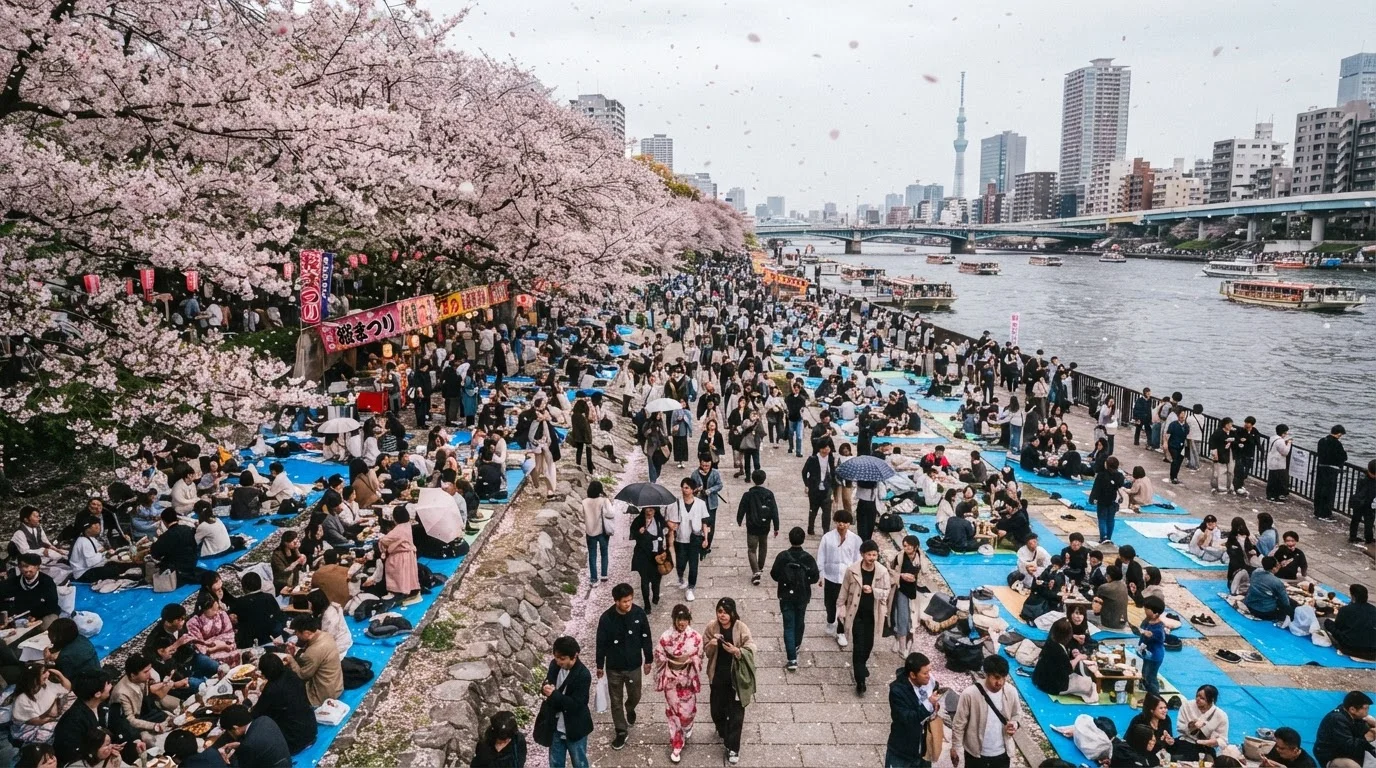
Why the Fantasy and the Reality Diverge
Japan's cherry blossom season — sakura — is one of the most photographed natural events on the planet. The images that flood social media every spring share a common aesthetic: near-empty pathways canopied in soft pink, a lone person in a yukata gazing serenely into the petals. That picture is largely fiction, or at minimum a product of a 4 a.m. alarm and serious photo-editing patience.
The gap between the Instagram fantasy and the lived experience causes real planning failures for travelers who've done their research on aesthetics rather than logistics. What follows are the myths worth examining before you commit flights and accommodation to one of travel's most logistically demanding seasons.
Myth
Cherry blossom season happens at roughly the same time every year, so you can book months ahead and rely on the dates.
Fact
Peak bloom timing shifts by one to two weeks or more depending on winter temperatures, and forecasts are only reliable within a week or two of the event.
Japan's Meteorological Corporation and various research groups track bloom predictions annually, and the data shows notable year-to-year variation. A warm winter can push Tokyo's peak into late March; a cold one may delay it into mid-April. Planning a trip around a fixed date you read in a blog post from a previous year is a genuine gamble. Monitor current-year forecasts as your travel window approaches and build flexibility into your itinerary wherever possible.
Myth
Peak bloom lasts for weeks, so there's plenty of time to see the blossoms.
Fact
Full bloom (mankai) typically lasts only 7–10 days, and a single rainy or windy stretch can strip the petals within 24–48 hours.
The window between first bloom and petal fall is remarkably short. Travelers who arrive expecting two or three leisurely weeks of sakura often find they've missed peak by days — or that an early spring storm ended it abruptly. Planning for the shoulder of the bloom, either just before or just after peak, can still be beautiful and considerably less pressured than chasing the exact peak days.
Myth
Cherry blossom season means warm spring weather — perfect for light layers and daytime picnics.
Fact
In many parts of Japan, blossom season coincides with cool, often wet weather. Temperatures in Tokyo during peak bloom frequently sit between 8°C and 16°C (46°F–61°F).
The iconic hanami (flower-viewing) picnic culture is real, but it happens under conditions that many international travelers don't anticipate. Evening gatherings under blooming trees can be genuinely cold. Rain is common. Packing a compact umbrella, a warm mid-layer, and waterproof footwear isn't overcaution — it's standard preparation for the season. Don't let the floral scenery fool you into packing for summer.
Myth
The famous spots — Philosopher's Path in Kyoto, Ueno Park in Tokyo — are the best places to see the blossoms.
Fact
These locations are extraordinarily crowded during peak season and may deliver a less enjoyable experience than lesser-known alternatives.
Ueno Park in Tokyo can draw tens of thousands of visitors on a peak weekend day. Navigating the crowds, finding a spot to sit, and actually appreciating the trees becomes secondary to the logistics of the crowd itself. Lesser-known spots — neighborhood rivers, temple grounds away from the main tourist corridors, regional parks — often feature the same or comparable blossom density with dramatically less congestion. Local tourism boards and city parks agencies typically publish bloom maps that include non-famous sites.
Myth
Sakura season is one unified national event — the whole country blooms at the same time.
Fact
The cherry blossom front moves northward across Japan over roughly three months, from Okinawa's January blooms to Hokkaido's late April or early May peak.
This geographic spread is one of sakura's most underused advantages for flexible travelers. If you miss peak in Kyoto, Tohoku may still be approaching its finest days. Hirosaki Castle in Aomori Prefecture, for instance, typically peaks in late April to early May — well after most travelers have left the main Honshu circuit. Building a northward itinerary around the moving bloom front is a genuinely strategic and rewarding approach to the season.
Planning Around the Real Sakura Experience
Understanding what cherry blossom season actually involves — rather than what it looks like online — changes how you plan entirely. If the crowds at Shinjuku Gyoen or Maruyama Park feel overwhelming, Japan's geography works in your favor: the sakura zensen (cherry blossom front) moves northward across the country over several weeks, meaning travelers who build flexibility into their itinerary can follow the bloom from Kyushu through Tohoku without fighting the same masses at every stop.
Smaller cities like Hirosaki, Kakunodate, and Yoshino often offer bloom experiences that rival anything in Tokyo or Kyoto with a fraction of the congestion. For those already planning a Tokyo stay, quieter neighbourhood parks and residential streets hold their own surprises during sakura season and rarely appear on any tour group's itinerary.
7–10 days
Typical duration of peak cherry blossom bloom
Japan's cherry blossom full bloom window is consistently brief, with petal fall accelerated by wind or rain — underscoring why timing flexibility matters.
~3 months
Span of sakura season across Japan nationally
From Okinawa's January blooms to Hokkaido's May peak, the national sakura season offers a much wider planning window than most travelers realize.
One underappreciated planning move: build in a buffer of at least two or three days on either side of forecast peak bloom. Bloom predictions, even from Japan's Meteorological Corporation, carry meaningful uncertainty. Travelers who schedule only a narrow window around a predicted date often arrive to bare branches or fallen petals. And if you're locking in non-refundable bookings for a high-stakes trip like this, it's worth revisiting what your travel insurance actually covers — policies vary widely on weather-related disruptions.
Ultimately, sakura season rewards patience, flexibility, and a willingness to wander beyond the obvious. The travelers who recall it most fondly are rarely those who ticked off the famous spots — they're the ones who stumbled onto a neighborhood canal lined with blossoms and stayed until the last light faded. For more on that approach to city travel, see our piece on why over-scheduling undermines what you actually see.
The content on this site is for informational purposes only and is not a substitute for professional advice. Always consult a qualified professional for guidance specific to your situation.