

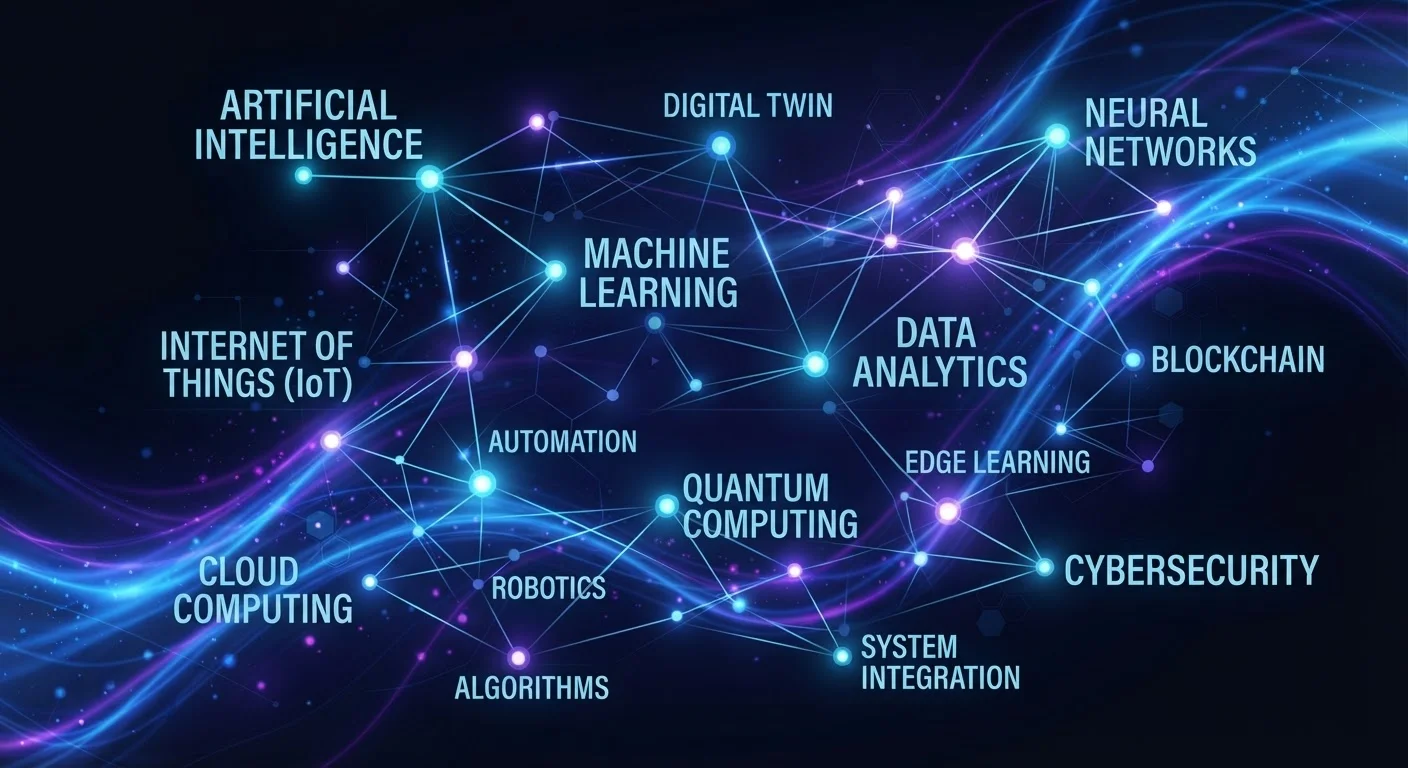
Why This Glossary Exists
Whether you're reading about artificial intelligence in the news, hearing about blockchain at work, or trying to follow a conversation about quantum computing, the vocabulary of emerging technology can feel like a foreign language. Terms get used interchangeably, explained poorly, or simply assumed as given.
This quick-reference guide cuts through that noise. Each definition below is written for a general audience — no CS degree required. Bookmark it, scan it before a meeting, or use it to verify something you half-remember hearing. For a similarly grounded approach to privacy-specific terms, see our privacy policy terminology guide.
Large Language Model (LLM)
A type of AI system trained on vast quantities of text to generate, summarize, translate, or answer questions in natural language. LLMs power tools like AI chatbots and writing assistants. They predict likely word sequences rather than 'understanding' language the way humans do.
Generative AI
A category of artificial intelligence that produces new content — text, images, audio, video, or code — rather than simply classifying or analyzing existing data. It learns patterns from training data and uses them to create novel outputs.
Edge Computing
Processing data locally on a device or nearby server rather than sending it to a distant cloud data center. This reduces latency (delay) and can improve privacy. Common in smart devices, autonomous vehicles, and industrial sensors.
Digital Twin
A virtual replica of a physical object, system, or process, updated in real time with data from the real-world counterpart. Engineers and planners use digital twins to simulate changes, predict failures, and test ideas before acting on the physical version.
API (Application Programming Interface)
A defined set of rules that lets one piece of software talk to another. When an app displays a map or processes a payment, it's typically communicating with another service through an API. Think of it as a standardized electrical outlet — different devices, same interface.
Blockchain
A distributed ledger that records transactions across many computers simultaneously, making records very difficult to alter after the fact. Best known as the underlying technology for cryptocurrencies, but also used in supply chain tracking and digital contracts.
Zero-Trust Security
A cybersecurity framework that assumes no user, device, or network is automatically trustworthy — even inside an organization's own systems. Every access request is verified continuously rather than once at login.
Federated Learning
A machine learning approach where a model is trained across many devices without transferring raw data to a central server. Each device trains locally and shares only model updates, helping preserve user privacy while still improving AI performance.
Quantum Computing
Computing that uses quantum-mechanical phenomena — such as superposition and entanglement — to process certain types of calculations exponentially faster than classical computers. Currently in an experimental phase; not yet in everyday consumer use.
Model Hallucination
When an AI system produces a confident-sounding response that is factually incorrect or entirely fabricated. It is a known limitation of LLMs and a key reason AI outputs require human review for accuracy-sensitive tasks.
Inference
The process by which a trained AI model generates a response or makes a prediction based on new input. 'Training' is how a model learns; 'inference' is the model doing its job in real time.
Latency
The time delay between sending a request and receiving a response in a digital system. Low latency is critical for applications like live video, gaming, autonomous vehicles, and real-time AI processing.
Context: Where These Terms Show Up
Understanding these terms matters because they increasingly shape decisions that affect everyday life — from how your data is used to how products are designed, how healthcare is delivered, and how financial systems operate.
| Number of LLM parameters (GPT-4, estimated) | ~1 trillion (Independent AI research estimates, widely reported) |
| Global IoT connected devices (projected) | Over 29 billion by 2030 (Statista, IoT market research) |
| Edge computing market size (global, 2023) | ~$61 billion (Grand View Research, 2024 report) |
| Generative AI adoption pace | Fastest-growing enterprise tech category in 2023–24 (McKinsey Global Survey on AI, 2024) |
| Model hallucination rate | Varies widely by task and model (Stanford HAI, AI Index Report 2024) |
Many of these concepts intersect. An LLM (large language model) might run on edge computing hardware and output results processed through an API. A digital twin of a factory might be trained on IoT sensor data. Understanding the vocabulary helps you see those connections. For a deeper look at how connected devices communicate and what they do, our IoT explainer guide is a solid companion resource.
Keeping your own devices secure in this landscape is equally important — our everyday device security guide covers practical steps in plain language. And if you want to explore other reference glossaries across topics, you'll find the same format applied to travel planning terms and debt and credit vocabulary across our site.
These Definitions Evolve Quickly
Emerging technology vocabulary is a moving target. Terms like 'AI agent' or 'multimodal model' may carry different meanings depending on the context or publication date. When precision matters — in a legal, financial, or medical setting — always verify the specific meaning intended by the source. This glossary reflects general, widely accepted usage rather than any single vendor's definition.
The content on this site is for informational purposes only and is not a substitute for professional advice. Always consult a qualified professional for guidance specific to your situation.