

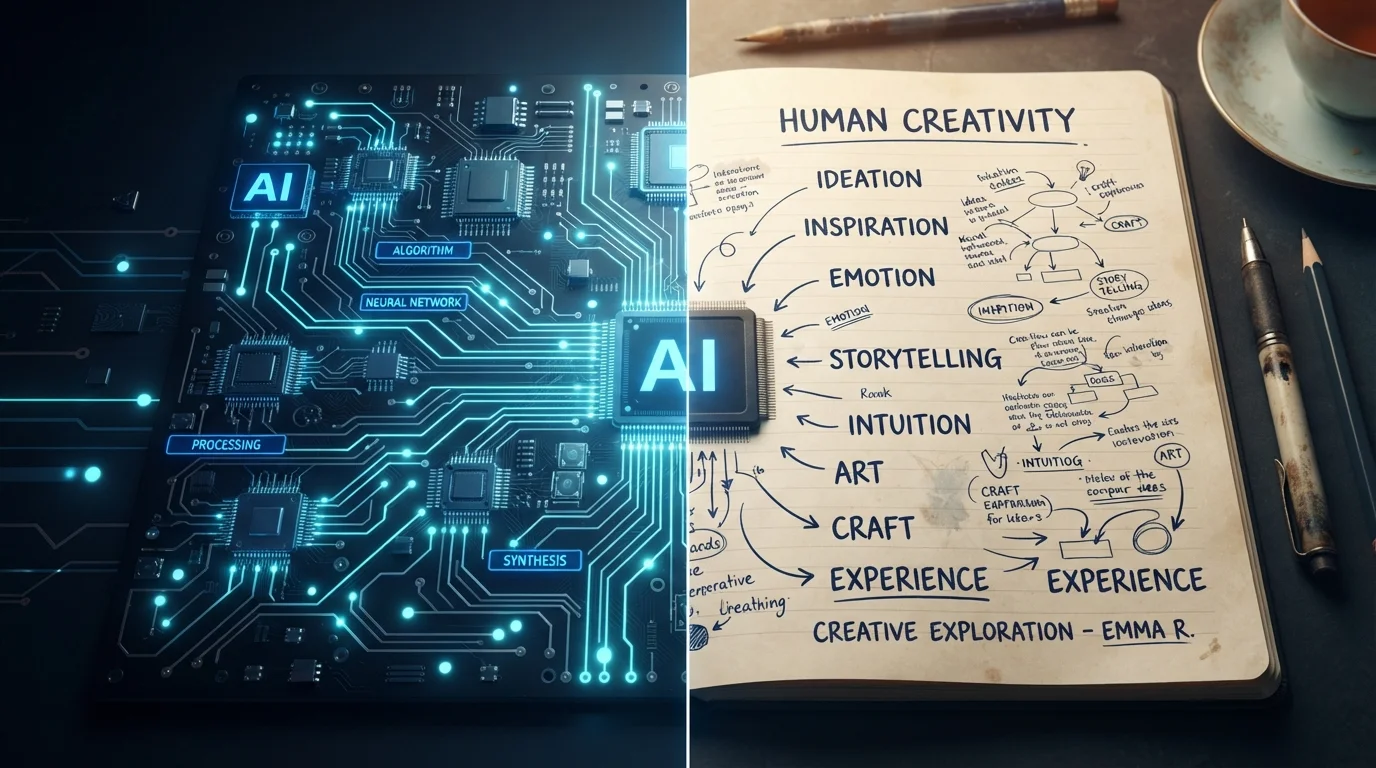
Option A
AI-Generated Content
The scalable, pattern-driven output machine.
Best for: High-volume, structured tasks where speed and consistency matter more than originality or lived perspective.
Option B
Human-Written Content
The intentional, experience-grounded creative voice.
Best for: Nuanced storytelling, opinion, accountability, and situations where trust and genuine expertise are non-negotiable.
How Each Type of Content Is Actually Made
Understanding the difference starts with the process, not the output. When a human writer produces content, they draw on memory, reasoning, emotion, research, and judgment accumulated over a lifetime. They decide what to include, what to leave out, and why — choices grounded in genuine comprehension.
AI-generated content works fundamentally differently. Large language models — the technology behind tools like ChatGPT — are trained on vast quantities of existing text and learn to predict which words statistically follow other words in a given context. They don't understand meaning the way humans do; they pattern-match at extraordinary scale. Learn more about what generative AI actually does under the hood before drawing conclusions about its output.
This distinction matters because it shapes the characteristic strengths and weaknesses of each. AI is fast, consistent, and tireless. It doesn't get writer's block. But it also has no independent judgment about truth — it can produce a confident-sounding sentence that is factually wrong, because confidence and accuracy are not the same thing in a statistical system.
| Criterion | AI-Generated Content | Human-Written Content |
|---|---|---|
| Production process | Statistical pattern prediction | Reasoning, judgment, and intent |
| Speed | Near-instant at scale | Slower; requires time and effort |
| Factual accuracy | Variable; errors stated confidently | Variable; errors can be verified and corrected |
| Accountability | None inherent to the system | Writer and publisher responsible |
| Original voice and expertise | Simulated from training data | Genuine lived and professional experience |
| Consistency at volume | High; repeatable style | Variable; depends on individual writer |
| Creative and emotional depth | Limited; pattern-based approximation | Strong; driven by authentic perspective |
Where the Quality Gap Is Real — and Where It Isn't
The quality comparison isn't simple. On certain tasks — generating structured summaries, drafting product descriptions, producing FAQ content — well-prompted AI tools can produce output that is serviceable and saves significant time. The gap between AI and human output narrows when tasks are formulaic and the source information is solid.
Where the gap widens considerably: original analysis, deeply sourced journalism, persuasive writing grounded in professional expertise, and anything requiring accountability. A human writer can be questioned, corrected, and held responsible for their claims. An AI system cannot be held accountable in the same way, and its outputs have no authorial intent behind them.
~76%
Adults who find AI-generated misinformation concerning
A 2023 Pew Research Center survey found roughly three-quarters of U.S. adults are concerned about the spread of AI-created false content online.
10x
Speed advantage of AI for structured drafting tasks
Industry estimates commonly suggest AI tools can produce initial structured drafts roughly ten times faster than a writer working from scratch on the same template.
There's also the misinformation dimension. AI-generated text, images, and video are becoming increasingly convincing, which creates real risks for readers who encounter them without context. Developing habits to spot AI-generated misinformation is becoming a practical media literacy skill, not just a niche concern.
Practical Implications for Readers and Creators
For most readers, the immediate question is: can I trust what I'm reading? The honest answer is that the source matters more than the production method alone. Human-written content can be poorly researched or deliberately misleading. AI-generated content, when used responsibly under human editorial oversight, can be accurate and useful.
What to watch for in either case: clear sourcing, named authorship and accountability, and transparency about methodology. If a piece makes specific factual claims, those claims should be verifiable independently of the content itself. This is especially true for health, finance, and legal topics where errors carry real consequences.
Transparency Is the Key Variable
Neither the presence of AI assistance nor human authorship alone guarantees quality or accuracy. What matters most is transparency: whether the creator discloses how content was produced, who is accountable for its claims, and whether sources are verifiable. Readers are well within their rights to ask those questions of any content they encounter.
If you use AI-powered apps or tools as part of your content workflow, it's also worth understanding how those tools handle your data. What to verify before trusting an AI app with your personal information is a practical starting point for evaluating those tools responsibly.
The most durable framing may be this: AI and human authorship aren't always in opposition. Increasingly, skilled communicators use AI as a tool within a human-led process — much like how calculators didn't replace mathematicians, but changed how they work. The critical ingredient remains human judgment about what is true, what matters, and what is worth saying.
The content on this site is for informational purposes only and is not a substitute for professional advice. Always consult a qualified professional for guidance specific to your situation.