

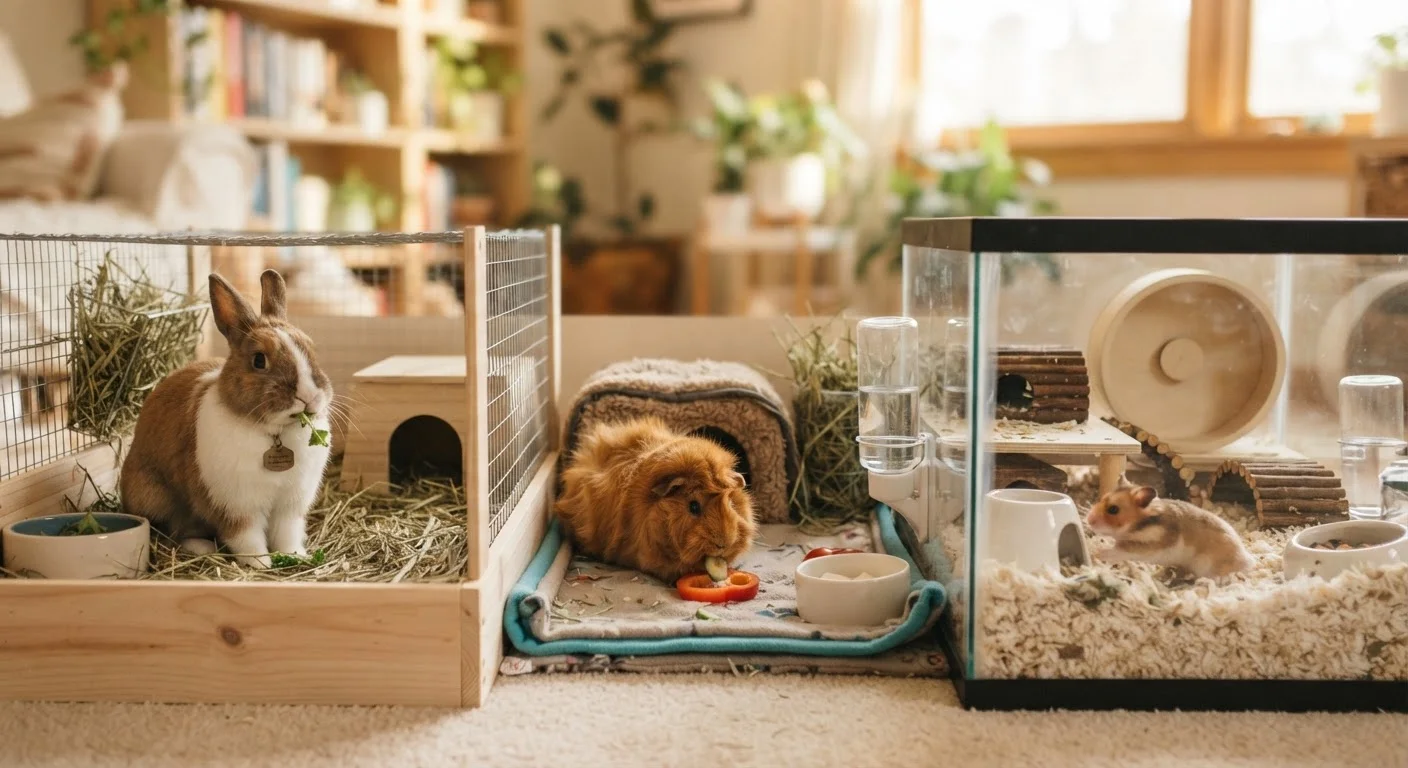
Our Verdict
No single small pet is universally 'easier' than another. Rabbits demand the most space and social engagement, guinea pigs thrive with companionship and a hay-heavy diet, and hamsters need enrichment-rich solitary setups and nocturnal-friendly handling. Matching a species to your lifestyle is the first step toward genuinely responsible ownership.
| Best for | Recommended |
|---|---|
| Those with more floor space and time for daily interaction | Rabbit |
| Families or owners who want a social, handleable small pet | Guinea Pig |
| Solo owners with limited space who are active in the evening | Hamster |
Why 'Small Pet' Doesn't Mean Low-Maintenance
Many people choose rabbits, guinea pigs, or hamsters expecting a simpler commitment than a dog or cat. In reality, each species has evolved distinct behavioral patterns, dietary requirements, and environmental needs that, when overlooked, quickly lead to stress, illness, or shortened lifespans. Understanding what makes each animal unique is the foundation of responsible care.
If you're still evaluating whether a small pet is the right fit for your household, the common early mistakes new pet owners make are worth reviewing before committing. Equally, prospective owners should be aware that even small animals carry ongoing costs that extend well beyond purchase price, including veterinary care from an exotic or small-animal specialist.
Species at a Glance: Key Differences
Before diving into individual care needs, a side-by-side comparison helps clarify how differently these three animals are designed to live.
| Rabbit | Guinea Pig | Hamster | |
|---|---|---|---|
| Social nature | Social; may enjoy a bonded companion | Highly social; thrives in pairs or groups | Largely solitary (especially Syrians) |
| Activity pattern | Crepuscular (dawn and dusk) | Active during the day | Crepuscular to nocturnal |
| Minimum space (recommended) | 8 sq ft enclosure + 24 sq ft exercise | 7.5 sq ft per animal | 450 sq in floor space minimum |
| Dietary foundation | Unlimited timothy hay, leafy greens | Unlimited hay, leafy greens + vitamin C | Pelleted mix, seeds, fresh vegetables |
| Key health concern | GI stasis, dental disease | Vitamin C deficiency (scurvy) | Wet tail, diabetes (in dwarf species) |
| Typical lifespan | 8–12 years | 4–8 years | 2–3 years |
These differences have real consequences. A hamster housed with a companion may fight seriously. A rabbit confined to a small hutch may develop skeletal problems and behavioral frustration. A guinea pig kept alone may show signs consistent with chronic stress. Knowing each species' baseline needs prevents the most common care failures.
Rabbit Care: Space, Diet, and Social Complexity
Domestic rabbits are intelligent, curious animals that require significantly more space than most enclosures marketed for them provide. The House Rabbit Society recommends a minimum of 8 square feet of enclosure space paired with at least 24 square feet of daily exercise space — ideally more. Rabbits that lack room to run, jump, and explore can develop muscle atrophy and behavioral problems including destructive chewing and aggression.
Diet: Unlimited grass hay (particularly timothy hay for adults) should form the foundation of a rabbit's diet — roughly 80% of daily intake. Leafy greens such as romaine lettuce, cilantro, and kale can be offered in moderate portions. Pellets should be limited to a small daily measure. Fruit, sweet vegetables, and starchy foods should be avoided or given only as rare treats, as they can disrupt gut motility.
Social needs: Rabbits are social by nature and many — though not all — do well with a neutered companion of the same species. Bonding requires careful introduction. Human interaction is also important; rabbits that are regularly, gently handled from a young age are generally calmer and easier to care for. For enrichment ideas that complement daily handling, see enrichment activities that fit into a busy schedule.
Rabbit-Proof Before You Allow Free Roam
Rabbits given free-roaming access to a room will chew baseboards, cables, and furniture if given the opportunity. Before expanding your rabbit's space, secure or cover electrical cords, protect wooden furniture legs, and block access to areas you can't supervise. Providing appropriate chew items — untreated willow sticks, hay-based toys — helps redirect this natural behavior.
Guinea Pig Care: Companionship and Vitamin C
Guinea pigs (also called cavies) are highly vocal, sociable animals. Unlike hamsters, guinea pigs are generally not territorial with their own kind and benefit noticeably from living in same-sex pairs or small groups. A guinea pig kept alone without substantial human interaction may show lethargy or repetitive behaviors that suggest boredom or distress.
Diet: Like rabbits, guinea pigs require unlimited timothy hay and should have access to fresh leafy greens daily. Critically, guinea pigs cannot synthesize their own vitamin C — a deficiency leads to scurvy. Bell peppers, parsley, and leafy greens provide good dietary sources. Commercial guinea pig pellets fortified with vitamin C are helpful, but vitamin C degrades quickly; pellets should be fresh and stored properly. Citrus can be offered sparingly. Consult a veterinarian about appropriate vitamin C supplementation strategies for your specific animals.
Space: The Humane Society recommends a minimum cage size of 7.5 square feet for one guinea pig, with more space needed for pairs or groups. Multi-level cages designed for ferrets are often unsuitable due to ramp and level spacing risks; single-story C&C (coroplast and cube grid) enclosures are widely recommended by cavy welfare advocates.
Hamster Care: Solitary Life and Nocturnal Rhythms
The Syrian hamster — the most commonly kept species in the US — is a solitary animal in the wild and should be housed alone. Placing two Syrian hamsters together typically results in serious fighting. Some dwarf species (such as Roborovski or Campbell's) may tolerate same-sex pairs when raised together from a young age, but cohabitation should be monitored closely and is never guaranteed to be peaceful.
Habitat and enrichment: Hamsters are highly active, particularly at night. A wheel is not optional enrichment — it is a necessity. Solid-surface wheels with a diameter of at least 10 inches (for Syrians) allow a natural running posture. Enclosures should provide deep substrate (6–10 inches) for burrowing, which is a core behavioral need. A minimum floor space of 450 square inches is widely cited by welfare organizations, though larger is generally better.
Handling considerations: Because hamsters are crepuscular to nocturnal, handling during daytime hours when the animal is sleeping can cause stress and may result in biting — not aggression, but a startled response. Handling sessions are best kept to evenings and should build gradually to allow the animal to become comfortable with human scent and touch first.
Once you've reviewed care fundamentals, the new pet owner's roadmap offers practical guidance on first-day setup and scheduling that initial veterinary visit — which is important for all three species.
This article is for general informational purposes only and does not constitute veterinary advice. Always consult a qualified small-animal or exotic veterinarian for guidance specific to your pet's health and care needs.
The content on this site is for informational purposes only and is not a substitute for professional advice. Always consult a qualified professional for guidance specific to your situation.