

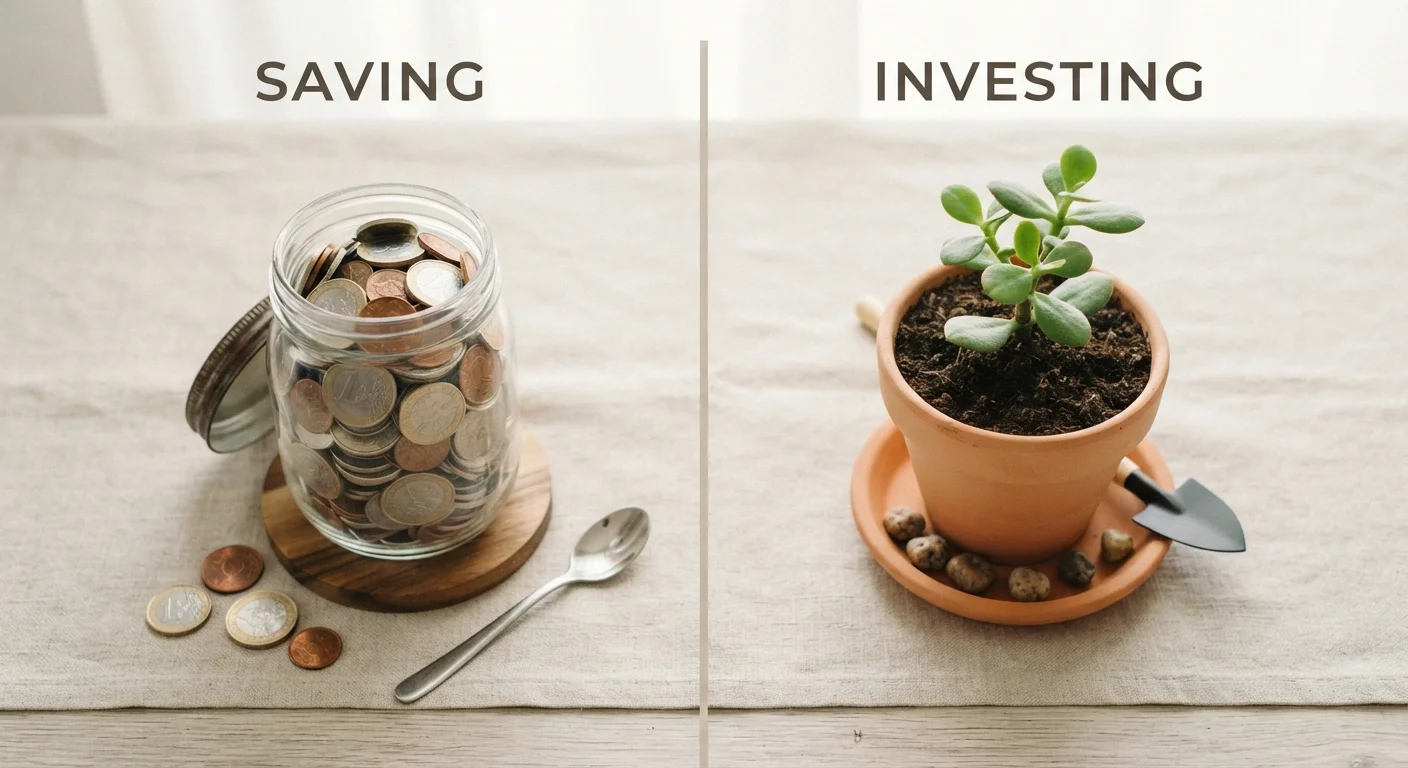
Two Tools, Two Jobs
Saving and investing are often mentioned in the same breath, but they do fundamentally different jobs. Treating them as interchangeable is one of the most common stumbling blocks for people building financial security.
Saving is about protection and availability. When you deposit money into a savings or checking account, you're prioritising safety — that money should be there, in full, whenever you need it. The trade-off is modest growth: traditional savings accounts offer relatively low interest rates, though high-yield savings accounts can offer meaningfully better returns while still keeping your principal safe.
Investing is about growth over time. By purchasing assets — stocks, bonds, index funds, or other vehicles — you give your money the opportunity to compound and outpace inflation. The trade-off is risk: markets fluctuate, and the value of investments can fall as well as rise. Past performance does not guarantee future results.
Understanding these trade-offs is the starting point. Before diving deeper, it helps to be comfortable with the core vocabulary — our glossary of key financial terms covers concepts like liquidity, APY, and asset allocation in plain language.
~56%
US adults who own stocks or stock funds
According to Gallup polling, roughly 56% of American adults reported owning stock — including through retirement accounts — in recent years, highlighting how common investing has become across income levels.
3–6 months
Recommended emergency fund size
Financial educators commonly recommend keeping three to six months of essential living expenses in accessible savings before directing additional funds toward higher-risk investments.
~2–3%
Average long-run US inflation rate
The Federal Reserve targets roughly 2% annual inflation, meaning money that earns less than this in savings gradually loses purchasing power — one reason long-term savings often benefit from investment exposure.
When to Save and When to Invest
The single most useful question to ask about any sum of money is: when will I need this? Time horizon drives the save-or-invest decision more than almost any other factor.
- Short-term needs (under 2–3 years): Money you'll need soon — for a car repair, a vacation, or a home down payment within the next couple of years — generally belongs in savings. You can't afford to wait out a market downturn.
- Medium-term goals (3–7 years): Goals in this range involve more nuance. A mix of lower-risk investments and savings may be appropriate, depending on how flexible the timeline is.
- Long-term goals (7+ years): Retirement savings, for example, can typically tolerate market volatility because there's time to recover from downturns. This is where investing tends to do the most work.
This framework — matching money to its purpose — is explored in more depth in our guide to aligning money with your financial goals.
Start With Your Emergency Fund
Before investing, prioritise building a savings cushion that covers three to six months of essential expenses. This gives you financial breathing room so you won't be forced to sell investments in a downturn to pay for an emergency. Once that foundation is in place, you'll be better positioned to invest with a longer time horizon.
The Role of Risk — and Why It Matters
Risk is what separates saving from investing most sharply. In a federally insured savings account, your deposited principal is protected up to applicable limits. The value doesn't swing based on market conditions.
Investments carry no such guarantee. Equity markets can — and do — decline, sometimes sharply. A diversified portfolio spread across different asset classes and time horizons can help manage, but not eliminate, that risk. Investors generally accept short-term uncertainty in pursuit of longer-term growth that savings accounts cannot typically deliver on their own.
This doesn't make investing inherently dangerous — it makes it different. The risk of investing is often offset by the risk of not investing: money sitting in low-yield savings for decades may lose real purchasing power to inflation. Both inaction and action carry trade-offs worth understanding.
“The stock market is a device for transferring money from the impatient to the patient.”
— Warren Buffett, Chairman and CEO of Berkshire Hathaway, widely cited investor
If you want to understand the specific vehicles available — from individual stocks to bond funds — our plain-language guide to investment types breaks them down clearly.
Why You Likely Need Both
A well-rounded financial plan rarely relies on one strategy alone. Saving without investing may leave long-term goals underfunded. Investing without adequate savings can force you to sell assets at the wrong time — such as during a market dip — simply to cover an emergency.
The most common starting sequence recommended by financial educators looks like this:
- Build a basic emergency fund (often cited as three to six months of essential expenses) in an accessible savings account.
- Direct longer-term money — particularly retirement contributions — into appropriate investment vehicles.
- Continue saving for near-term goals while allowing invested assets to grow over time.
This isn't a rigid prescription, and everyone's situation is different. Some people have employer-matched retirement plans that make early investing highly advantageous; others carry high-interest debt that should be prioritised first. It's also worth being mindful of habits that can quietly undermine savings progress. For decisions specific to your circumstances, a licensed financial adviser can help you find the right balance.
This article is for general informational and educational purposes only and does not constitute personalised financial, investment, or tax advice. Please consult a qualified financial professional before making decisions about your own finances.
Frequently Asked Questions
Saving keeps your money safe and accessible, usually in a bank or credit union account. Investing puts your money into assets that can grow over time but may also lose value. The core difference is risk versus stability.
Most financial educators recommend building a basic emergency fund — typically three to six months of essential expenses — before investing significantly. This ensures you won't need to sell investments at a loss to cover an unexpected cost.
Your principal balance in an FDIC-insured account is protected up to federal limits, so you typically won't lose the amount you deposited. However, if your savings account's interest rate is lower than the rate of inflation, your money's purchasing power can gradually erode over time.
There is no single right answer — it depends on your goals, income, expenses, and timeline. A common approach is to keep short-term and emergency funds in savings while directing long-term money (retirement, for example) toward investments. Consulting a licensed financial adviser can help you determine the right balance for your situation.
In everyday language, people sometimes use 'investment' loosely, but in financial terms a savings account is not an investment. It stores and preserves money rather than exposing it to market risk for the purpose of growth.
The content on this site is for informational purposes only and is not a substitute for professional advice. Always consult a qualified professional for guidance specific to your situation.