

Start here
Why Purpose-Based Saving Matters
Next
The Emergency Fund: Your Financial Safety Net
Then
Short-Term Goals: Saving With a Deadline
When you're ready
Long-Term Wealth: Putting Time to Work
Apply it
Building Your Money Allocation System
Why Purpose-Based Saving Matters
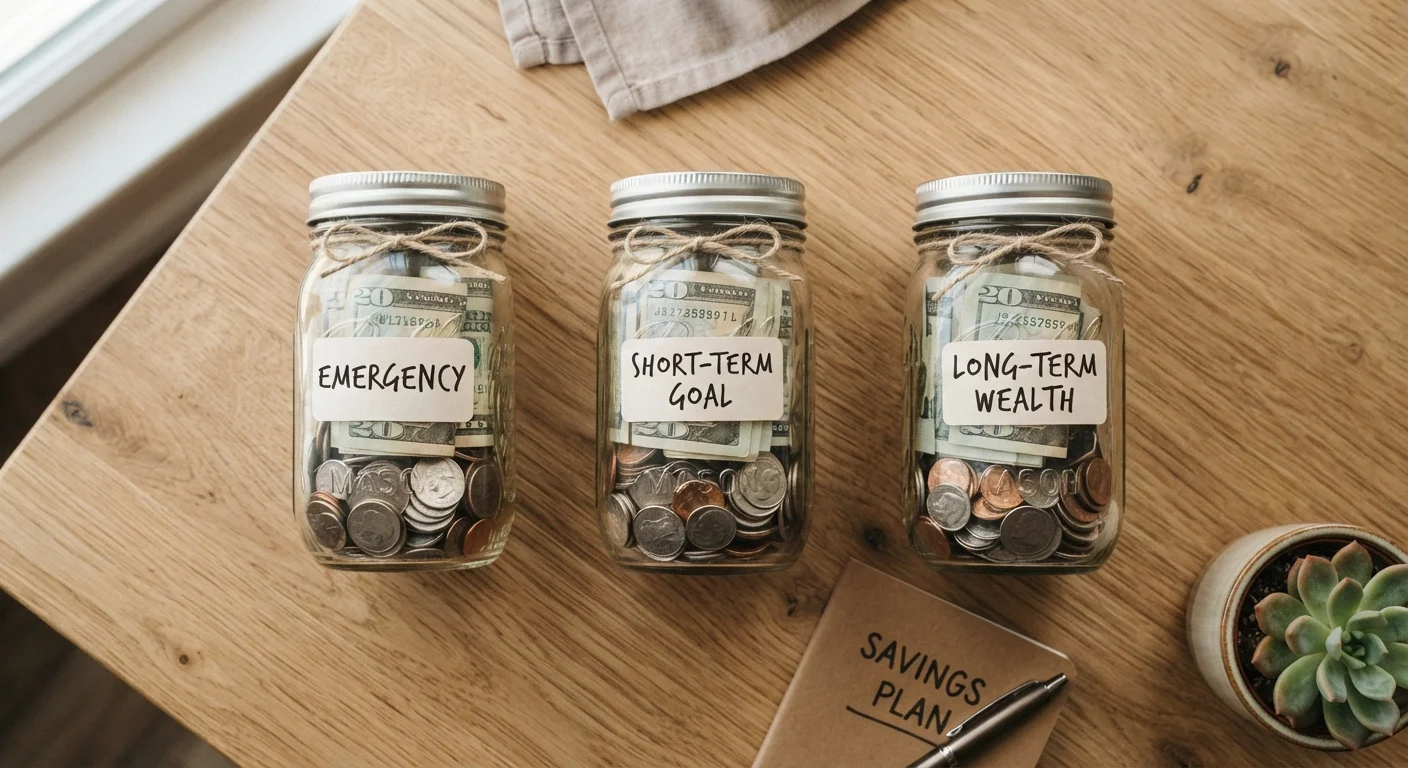
Most people treat their savings as a single undifferentiated pool of money. The problem with that approach is that different financial goals require different strategies — and mixing them leads to poor decisions in both directions. You might drain money earmarked for a house down payment during a job loss, or keep retirement savings stagnating in a low-interest account out of caution.
Purpose-based saving solves this by assigning every dollar a clear job: emergency protection, a near-term target, or long-term wealth accumulation. Each job has a different time horizon, risk tolerance, and appropriate vehicle. Understanding this framework is foundational to building genuine financial security. If you're new to the vocabulary of saving and investing, the article Key Financial Terms Every New Saver and Investor Should Know is a useful starting reference.
Liquidity
How quickly and easily an asset can be converted to cash without losing value. A savings account is highly liquid; real estate is not.
Capital preservation
A financial strategy focused on protecting the original amount you saved or invested, prioritizing safety over growth.
Compounding
The process by which investment returns generate their own returns over time, allowing money to grow at an accelerating rate.
Time horizon
The length of time you plan to hold a savings or investment before needing access to the money. Longer horizons generally allow more risk.
Tax-advantaged account
A savings or investment account that offers a tax benefit — such as deductions on contributions or tax-free growth — under specific IRS rules.
Sinking fund
A dedicated savings account where you set aside small, regular amounts to cover a known future expense, preventing it from disrupting your budget.
The Emergency Fund: Your Financial Safety Net
An emergency fund is cash you can access immediately when an unexpected expense — medical bill, car repair, job loss — threatens your financial stability. Its defining feature is liquidity: the ability to convert it to spendable cash instantly, without penalties or losses.
A commonly cited target is three to six months of essential living expenses, though the ideal amount varies based on your employment type, household structure, and risk tolerance. The important thing is that this money is never invested in stocks or other volatile assets. Market downturns often coincide with the events that trigger emergency spending, so the last thing you want is a depleted fund when you need it most.
Where should it live? High-yield savings accounts offer meaningfully better interest rates than traditional savings accounts while keeping your money accessible and FDIC-insured. They are generally considered one of the most appropriate homes for an emergency fund.
Don't Invest Your Emergency Fund
Placing emergency savings in stocks, ETFs, or other market-linked assets exposes them to the risk of loss at the exact moment you may need the money most. Market downturns and personal financial crises can — and do — occur simultaneously. Keep emergency funds in stable, FDIC-insured accounts only.
Short-Term Goals: Saving With a Deadline
Short-term goals are financial targets you plan to reach within roughly one to three years — a vacation, a vehicle down payment, a home repair reserve, or a wedding fund. Because the timeline is finite, capital preservation matters more than growth. You cannot afford to lose 20% of a down payment fund in a market correction the month before you need it.
The best tools for short-term savings balance modest returns with stability. Options commonly discussed include high-yield savings accounts and short-term certificates of deposit (CDs). For predictable, recurring expenses — like annual insurance premiums or holiday spending — a sinking fund approach can prevent budget shocks by spreading the cost over many months.
Keeping short-term goal money in its own dedicated account — separate from your emergency fund — also removes the temptation to borrow from one bucket to fill another.
Label Your Accounts by Goal
Many online banks and credit unions allow you to create multiple savings sub-accounts with custom names. Naming accounts 'Emergency Fund,' 'Vacation 2026,' or 'Car Down Payment' creates a psychological boundary that discourages mixing funds. This simple step makes purpose-based saving far easier to maintain.
Long-Term Wealth: Putting Time to Work
Long-term wealth building operates on a fundamentally different logic. When your time horizon extends beyond five to ten or more years — retirement being the clearest example — you can accept short-term market volatility because you have time to recover and benefit from compounding (the process by which investment returns generate their own returns over time).
This is where investing, rather than saving, does the heavy lifting. Tax-advantaged accounts such as employer-sponsored 401(k) plans and individual retirement accounts (IRAs) are common vehicles for long-term wealth, offering either upfront tax deductions or tax-free growth depending on the account type. For a deeper look at why investing serves a different purpose than saving, see The Difference Between Saving and Investing — and Why Both Matter.
Strategies like dollar-cost averaging — investing a fixed amount at regular intervals regardless of market conditions — can help manage the psychological challenge of investing through market fluctuations. Past performance does not guarantee future results, and all investing involves risk of loss.
This article is for general informational and educational purposes only, and does not constitute personalised financial, investment, tax, or legal advice. Consult a qualified financial professional before making decisions specific to your situation.
Building Your Money Allocation System
The practical challenge is building all three buckets simultaneously without feeling like you're making no progress. A layered approach helps: start by accumulating a starter emergency fund — a small buffer of $500 to $1,000 — before spreading contributions more evenly.
From there, consider automating transfers to each dedicated account on payday. This mirrors the logic of the pay-yourself-first budgeting method: moving money to its intended purpose before it can be absorbed into everyday spending. Tie your budgeting approach to your three-bucket system so every income dollar has a destination.
As your income grows or debts are paid off, review your allocation percentages. The emergency fund eventually reaches its target and requires only periodic top-ups; at that point, the freed-up cash flow can flow more heavily toward short-term goals or long-term investment accounts. Avoid the common pitfalls that quietly erode this progress — financial decisions that set back long-term savings are often invisible until the damage is done.
Pay-Yourself-First Budgeting Guide
Understand how to automate your savings by treating contributions to each money bucket as a non-negotiable expense that comes first — before discretionary spending.
Sinking Fund Planner
A structured method for identifying predictable future expenses and calculating how much to set aside monthly so they never catch your budget off guard.
Dollar-Cost Averaging Explainer
Learn how investing a consistent dollar amount at regular intervals can reduce the impact of market timing on long-term wealth accumulation.
Frequently Asked Questions
A widely cited guideline is three to six months of essential living expenses. The right amount depends on job stability, household income sources, and personal risk tolerance. Those with variable income or dependents often aim for the higher end of that range.
Financial educators generally advise against investing emergency funds in stocks or volatile assets, because market downturns can coincide with the very moments you need access to cash. High-yield savings accounts or money market accounts offer better returns than traditional savings while preserving liquidity and stability.
Short-term goals are generally those you plan to fund within one to three years — such as a vacation, car down payment, or home repair. Because the timeline is tight, capital preservation matters more than growth, making savings accounts or certificates of deposit more appropriate than equities.
Most financial educators suggest beginning as soon as you have a starter emergency fund in place and your high-interest debt under control. Time in the market is a key driver of compounding returns, so starting early — even with modest amounts — tends to be more beneficial than waiting.
Yes, and many financial planners recommend it. A layered approach — building a starter emergency fund first, then splitting contributions across all three buckets — lets you make progress without putting everything on hold until one goal is complete.
Emergency funds fit well in high-yield savings or money market accounts. Short-term goals are often served by savings accounts or short-term CDs. Long-term wealth typically lives in tax-advantaged investment accounts such as 401(k)s or IRAs, or taxable brokerage accounts for additional investing beyond contribution limits.
The content on this site is for informational purposes only and is not a substitute for professional advice. Always consult a qualified professional for guidance specific to your situation.