

Our Verdict
Passive income and capital growth are not competing strategies — they are complementary tools that serve different financial needs. Income-focused investing suits those who want regular cash flow, while growth-focused investing is typically better suited to long-term wealth accumulation. A well-rounded financial plan often incorporates both, adjusted to individual circumstances.
| Best for | Recommended |
|---|---|
| Those seeking regular cash flow from their investments | Passive Income |
| Those building long-term wealth over a decade or more | Capital Growth |
| Those balancing current income needs with future accumulation | Blended Approach |
What These Two Approaches Actually Mean
When an investment works for you, it can do so in one of two fundamental ways: it can pay you along the way, or it can become worth more than what you paid for it. Understanding this distinction is a cornerstone of building a coherent investment strategy.
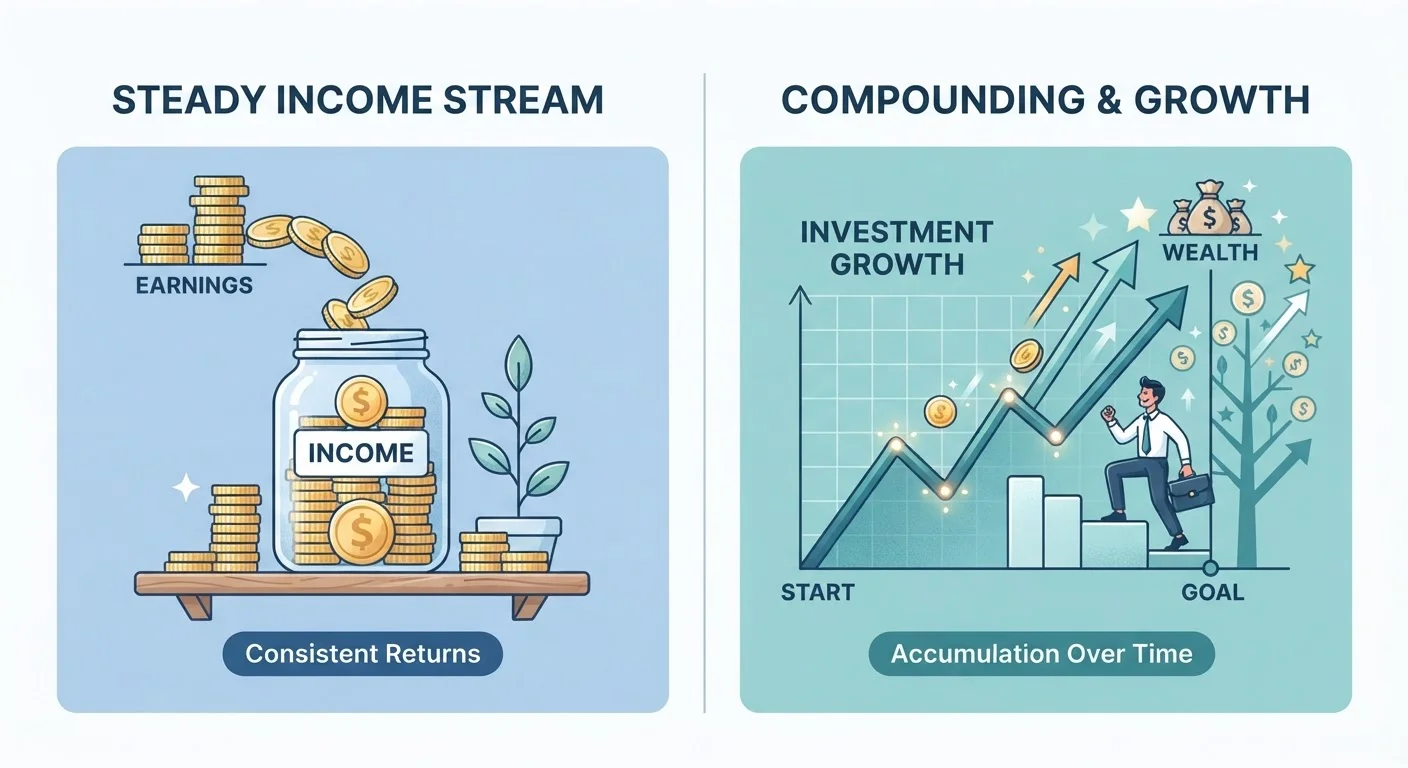
Passive income refers to returns generated while you continue to hold an asset — without selling it. Common examples include stock dividends, bond interest payments, and rental income from property. The asset itself remains in your possession; what changes is the regular cash it produces.
Capital growth (sometimes called capital appreciation) refers to an increase in the market value of an asset over time. You don't receive cash along the way — you realize the gain only when you sell. Growth-oriented investors typically hold assets for extended periods, allowing compound appreciation to work over time. Our guide to how compound interest works explains why time is such a powerful factor in this equation.
It's worth noting that many assets can do both — a stock might pay dividends and appreciate in price. The distinction is about emphasis and strategy, not strict categorization.
How Each Approach Works in Practice
Income-focused investing prioritizes assets that deliver consistent cash distributions. Dividend-paying stocks, corporate and government bonds, real estate investment trusts (REITs — companies that own income-producing property and are required to distribute a portion of earnings to shareholders), and certain funds structured around yield are typical examples. The appeal is predictability: investors can plan around expected cash flow, which may supplement salary, fund retirement expenses, or be reinvested to compound returns further.
Growth-focused investing prioritizes assets expected to increase substantially in value. Stocks in younger or rapidly expanding companies, broad equity index funds, and certain alternative assets tend to fall into this category. Returns are not distributed — they accumulate within the asset. The trade-off is that those gains remain unrealized and subject to market fluctuation until the investor chooses to sell. Understanding the range of investment vehicles available helps clarify which types of assets align with each approach.
| Passive Income | Capital Growth | |
|---|---|---|
| How returns are received | Regular cash distributions (dividends, interest, rent) | Realized upon sale of the asset |
| Typical asset examples | Dividend stocks, bonds, REITs, income funds | Growth stocks, equity index funds |
| Cash flow during holding period | Yes — ongoing income | Generally no — value accrues within asset |
| Typical time horizon emphasis | Short to medium term; or ongoing retirement income | Medium to long term (often 10+ years) |
| Volatility profile | Generally lower, but not risk-free | Typically higher; subject to market swings |
| Main risk | Payout cuts; inflation eroding real value | Market decline; no cash flow if value drops |
Neither strategy is inherently superior. Both carry risk — income-generating assets can cut or eliminate payouts during downturns, and growth assets can lose significant value. Past performance in either category does not guarantee future results.
Matching the Approach to Your Goals
Choosing between income and growth — or blending the two — depends on several factors unique to your situation. A qualified financial adviser can help you think through these variables for your own circumstances.
- Time horizon: Investors with longer timeframes (often 10 years or more) may tolerate the volatility of growth assets because there is more time to recover from market downturns. Those with shorter horizons, or who need funds soon, may prefer the more immediate return of income-generating assets.
- Cash flow needs: If you rely on your portfolio for living expenses — a common situation in retirement — passive income provides spendable funds without requiring you to sell holdings. Growth investors, by contrast, typically plan to sell assets at a future point to access returns.
- Tax considerations: The tax treatment of dividends, interest, and capital gains varies and can meaningfully affect net returns. This is an area where professional tax guidance is strongly recommended.
- Risk tolerance: Growth assets tend to be more volatile than income assets, though this is not universal. Understanding your own comfort with fluctuation matters.
Many investors hold a mix of both — a concept closely tied to diversification as a risk management principle. Holding a range of asset types with different return profiles can smooth the overall experience of investing over time.
Consider Starting With Your Goals, Not the Assets
Before evaluating specific investments, clarify what you need your money to do and when. If you're decades from needing the funds, growth may play a larger role. If you need income within a few years, yield-focused assets may deserve more weight. This goal-first approach helps prevent chasing returns that don't match your actual situation. Always verify your strategy with a licensed financial professional.
This article is for general informational and educational purposes only and does not constitute personalised financial, investment, tax, or legal advice. Please consult a qualified financial professional before making decisions about your own investments.
The content on this site is for informational purposes only and is not a substitute for professional advice. Always consult a qualified professional for guidance specific to your situation.