

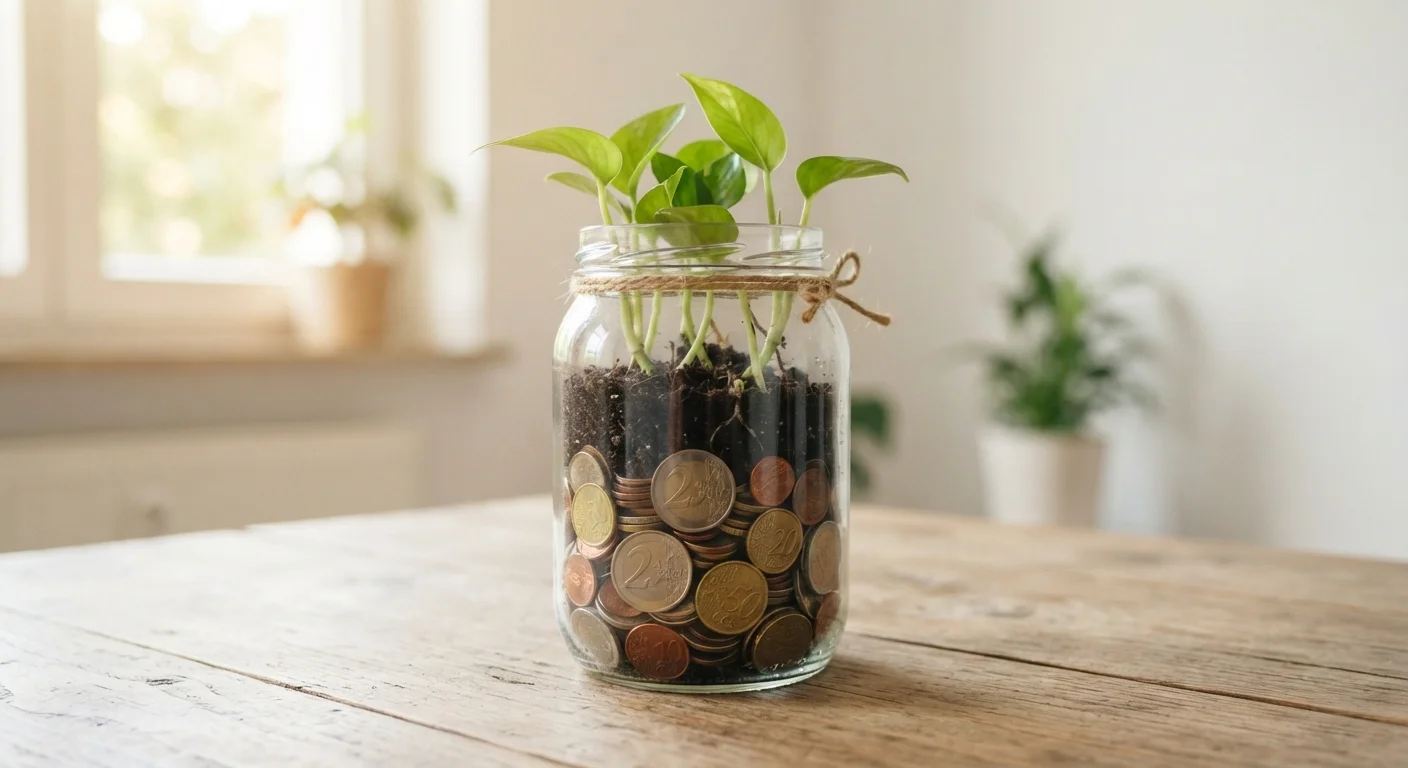
How Compound Interest Actually Works
Think of compound interest as a snowball rolling downhill. It starts small, but as it rolls, it picks up more snow — and that new snow also picks up more snow. Your balance grows not just from what you put in, but from the returns stacking on top of previous returns.
Here's a simplified example: You deposit $1,000 in a savings account earning 5% per year. After year one, you have $1,050. In year two, you earn 5% on $1,050 — not the original $1,000 — giving you $1,102.50. By year ten, that same $1,000 grows to roughly $1,629 without any additional deposits. By year 30, it reaches approximately $4,322.
The math behind this is expressed as: A = P(1 + r/n)nt, where A is the final amount, P is the principal, r is the annual rate, n is the number of compounding periods per year, and t is time in years. You don't need to memorize the formula — just understand what it captures: time and rate both matter enormously.
$4,322
Growth of $1,000 at 5% over 30 years
Illustrates compound growth with no additional contributions beyond the initial deposit, compounded annually.
72 ÷ Rate
Years to double money (Rule of 72)
A widely used mental math shortcut: at 6% annual return, money roughly doubles every 12 years.
10+ years
Payoff time for minimum-payment credit card debt
A $3,000 balance at ~22% APR with only minimum payments can take over a decade to clear, illustrating compounding's cost in debt.
Why Time Is Your Most Valuable Asset
No financial concept illustrates the value of time quite like compound interest. Consider two hypothetical savers. The first contributes $200 per month starting at age 25. The second waits until 35 and contributes the same $200 monthly. Assuming the same average return, the early starter ends up with significantly more at retirement — not because they contributed more in total, but because their money had more years to compound.
This is the core principle sometimes described as "paying yourself first." Even modest, consistent contributions made early can outperform larger contributions made late. That's not motivation speak — it's arithmetic.
Start Small, Start Now
You don't need a large lump sum to benefit from compounding. Even $25 or $50 per month invested consistently over many years can grow significantly thanks to the compounding effect. The most important variable in your control right now is simply beginning — time in the market is the fuel that compounding runs on.
For a broader look at how compounding fits within a savings and investing strategy, see our glossary of key financial terms for new savers and investors.
Compound Interest in Debt: The Other Side of the Equation
Compound interest isn't always working in your favor. On credit cards and other revolving debt, unpaid interest is added to your principal balance — and the next billing cycle, you're charged interest on that larger amount. This is how a modest balance can quietly spiral over time.
For example, a $3,000 credit card balance at a 22% APR, with only minimum payments, can take well over a decade to pay off and cost several thousand dollars in interest alone. The compounding mechanism is identical to what builds wealth in savings — it's just working against you.
Understanding this symmetry is critical. The same discipline that makes compound interest powerful in investing — consistency and time — also explains why carrying high-interest debt for years is so costly. For a plain-language breakdown of how interest applies in the context of credit, see key terms in debt and credit.
“Compound interest is the eighth wonder of the world. He who understands it, earns it; he who doesn't, pays it.”
— Attributed to Albert Einstein, Quote widely cited in financial education contexts — original attribution is disputed, but the principle it describes is mathematically sound and broadly accepted.
Putting Compound Interest to Work
Capturing the benefits of compounding requires two things: a vehicle that pays compound returns, and the discipline to leave earnings reinvested rather than withdrawing them. Tax-advantaged accounts like 401(k)s and IRAs are common contexts where this plays out over decades, since contributions grow without being reduced by annual taxes on gains.
For savings, APY (Annual Percentage Yield) is the number to watch — it reflects the compounding effect and gives an apples-to-apples comparison between accounts. A nominal rate of 4.8% compounded monthly translates to a slightly higher APY than the same rate compounded annually.
Reinvesting dividends in investment accounts achieves the same compounding effect: those dividend payments buy more shares, which generate more dividends, which buy still more shares. To understand the types of accounts and assets where this plays out, our guide on investment vehicles covers the essentials in plain language. You can also explore passive income vs. capital growth to understand how different strategies interact with compounding over time.
Compounding Frequency Makes a Difference
When comparing savings accounts or investment products, look at the APY rather than the nominal interest rate. Two accounts can advertise the same rate but deliver different returns depending on how often they compound. Daily compounding produces slightly more than monthly, which produces slightly more than annual — and over long time horizons, those differences add up.
This article is for general informational and educational purposes only. It does not constitute personalized financial, investment, or tax advice. Consult a qualified financial professional before making decisions about your own financial situation.
Frequently Asked Questions
Simple interest is calculated only on your original principal. Compound interest is calculated on the principal plus any interest already earned, so your balance grows faster over time. For long-term savings or investments, the difference becomes substantial.
It depends on the account or product. Savings accounts often compound daily or monthly, while some bonds compound annually. More frequent compounding produces slightly higher returns. Always check the APY, which accounts for compounding frequency, for an accurate comparison.
Yes. Credit card balances, student loans, and other debts can also compound — meaning unpaid interest gets added to your balance, and future interest is charged on that larger amount. This is why carrying high-interest debt can become costly very quickly.
The Rule of 72 is a quick mental math shortcut: divide 72 by your annual interest rate to estimate how many years it takes to double your money. For example, at a 6% annual return, your investment would roughly double in about 12 years.
Yes. High-yield savings accounts and money market accounts at banks and credit unions pay interest that compounds, typically daily or monthly. The rate matters — a higher APY means faster compounding growth on your balance.
Because compounding is exponential, not linear. An extra decade of growth can double or triple the ending value of an account, even with no additional contributions. Early starters benefit from more compounding cycles, which is why financial educators consistently emphasize beginning as soon as possible.
The content on this site is for informational purposes only and is not a substitute for professional advice. Always consult a qualified professional for guidance specific to your situation.