

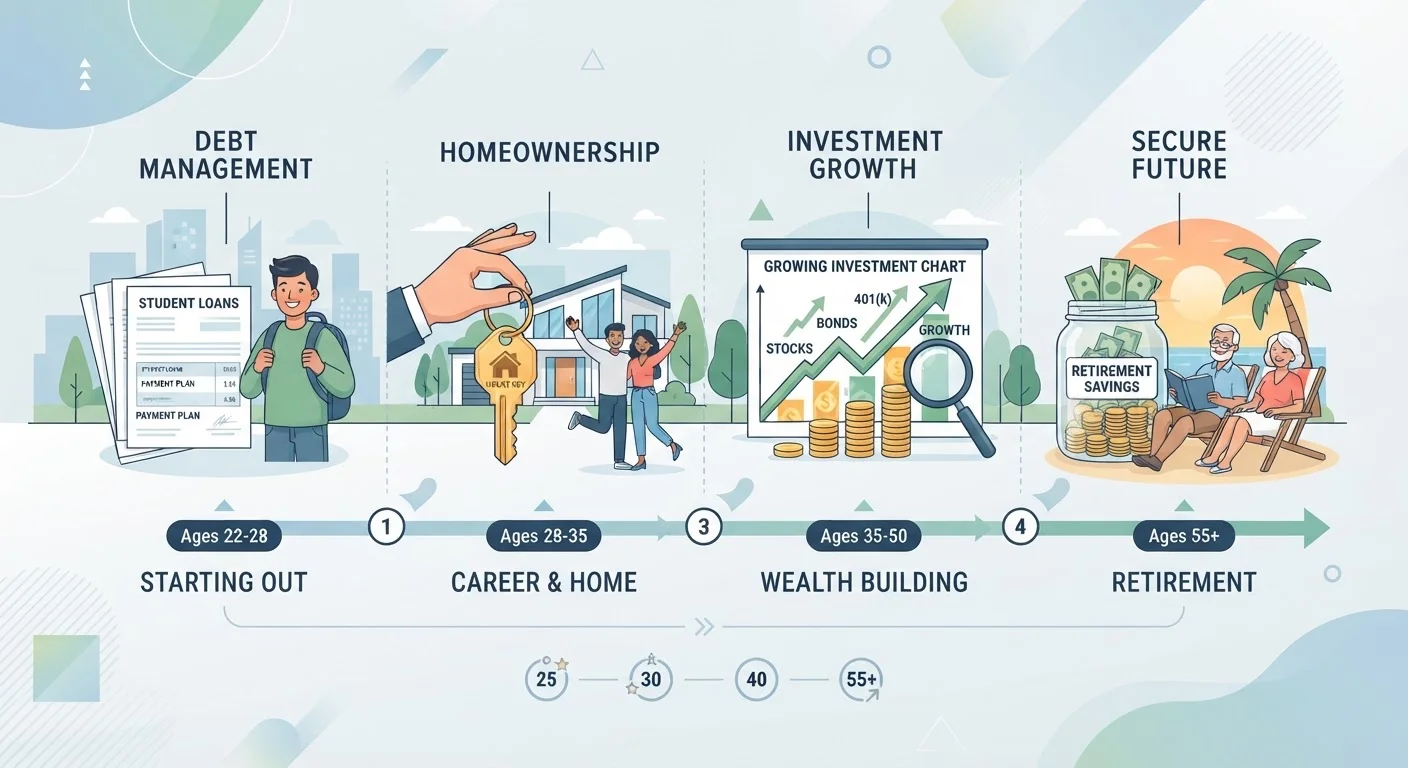
Why Debt and Credit Look Different at Every Stage
Debt is not a single, static problem to be solved once and forgotten. It's a moving target that changes shape depending on your income, obligations, goals, and life circumstances. A student loan that makes sense at 22 creates a very different financial picture at 42. A mortgage that represents responsible leverage in your 30s can feel burdensome if you're carrying it into retirement.
Understanding how debt and credit evolve across adult life helps you make proactive decisions rather than reactive ones. Before diving into each stage, it helps to have a firm grasp of the terminology involved. Our plain-language debt and credit glossary covers the essential concepts — APR, credit utilisation, delinquency, and more — that appear throughout this guide.
$104,215
Average US household debt (2023)
According to the Federal Reserve's Survey of Consumer Finances, total household debt including mortgages, auto, student, and credit card balances.
43%
Maximum DTI for most mortgage approvals
The Consumer Financial Protection Bureau identifies 43% debt-to-income ratio as a common qualifying threshold for qualified mortgages.
30%
Credit utilisation guideline for good scores
Major credit scoring models treat utilisation above 30% as a negative signal; utilisation under 10% is generally associated with the strongest scores.
Your 20s: Building Credit from Scratch
For most people, the 20s are defined by two credit realities: limited history and high student debt. The Consumer Financial Protection Bureau notes that a thin credit file — meaning fewer than five accounts or a short history — can make it difficult to qualify for mainstream credit products at favorable rates.
The priority in this decade is establishing a credit foundation. This means opening a credit card and using it responsibly, making every payment on time, and keeping the balance well below the credit limit. Credit utilisation — the share of available credit you're currently using — is one of the most influential factors in your credit score. Keeping it under 30% is a widely cited guideline; under 10% is generally better still.
Student loans, when managed carefully, can also help build payment history. However, they can create strain when income is low. Federal income-driven repayment plans exist specifically to address this gap — explore them early rather than defaulting or deferring unnecessarily.
Start Credit-Building Before You Need to Borrow
Many lenders require at least six months of credit history before generating a score. Opening a secured credit card or becoming an authorized user on a trusted family member's account can establish that foundation before you need it for something important — like renting an apartment or financing a car.
For a deeper look at why responsible borrowers still run into trouble in this period, see our piece on why good borrowers end up in deep debt.
Your 30s: Balancing Major Debt Obligations
The 30s often bring the largest debt commitments of adult life: mortgages, car loans, and for many, lingering student debt — sometimes alongside a growing family and the costs that come with it. The risk in this decade is overextension: taking on multiple large obligations before income has sufficiently grown to support them comfortably.
A practical benchmark many financial educators reference is the debt-to-income (DTI) ratio — your monthly debt payments divided by gross monthly income. Lenders typically prefer a DTI below 43% for mortgage qualification, though a lower ratio generally signals a healthier financial position. Tracking yours periodically helps you spot stress before it becomes a crisis.
When juggling a mortgage, car payment, and remaining student debt in your 30s, list every debt with its rate and minimum payment before deciding where to send extra dollars. Structure beats intuition when money is tight.
Without a clear picture of all obligations, it's easy to overpay on low-rate debt while high-rate balances compound — a common and costly mistake.
In your 20s, treat your first credit card as a credit-building tool, not a spending tool. Charge only what you can pay in full each month, and set up autopay for at least the minimum to protect against missed payments.
A single late payment can remain on a credit report for up to seven years, damaging score and borrowing costs far beyond the original mistake.
This is also the decade to choose a structured repayment strategy for any high-interest consumer debt. The debt snowball and debt avalanche methods offer two complementary frameworks — one optimises for motivation, the other for minimising total interest paid.
Your 40s: Reducing Debt While Building Wealth
By the 40s, income typically peaks for many households, creating an opportunity to simultaneously pay down debt and accelerate savings. The core tension is allocation: every dollar directed toward extra mortgage payments is a dollar not going into a retirement account. The right balance depends on interest rates, tax considerations, and individual risk tolerance — factors worth discussing with a licensed financial adviser.
High-interest debt (credit cards, personal loans above roughly 7–8%) generally warrants priority payoff. Low-rate mortgage debt, by contrast, may be less urgent to eliminate aggressively if tax-advantaged retirement contributions would otherwise be missed. That said, carrying any high-interest revolving balance into this decade is a significant drag on wealth accumulation.
Lifestyle Inflation Can Quietly Undo Progress
Income growth in your 40s can mask an underlying problem: expenses and debt rising in lockstep with earnings. Regularly comparing your debt-to-income ratio year over year — not just your income — helps confirm you're actually making financial progress rather than running in place. If your payments are growing as fast as your paycheck, the risk is still there.
This is also when early warning signs of debt overload tend to surface quietly — lifestyle inflation, reliance on credit for regular expenses, or minimum-only payments. Identifying these patterns early gives you the most room to course-correct.
Your 50s and Beyond: Protecting What You've Built
As retirement approaches, the goal shifts from accumulation to protection. Entering retirement with significant high-interest debt substantially increases the income you'll need to draw from fixed or investment-based sources — which in turn accelerates portfolio depletion. Financial planning professionals commonly advise having consumer debt eliminated and being on a clear path to mortgage payoff before leaving full-time employment.
Credit management remains relevant in retirement, not for new borrowing necessarily, but because your credit score still affects insurance pricing in many states, potential refinancing access, and the terms of any credit line you might use for liquidity. Maintaining a modest, paid-off credit card keeps your file active without adding risk.
For retirees who do carry debt, fixed income makes the principles of responsible borrowing even more critical — there is less margin to recover from a misstep at this stage.
Social Security and Debt Garnishment
While most Social Security benefits are protected from general creditor garnishment under federal law, they are not fully protected in all circumstances — federal student loans and certain tax obligations are notable exceptions. Retirees carrying unresolved federal debts should seek guidance from a financial or legal professional before assuming their income is fully protected.
Credit Habits That Serve You at Any Age
Across every decade, a small set of behaviors consistently separates strong credit profiles from troubled ones. These are not sophisticated strategies — they are deliberate, sustained habits:
- Pay on time, every time. Payment history is the single largest factor in most credit scoring models.
- Keep utilisation low. High balances relative to limits signal risk to lenders and score models alike.
- Don't open credit unnecessarily. Each application generates a hard inquiry and lowers average account age, both of which can drag scores.
- Monitor your reports regularly. Errors and fraudulent accounts appear more often than most people expect. Federal law entitles US consumers to free reports from each major bureau annually.
- Avoid closing old accounts carelessly. Length of credit history matters, and closing an old card can shorten your average account age.
Sound credit habits integrate naturally with broader budgeting discipline. Our complete guide to budgeting basics covers how debt management fits within the full picture of personal finance planning.
This article is for general informational and educational purposes only and does not constitute personalised financial, tax, or legal advice. Consult a qualified financial professional before making decisions about your specific situation.
The content on this site is for informational purposes only and is not a substitute for professional advice. Always consult a qualified professional for guidance specific to your situation.