

Our Verdict
Neither home training nor gym training holds a universal edge — both can support strength, cardiovascular fitness, and body composition goals. The right choice depends on an individual's budget, lifestyle, available space, and what environment helps them show up consistently. Many people find a hybrid approach most sustainable.
| Best for | Recommended |
|---|---|
| Those with limited time or unpredictable schedules | Home Training |
| Those pursuing advanced strength or sport-specific goals requiring specialized equipment | Gym Training |
| Those who benefit from structure, community, or professional coaching | Gym Training |
| Those prioritizing long-term cost savings and workout flexibility | Home Training |
The Core Question: What Actually Drives Fitness Progress?
Before comparing environments, it helps to understand what exercise science consistently identifies as the real drivers of progress: progressive overload (gradually increasing the challenge placed on your muscles or cardiovascular system), adequate recovery, and consistency over time. Neither your zip code nor the brand on the weight rack determines those outcomes.
Research published in exercise science literature repeatedly shows that adherence — simply showing up and training regularly — is the strongest predictor of long-term fitness improvement. This means the environment that makes consistency easiest for you is, practically speaking, the more effective one. With that foundation in place, the practical trade-offs between home and gym become clearer.
For a broader look at what exercise really does and doesn't do, see our examination of enduring fitness myths grounded in current evidence.
Equipment, Space, and What You Can Actually Do
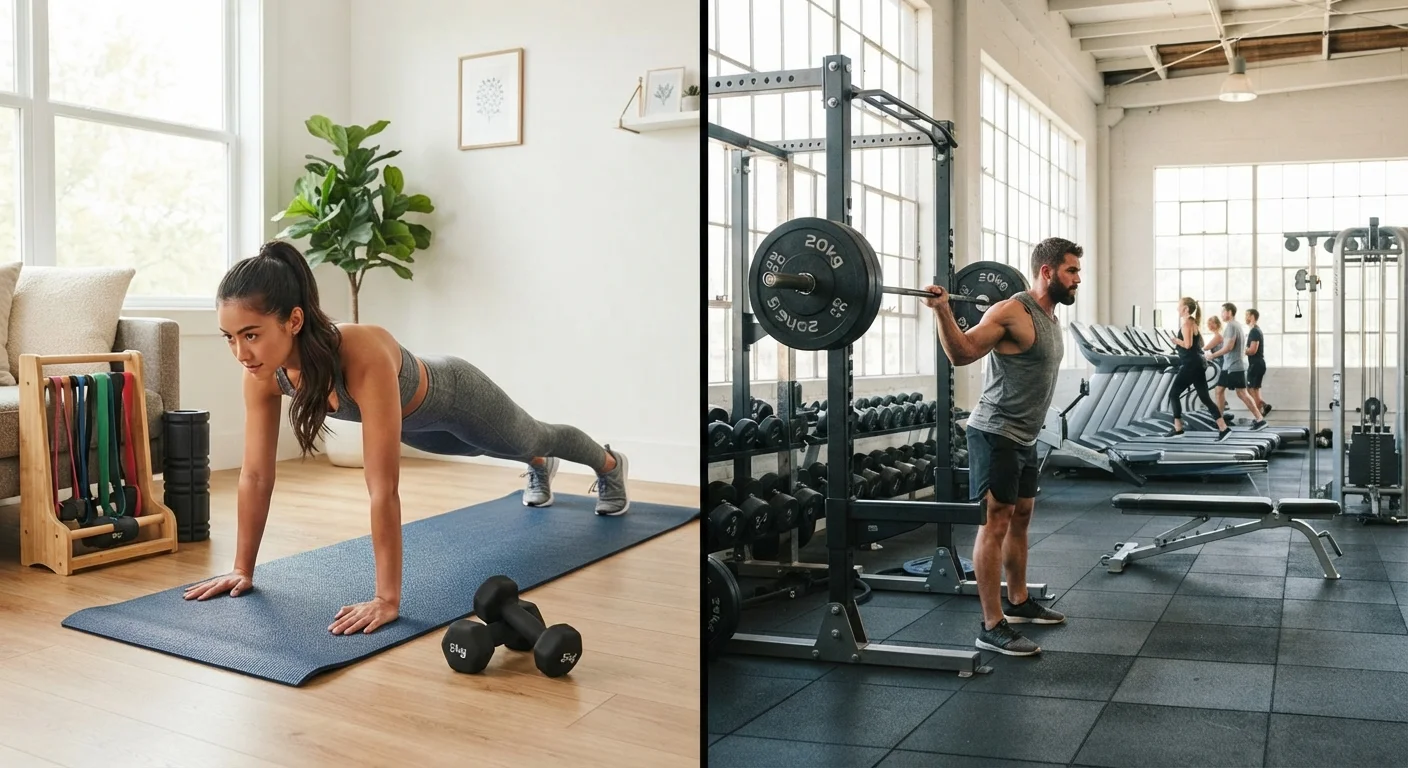
This is where the gap between home and gym is most concrete. A commercial gym typically offers a full range of barbells, cable machines, resistance equipment, and cardio machines — enabling virtually any training style, from powerlifting to sport-specific conditioning.
Home setups vary enormously. A pair of adjustable dumbbells and a pull-up bar open up a surprisingly wide range of exercises, particularly for beginners and intermediate trainees. Bodyweight training — push-ups, lunges, rows using a sturdy table — can build meaningful strength and cardiovascular fitness with no equipment at all. However, advanced strength goals (such as heavy compound lifting) genuinely require more load than most home setups can provide affordably.
Space is a real constraint. Effective home training requires a footprint of roughly 6×6 feet of clear floor — achievable in most living rooms, but worth assessing honestly before committing. Our companion piece on bodyweight versus free-weight training explores what each approach builds and where each excels.
| Home Training | Gym Training | |
|---|---|---|
| Upfront cost | Low to moderate (equipment one-time purchase) | Low (membership deposit or joining fee) |
| Ongoing cost | Minimal after setup | $10–$80+ per month |
| Equipment variety | Limited by budget and space | Extensive, regularly maintained |
| Convenience | Very high — no commute required | Requires travel and scheduling |
| Social accountability | Minimal unless self-directed | High — trainers, classes, peers |
| Privacy | Complete | Shared public environment |
| Suitability for advanced strength goals | Limited without significant investment | Well-suited with full equipment range |
Cost: Upfront vs. Long-Term
Gym memberships in the US typically range from roughly $10 to $80+ per month depending on facility tier and location, with some premium gyms exceeding that. Over five years, even a modest $30/month membership totals $1,800. A well-chosen home setup — adjustable dumbbells, resistance bands, a pull-up bar — can be assembled for a few hundred dollars and lasts years with minimal maintenance cost.
The calculus shifts, however, if a home gym grows to include a barbell, rack, and bench. That investment can run $500–$1,500 or more. For those who use a gym sporadically, a home setup often delivers better value. For those who train six days a week and use specialized equipment regularly, a gym membership may be more cost-efficient than replicating that infrastructure at home.
Start With What You'll Actually Use
The most sophisticated gym membership or home equipment setup delivers zero benefit if it goes unused. Before investing in either, honestly assess your schedule, motivation style, and past exercise patterns. A modest, accessible setup that you use consistently will outperform an elaborate one you avoid. Consider starting with a low-cost trial — a short-term gym pass or a few basic home tools — before making a larger commitment.
Motivation, Accountability, and the Social Factor
Research in exercise psychology consistently finds that social support and environmental cues influence exercise behavior. For many people, the act of traveling to a gym — and being surrounded by others training — provides meaningful motivational momentum. Personal trainers, group fitness classes, and training partners are all resources a gym environment provides that home training generally does not.
Home training, by contrast, removes barriers but also removes external accountability. This suits highly self-directed individuals well. Those newer to structured exercise, or those who have struggled with consistency, may find a gym's social infrastructure genuinely useful — not merely as a luxury, but as a behavioral support system. If you're just starting out with resistance work, common beginner mistakes in resistance training are worth reviewing regardless of where you train.
~50%
Adults who cite convenience as top exercise barrier
A Centers for Disease Control and Prevention (CDC) survey found that time and convenience are among the most commonly cited barriers to regular physical activity among US adults.
~80%
US adults not meeting federal activity guidelines
According to the US Department of Health and Human Services, roughly 80% of American adults do not meet the recommended guidelines for both aerobic and muscle-strengthening activity.
Flexibility, Privacy, and Lifestyle Fit
Home training wins decisively on convenience. No commute, no waiting for equipment, no shared locker rooms — and the ability to train at 5 a.m. or 11 p.m. without restriction. For parents of young children, shift workers, or those in areas with limited gym access, this flexibility is not a minor perk but a meaningful enabler of consistent exercise.
Privacy matters to many people, particularly those new to exercise or recovering from injury who may feel self-conscious in a public setting. Training at home removes that friction entirely. Gyms that offer quieter off-peak hours or designated beginner areas can partially address this, but home training remains the more private option by default.
Whichever environment you choose, physical activity outside of structured sessions compounds your results significantly. Everyday movement habits — from walking to posture — contribute meaningfully to overall fitness over time.
This article is for general informational and educational purposes only and does not constitute medical or professional fitness advice. Consult a qualified healthcare or fitness professional before beginning any new exercise program, especially if you have an existing health condition.
The content on this site is for informational purposes only and is not a substitute for professional advice. Always consult a qualified professional for guidance specific to your situation.