

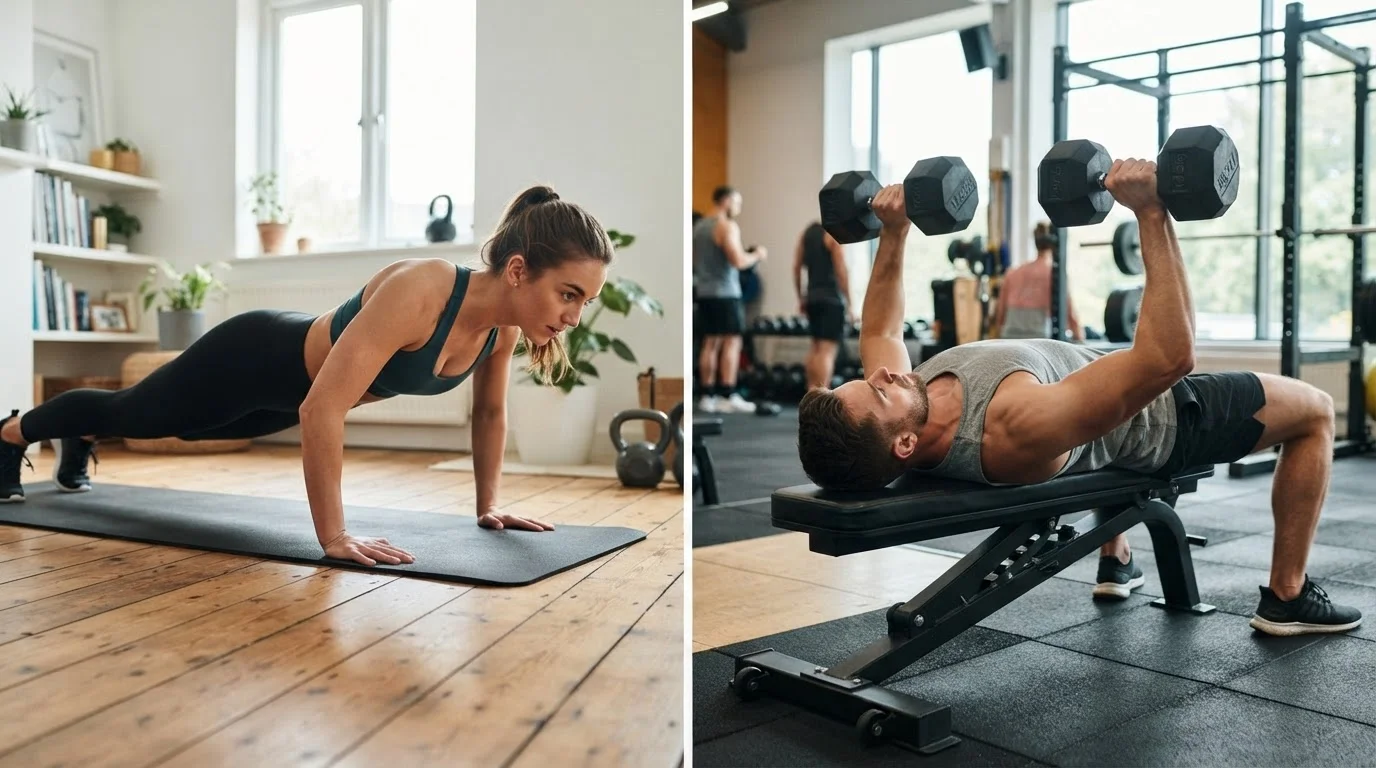
Option A
Bodyweight Training
The accessible, anywhere foundation of functional strength.
Best for: Beginners building movement patterns, travelers, and anyone prioritizing convenience and joint-friendly progression.
Option B
Free Weights
The precise, scalable tool for targeted strength and muscle development.
Best for: Intermediate to advanced exercisers seeking measurable progressive overload and muscle-specific hypertrophy.
What Each Method Actually Does to Your Body
Both bodyweight training and free-weight training belong to the category of resistance exercise — they both challenge muscles against an opposing force, stimulating the neuromuscular adaptations that build strength, endurance, and muscle tissue. The physiological mechanisms are essentially the same. What differs is how load is applied and how easily that load can be varied.
Bodyweight training uses your own body mass as resistance. Exercises like push-ups, pull-ups, squats, and dips engage multiple muscle groups simultaneously and tend to emphasize relative strength — how strong you are relative to your own weight. Because the load is fixed at your body weight, progression happens by changing leverage (elevating feet during push-ups, for example), reducing base of support, or adding volume and tempo manipulation.
Free weights — dumbbells, barbells, and kettlebells — apply an external, adjustable load. This makes it straightforward to add small, measurable increments over time, which is the core mechanism behind progressive overload, the principle responsible for virtually all long-term fitness gains. Research consistently shows that when volume and effort are matched, both modalities produce comparable strength and hypertrophy outcomes — but free weights make that matching easier to control and document.
This article is for general informational and educational purposes only and does not constitute medical or exercise advice. Consult a qualified healthcare or fitness professional before beginning any new training program.
Head-to-Head: Key Differences at a Glance
Understanding the practical trade-offs between these two methods helps you match the right tool to your specific situation. The comparison below covers the factors most people encounter when deciding how to structure their training.
| Criterion | Bodyweight Training | Free Weights |
|---|---|---|
| Equipment required | None (minimal space only) | Dumbbells, barbells, or kettlebells |
| Load adjustability | Indirect (leverage, tempo, volume) | Direct, precise increments |
| Progressive overload ease | Moderate — requires creativity | High — straightforward to track |
| Movement quality development | High — multi-joint, stabilizer-rich | Moderate — depends on exercise choice |
| Muscle isolation potential | Low to moderate | High |
| Hypertrophy potential | Moderate to high with advanced progressions | High across experience levels |
| Injury risk for beginners | Generally lower | Moderate — technique-dependent |
| Cost | Effectively zero | Variable; moderate to significant upfront |
| Portability | Complete — no equipment to transport | Low — requires gym or home setup |
One nuance worth noting: "free weights" covers a wide range of implements. A single kettlebell, for instance, is technically free-weight training but can be used almost anywhere — blurring the equipment-access advantage that bodyweight training traditionally holds. Similarly, gymnastic rings and resistance bands can extend bodyweight progressions considerably. The boundaries between categories are more porous in practice than they appear on paper.
Where Bodyweight Training Genuinely Excels
Bodyweight training's biggest underappreciated strength is its emphasis on movement quality. Because exercises require managing your body through space rather than pushing or pulling a fixed implement, they develop proprioception (your body's sense of its own position), joint stability, and coordinated muscle activation patterns that transfer well to everyday movement and sport.
Core involvement is also typically higher in bodyweight work. A push-up, performed correctly, requires the entire trunk to maintain a rigid plank position throughout the movement — meaning the chest, shoulders, and triceps are never isolated from the stabilizing role of the core. This integration is often cited as a reason bodyweight training translates effectively to athletic performance.
~Equal
Strength gains: bodyweight vs. free weights
A 2017 meta-analysis in the Journal of Human Kinetics found no statistically significant difference in strength outcomes between bodyweight and weighted resistance training when volume and intensity were equated.
70%+
Core muscle activation in push-up variants
Studies using electromyography have reported substantial trunk muscle activation during push-up variations, highlighting the integrated nature of bodyweight movements.
48–72 hrs
Recommended recovery between sessions for same muscle group
The American College of Sports Medicine advises allowing 48 to 72 hours of recovery between resistance training sessions targeting the same muscle group, regardless of equipment used.
Beginners especially benefit from starting with bodyweight movements. Learning to control your own body weight before adding external load reduces injury risk and builds the movement literacy that makes free-weight training safer later. For more on common pitfalls that new exercisers encounter, see where beginners go wrong with resistance training.
The convenience factor is also real. A consistent bodyweight routine performed at home can match gym-based training for many outcomes — as discussed in the trade-off analysis of training at home versus at a gym.
Where Free Weights Have the Edge
The primary advantage of free weights is load specificity. You can add 2.5 lbs to a barbell, repeat the same movement pattern, and directly measure whether you are progressing. This precision is difficult to replicate with bodyweight training, where progression is typically less linear and harder to quantify.
For muscle hypertrophy specifically — increasing the size of muscle tissue — research supports that mechanical tension and metabolic stress driven by sufficiently heavy loads are key drivers. Free weights allow you to reach challenging loads across a wide rep range without relying on leverage tricks or extreme tempo manipulation. This makes them particularly well-suited to structured hypertrophy programs.
Hypertrophy Requires Sufficient Challenge
Research suggests that muscles grow most effectively when trained close to their maximum effort capacity — typically within a few repetitions of failure — rather than through high volume at low effort. This principle applies equally to bodyweight and free-weight training. With bodyweight work, achieving that level of challenge requires selecting sufficiently difficult exercise progressions, not simply adding more easy repetitions.
Free weights also allow greater isolation of specific muscle groups when that is the goal. Exercises like Romanian deadlifts, lateral raises, or bicep curls target muscles in a way that bodyweight training generally cannot replicate without additional implements. For anyone managing muscle imbalances or rehabilitating a specific area under professional guidance, this specificity can be clinically useful.
It is worth noting that resistance training of any kind — whether bodyweight or free weight — represents a different physiological stimulus than cardiovascular exercise. For a clear breakdown of how they compare, see cardio vs. strength training.
Building a Smarter Approach: Using Both Strategically
Framing bodyweight training and free weights as competing options misses the bigger picture. Most effective, well-designed training programs incorporate both. A common approach is to use free weights for compound strength movements — squats, deadlifts, presses — and complement them with bodyweight exercises for core work, mobility, and higher-rep accessory training.
For those who cannot access a gym consistently, a well-structured bodyweight program with deliberate progression is not a compromise — it is a legitimate path to meaningful fitness gains, provided effort and consistency are maintained. The key variable, as always, is applying progressive challenge over time. Common fitness myths often oversimplify this decision into an either-or question, but the evidence supports flexibility.
Ultimately, the best resistance training method is the one you will perform consistently, progress systematically, and sustain over the long term. Both bodyweight training and free weights can deliver that — the choice comes down to your goals, resources, and where you are in your fitness journey.
The content on this site is for informational purposes only and is not a substitute for professional advice. Always consult a qualified professional for guidance specific to your situation.