

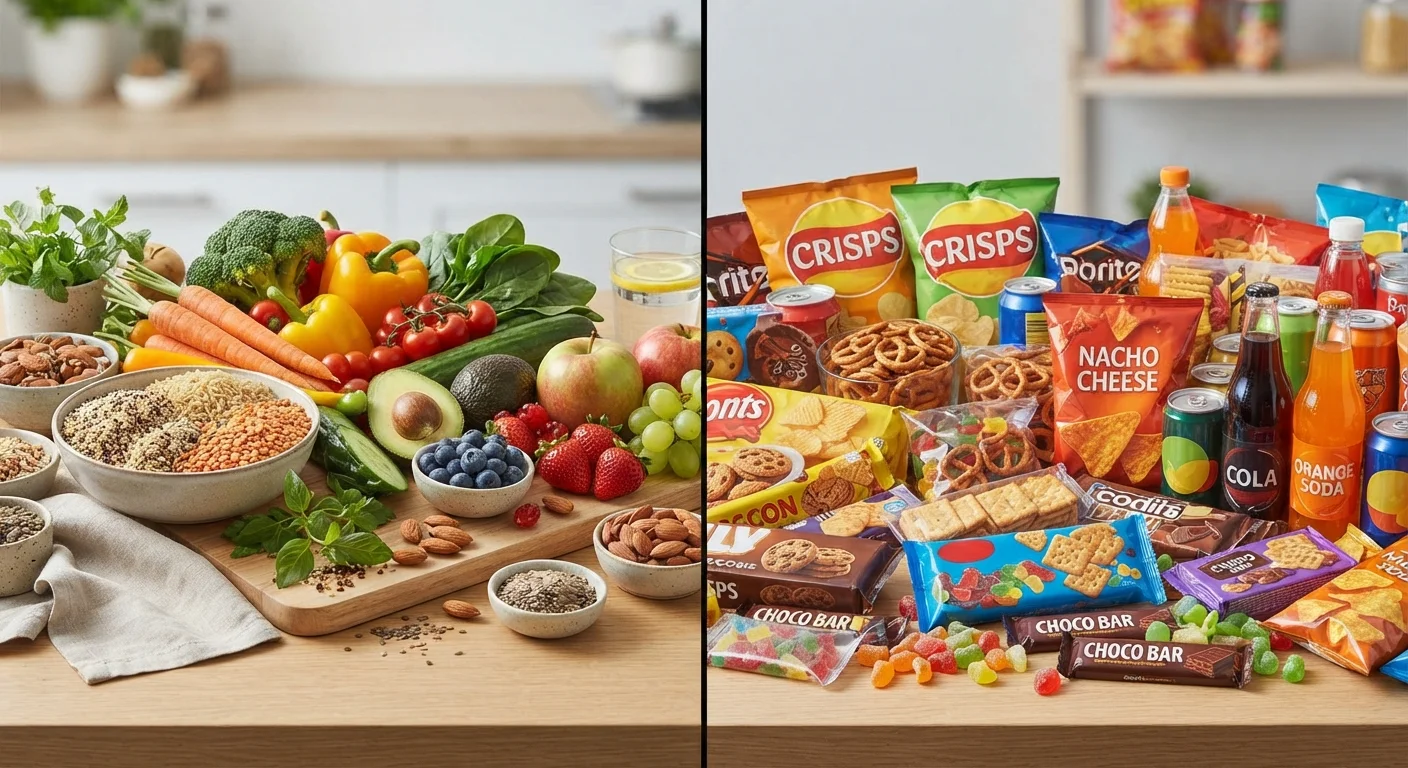
Option A
Whole Foods
Minimally processed, nutrient-dense foods as close to their natural state as possible.
Best for: People looking to maximize micronutrient intake, fiber, and diet quality over the long term.
Option B
Ultra-Processed Foods
Industrially formulated products with multiple additives beyond basic cooking ingredients.
Best for: Understanding what to limit — and recognizing where these foods fit in a realistic, balanced diet.
Defining the Terms: What Do These Categories Actually Mean?
The phrase "whole foods" refers to items that are unrefined or minimally processed — think fresh vegetables, fruit, legumes, whole grains, nuts, and eggs. They reach your plate with their natural nutrient matrix largely intact.
"Ultra-processed" is a more technical classification, formalized by the NOVA food classification system developed by researchers at the University of São Paulo. NOVA categorizes foods into four groups based on the extent and purpose of processing. Ultra-processed foods (NOVA Group 4) are industrial formulations containing ingredients rarely found in home kitchens — such as hydrolyzed proteins, modified starches, emulsifiers, flavor enhancers, and artificial colorings — combined with high amounts of added sugar, sodium, and refined fats.
This distinction matters because a food can be both processed and nutritious (plain canned tomatoes, frozen vegetables) or minimally processed yet still low in nutritional value. The NOVA framework shifts focus from individual nutrients to the overall nature of the food product. For a deeper dive into decoding what's in packaged foods, see how to read a nutrition label.
| Criterion | Whole Foods | Ultra-Processed Foods |
|---|---|---|
| Definition | Unrefined or minimally processed | Industrially formulated with additives |
| Fiber content | Naturally high in most plant foods | Often low or added back artificially |
| Micronutrients | Intact within natural food matrix | Often reduced; some added synthetically |
| Additives & preservatives | Absent or minimal | Emulsifiers, flavors, colors common |
| Satiety per calorie | Generally higher | Generally lower |
| Long-term disease risk (research) | Associated with lower risk | Associated with higher risk |
| Cost & convenience | Variable; often requires preparation | Typically lower cost; highly convenient |
What the Evidence Shows About Health Outcomes
The research landscape has shifted substantially over the past decade. A landmark 2019 randomized controlled trial by Hall and colleagues at the National Institutes of Health directly compared ultra-processed and unprocessed diets in a controlled inpatient setting. Participants on the ultra-processed diet consumed approximately 500 more calories per day and gained weight, while those on the unprocessed diet lost weight — even though both groups were given unlimited access to food matched for total available sugar, fat, fiber, and macronutrients.
Large epidemiological studies have also found consistent associations. A 2019 prospective cohort study published in The BMJ involving over 100,000 French adults found that a 10% increase in the proportion of ultra-processed food in the diet was associated with significantly higher rates of cardiovascular disease. Similar associations have been reported for type 2 diabetes, depression, colorectal cancer, and all-cause mortality in subsequent studies.
It's important to note that most large studies in this area are observational — they show associations, not definitive causation. Diet is difficult to isolate from other lifestyle factors. That said, the consistency of findings across different populations and study designs strengthens the overall picture.
~500 kcal/day
Extra calories consumed on ultra-processed diet
In a 2019 NIH randomized controlled trial by Hall et al., participants eating ultra-processed food consumed around 500 more calories daily than those on an unprocessed diet.
10%+
Increase in cardiovascular disease risk
A 2019 BMJ prospective cohort study of over 100,000 adults found a statistically significant rise in cardiovascular disease associated with a 10% increase in ultra-processed food intake.
58%
Of U.S. adult calorie intake from ultra-processed foods
Research published in BMJ Open using NHANES data estimated that ultra-processed foods account for more than half of total daily calorie intake among U.S. adults.
For context on how dietary patterns interact with broader nutrition myths, common nutrition myths examined against the evidence offers useful background.
Why Whole Foods May Benefit Health Beyond Their Nutrients
One reason whole foods appear beneficial isn't simply that they contain more vitamins and minerals — it's that nutrients in whole food matrices behave differently than isolated or synthetic equivalents. Fiber in whole grains, for example, feeds beneficial gut bacteria, slows glucose absorption, and promotes satiety in ways that added fiber in processed products may not fully replicate.
Phytonutrients — compounds like polyphenols in berries or carotenoids in leafy greens — are often reduced or absent in ultra-processed alternatives. These compounds are associated with anti-inflammatory effects in research settings, though the exact mechanisms are still being studied.
Ultra-processed foods, conversely, are engineered for palatability and long shelf life, which can work against natural hunger and fullness cues. Research suggests their combination of refined carbohydrates, added fats, salt, and flavor compounds may override normal satiety signaling more readily than less refined alternatives.
This article is part of a broader nutritional resource — see a complete guide to eating well for more on building a nutritionally sound long-term diet.
Practical Takeaways: Making the Shift Without Overhauling Everything
Nutrition research consistently shows that incremental, sustainable changes outperform drastic dietary overhauls for most people. You don't need a perfect diet to meaningfully improve diet quality. A few evidence-informed starting points:
- Anchor meals with whole food sources: Build plates around vegetables, legumes, whole grains, or minimally processed proteins before adding convenience items.
- Use ingredient lists as a quick screen: A very long list containing many unfamiliar additives is a reliable signal of ultra-processed status, even when front-of-pack claims suggest otherwise.
- Swap selectively, not wholesale: Replacing one or two regular ultra-processed choices — a packaged snack, a sweetened drink — with a whole food equivalent adds up significantly over time.
- Consider food context: Eating patterns matter more than individual foods. A diet rich in variety across whole food groups is more robustly supported by evidence than optimizing single items.
If you're also considering how supplements fit alongside a whole food approach, what dietary supplements can and cannot do provides a grounded, evidence-based overview. For those exploring different dietary patterns, plant-based vs. omnivorous eating examines how food quality considerations apply across dietary styles.
Processing Isn't Always a Problem
Not all food processing is harmful. Frozen vegetables, plain canned legumes, and pasteurized dairy are processed but retain strong nutritional profiles. The concern centers specifically on ultra-processed products (NOVA Group 4) formulated with additives designed to enhance palatability rather than preserve or prepare whole ingredients. Understanding this nuance helps avoid unnecessary food anxiety while still applying the evidence practically.
This article is for general informational and educational purposes only and does not constitute medical or dietary advice. Consult a qualified healthcare professional or registered dietitian before making significant changes to your diet, particularly if you have an existing health condition.
The content on this site is for informational purposes only and is not a substitute for professional advice. Always consult a qualified professional for guidance specific to your situation.