

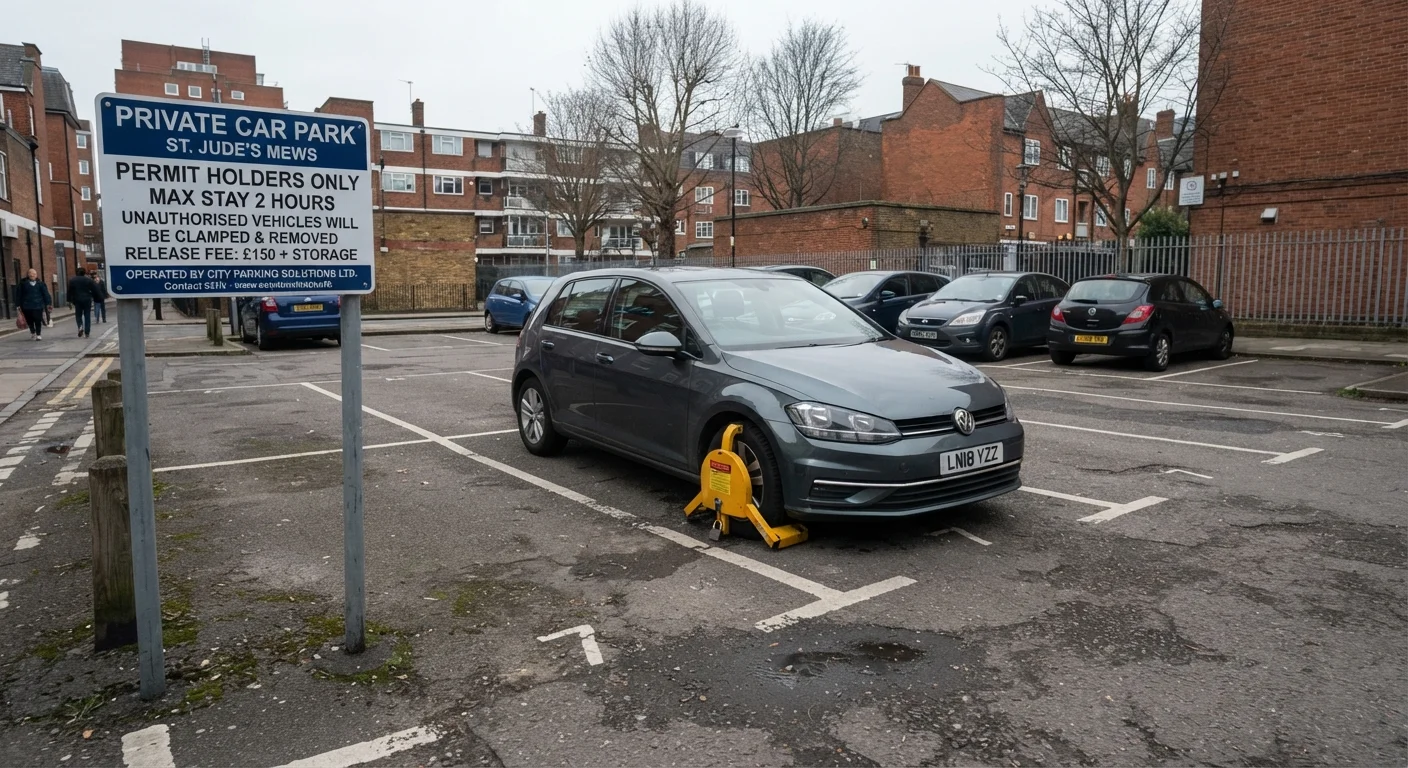
The Legal Difference Between Private and Government Parking Enforcement
When a government-authorized officer issues a parking ticket on a public street, that notice carries statutory weight — it is backed by local ordinances or state law, and non-payment triggers escalating penalties through official channels. A private parking charge operates in an entirely different legal space.
Private lots — whether at a shopping center, apartment complex, or hospital — are controlled by landowners or the parking management companies they contract. Any charge they issue is a civil contractual claim: the company argues that by parking in the lot, you entered into an agreement (defined by the posted signage) and then breached it. There is no statutory fine involved. This matters enormously when deciding how to respond.
Because the charge is civil rather than criminal, the issuing company bears the burden of proving their case if they pursue it through the courts. That burden includes demonstrating that adequate signage was posted, that you were the responsible party, and that the claimed amount is reasonable. For a fuller picture of the costs associated with car ownership beyond routine expenses, see our guide on the true cost of owning a car.
State Law Governs Your Rights
Private parking enforcement is regulated at the state level in the U.S., not federally. This means the rules on clamping, notice requirements, data access for license plate lookup, and fee caps differ from state to state. Before deciding how to respond to a private parking charge, check your state attorney general's website or a qualified legal resource for the specific rules that apply in your jurisdiction.
When Wheel Clamping Is and Isn't Permitted
Wheel clamping by private parties is a contentious area, and the law varies sharply by state. The short version for most U.S. drivers: private clamping is banned or tightly restricted in a significant number of states, and enforcement-without-authority can expose the clamping party to civil liability for trespass to chattels or conversion.
States that have moved to restrict or ban private clamping did so largely in response to predatory practices — vehicles clamped moments after the meter expired, excessive release fees, and aggressive tactics that left drivers with little recourse. Where clamping does remain legal, operators are typically required to post conspicuous notice of the practice, maintain accessible release procedures, and charge fees within regulatory limits.
If your vehicle is clamped on private property, do not attempt to remove the clamp yourself, as this may constitute property damage. Instead, document the scene thoroughly — photograph the clamp, the surrounding signage, and any payment information provided — then request release information and follow up with your state attorney general's office or a consumer protection agency if you believe the clamping was unlawful.
Document the Scene Before You Leave
If you suspect a parking situation could lead to a dispute, photograph the signage, meter or pay station, the position of your vehicle, and any timestamps visible on your phone. This evidence is far easier to gather on the spot than to reconstruct later, and it forms the backbone of any successful appeal. Time-stamped photos are particularly persuasive in written appeals and court proceedings.
How to Assess Whether a Charge Is Enforceable
Not every private parking notice you receive is one you are legally obligated to pay. Before sending payment, consider the following checklist:
- Was signage clearly visible and readable? Courts have consistently held that a valid contract requires the driver to have had a genuine opportunity to see and understand the terms. Faded, obstructed, or absent signs undermine enforceability.
- Is the charge amount proportionate? Wildly inflated charges may be challenged as penalties rather than genuine pre-estimates of loss — a distinction that courts treat seriously.
- Is the issuing company properly authorized? Some companies issue notices without a valid contract from the landowner. Requesting proof of their authority to manage that lot is a legitimate part of your response.
- Were you the driver? If another person was operating your vehicle, you may be able to redirect liability to them.
Answering these questions before responding will shape your appeal strategy. New drivers especially benefit from understanding these dynamics early — our article on owning your first car covers other often-overlooked realities of car ownership.
30+
U.S. states restricting or banning private clamping
Legal analyses of state-by-state parking enforcement laws consistently show a majority of states have enacted restrictions on private wheel clamping practices.
14–30 days
Typical appeal window on private parking notices
Most private parking operators set appeal deadlines in this range; missing the window can limit your formal options for dispute resolution.
Civil claim
Legal classification of private parking charges
Unlike government-issued penalty charge notices, private parking charges are contractual civil claims, meaning the issuing company must prove their case if the matter goes to court.
The Appeals Process and What to Expect
Most private parking companies have a formal appeals procedure, and you should use it before considering payment or escalation. The standard process works roughly as follows:
- Submit a written appeal to the company within the deadline printed on your notice — typically between 14 and 30 days. State your grounds clearly and attach evidence: photographs, payment receipts, timestamps, or anything that supports your position.
- Wait for their decision. The company is obligated to review your evidence. If they reject your appeal, they should explain why.
- Request independent review if available. Some private parking operators participate in arbitration or independent appeals panels. This is not universal, but where it exists, it provides a lower-cost alternative to court proceedings.
- Evaluate the small claims option. If the company takes you to small claims court, you present your evidence to a judge. Judges have ruled against parking companies that could not demonstrate clear signage or lawful authorization.
Throughout this process, maintain copies of every communication. Courts and arbitration panels look favorably on organized, documented responses. For a broader view of managing your vehicle across its lifetime — including unexpected administrative burdens — see our long-term car ownership guide.
Frequently Asked Questions
Yes, a private parking company can file a civil claim against you in small claims court. However, they must demonstrate that a valid contract was formed — typically through clear, visible signage — and that you breached its terms. Many companies do not pursue litigation for small amounts because the cost outweighs the recovery.
Wheel clamping by private parties is illegal or heavily restricted in the majority of U.S. states. States including California, Illinois, and New York have banned or tightly regulated the practice. If your vehicle is clamped unlawfully, you may have grounds for a civil claim against the clamping company or property owner.
Ignoring the notice will not create a criminal record, but the issuing company may sell the debt to a collections agency, which can affect your credit score. Some states allow private companies to pursue license plate data to identify registered owners, giving them a pathway to follow up on unpaid charges.
Start by submitting a formal written appeal to the issuing company within the timeframe stated on the notice — typically 14 to 30 days. If rejected, many parking management companies participate in independent arbitration schemes. Document your evidence carefully: photographs of signage, payment receipts, and timestamps all strengthen your case.
Not necessarily. If someone else was driving your vehicle at the time the charge was issued, you may be able to provide their details to transfer liability. Rules on this vary by state and by the terms the parking company uses, so review the notice carefully and respond within any stated deadline.
Unclear or absent signage is one of the strongest grounds for appeal. For a contractual parking charge to be enforceable, a driver must have had a reasonable opportunity to read and agree to the terms before parking. If signs were obscured, damaged, or absent, the contract argument substantially weakens.
The content on this site is for informational purposes only and is not a substitute for professional advice. Always consult a qualified professional for guidance specific to your situation.