

Start here
What Makes New Orleans Unlike Any Other U.S. City
Next
Navigating the French Quarter and Beyond
Go deeper
The Neighborhoods First-Timers Often Miss
Enrich your visit
Music, Food, and Living Traditions
Before you travel
Practical Tips Before You Go
What Makes New Orleans Unlike Any Other U.S. City
New Orleans exists at a genuinely rare cultural crossroads. Founded by French colonists in 1718 and later under Spanish rule before becoming part of the United States in 1803, the city absorbed waves of influence — West African, Caribbean, Haitian, and later Irish and Italian — in ways that produced a culture that doesn't map neatly onto any other American city.
That layered history shows up everywhere: in the architecture, in the street names that shift between French and English mid-block, in the food, and most powerfully in the music. Understanding that New Orleans is not simply a "fun party town" but a living repository of American cultural history will reshape how you experience every hour you spend there.
Creole
In the New Orleans context, 'Creole' historically referred to people born in the colony of French or Spanish descent, and later came to describe the mixed-heritage culture, architecture, cuisine, and community that developed in the city — distinct from both European origins and rural Cajun culture.
Shotgun house
A narrow, single-story home style common throughout New Orleans in which rooms are arranged in a straight line front to back, with no hallway. The style has roots in West African and Caribbean architectural traditions.
Second line
A New Orleans street parade tradition rooted in African American brass band culture. The 'second line' refers to community members who follow a formal procession, dancing to live brass band music — a living tradition organized by Social Aid and Pleasure Clubs.
Vieux Carré
French for 'Old Square,' this is the formal name for the French Quarter, the city's original colonial settlement and most architecturally intact historic neighborhood.
Lagniappe
A Louisiana French and Creole term meaning 'a little something extra' — a small bonus or gift. It's used colloquially across New Orleans to describe any unexpected addition or kindness.
Navigating the French Quarter and Beyond
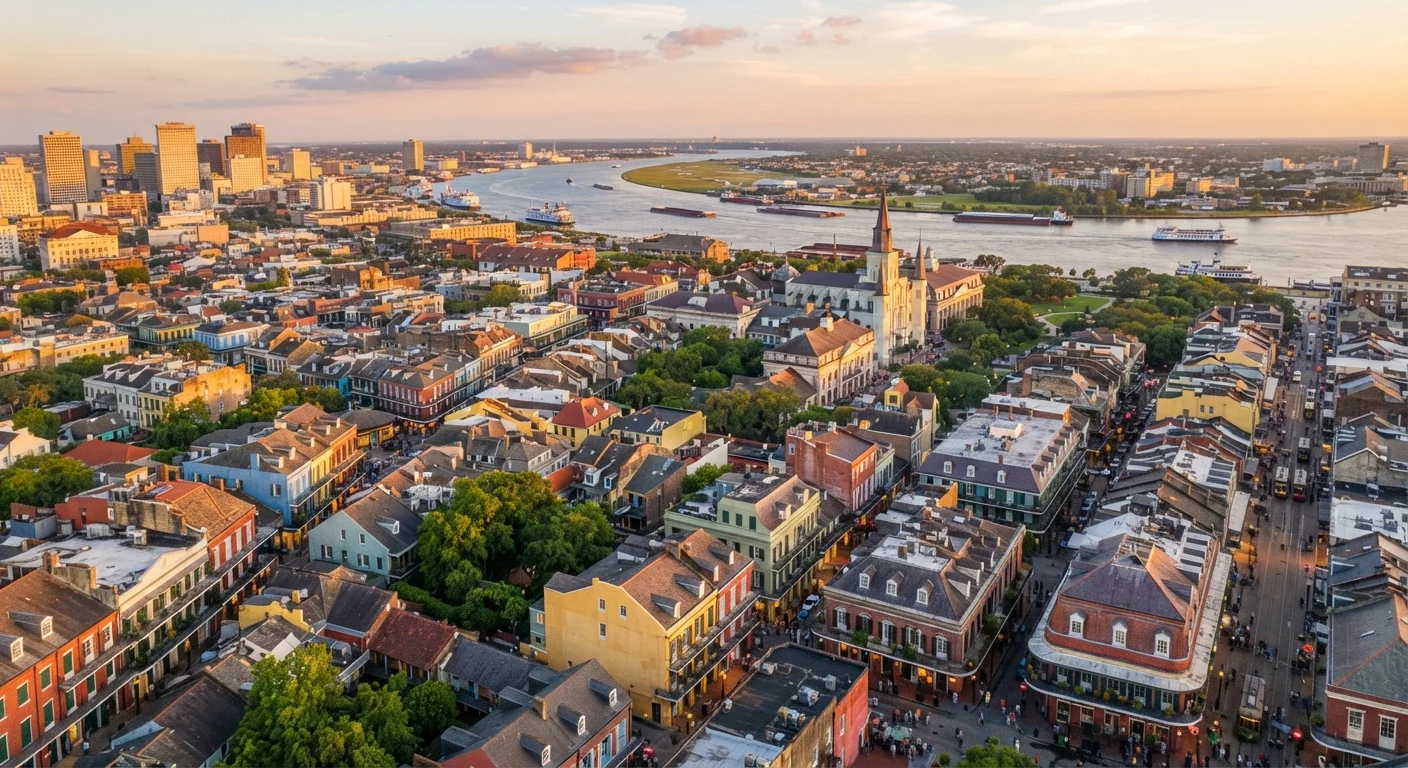
The French Quarter — or Vieux Carré ("Old Square") — is the city's oldest neighborhood and the logical starting point. Its grid of streets lined with Creole townhouses and Spanish colonial buildings survived the fires that destroyed much of the early city and offers some of the best-preserved 18th- and 19th-century urban architecture in the United States.
Bourbon Street draws enormous crowds and delivers a very particular experience, but Jackson Square, the St. Louis Cathedral, the French Market, and the quieter residential blocks above Esplanade Avenue tell a more nuanced story. Spend at least one morning walking the Quarter before the crowds arrive — the architecture reads completely differently in the stillness of early light.
Walk the Quarter Early in the Morning
The French Quarter transforms before 9 a.m. — streets are quiet, the light is soft, and the architecture is far easier to appreciate without crowds. Plan your architectural exploration in the morning and save the busier attractions for midday or evening.
The Neighborhoods First-Timers Often Miss
Most first-time visitors never leave the Quarter and the nearby Warehouse District. That means they miss the neighborhoods that longtime locals and cultural historians consider the soul of the city.
- Tremé: Just north of the French Quarter, the Tremé is widely regarded as the oldest African American neighborhood in the United States and the birthplace of jazz. Its streets, shotgun houses, and community institutions like the Backstreet Cultural Museum carry a history that shaped American music globally.
- Garden District: The antebellum mansions along Prytania Street and St. Charles Avenue reflect the city's 19th-century Anglo-American merchant class and are dramatically different in style from the Creole Quarter.
- Bywater and Marigny: These adjacent neighborhoods downriver from the Quarter blend working-class shotgun house architecture with an active arts and music scene and some of the city's most interesting independent venues.
New Orleans Neighborhoods Change Quickly
Gentrification has reshaped several of the neighborhoods mentioned here, and the cultural landscape evolves from year to year. What was primarily a residential community even a decade ago may look quite different today. Engaging with neighborhood-based cultural organizations and locally run walking tours is one of the best ways to understand these changes in context.
Music, Food, and Living Traditions
New Orleans is one of the few American cities where traditional music is genuinely woven into daily life rather than performed only for tourists. Jazz, blues, brass band, and gospel music can be heard at neighborhood bars, on street corners, and at community events throughout the year — not only on Frenchmen Street, though that strip in the Marigny remains one of the most reliable places to hear live music any night of the week.
The city's culinary tradition deserves its own framework. Dishes like red beans and rice (a Monday tradition tied to wash-day cooking), gumbo, jambalaya, and beignets each carry specific cultural histories worth knowing before you order. The city is also home to a distinct Vietnamese American community in the eastern neighborhoods, whose culinary footprint — particularly in the form of Vietnamese-Creole fusion cooking — has become part of the broader New Orleans food story.
New Orleans & Company (Official Tourism Authority)
The city's official destination marketing organization maintains a comprehensive events calendar, neighborhood guides, and cultural resources — a reliable starting point for planning any visit.
Backstreet Cultural Museum
Located in the Tremé, this community-run museum documents the history of Mardi Gras Indians, second lines, and jazz funerals — some of the most important and least-understood traditions in New Orleans cultural life.
Louisiana State Museum
The Louisiana State Museum operates several historic properties in the French Quarter, including the Cabildo and Presbytere, which offer deep historical context for the city's colonial past and ongoing cultural story.
Practical Tips Before You Go
A few practical realities will help you plan a more rewarding visit:
- Weather: New Orleans sits below sea level in a subtropical climate. Summer (June–September) is intensely hot and humid, with frequent afternoon thunderstorms. Spring and fall are generally more comfortable and coincide with major festivals.
- Getting around: The St. Charles streetcar line runs from Canal Street through the Garden District and Uptown — it's a legitimate way to move around the city, not just a tourist attraction. Many central neighborhoods are walkable, though summer heat makes distances feel longer.
- Flooding awareness: Parts of the city flood during heavy rain. Check local weather forecasts and be aware that some streets can become impassable quickly during storms.
- Respect living culture: Second line parades, jazz funerals, and Mardi Gras Indian practices are community traditions, not performances. Observe respectfully, follow the lead of locals, and ask before photographing participants.
As with any destination, conditions, entry requirements, and local advisories can change. Verify current information through official city, state, and federal government sources before you travel.
Frequently Asked Questions
The French Quarter is one of the most heavily visited areas in the city and is generally well-patrolled, but like any urban tourist district it warrants normal urban awareness — keep valuables out of sight, stay on busy streets at night, and check current local advisories before your trip.
Creole cuisine developed in New Orleans itself, influenced by French, Spanish, African, and Caribbean cooking traditions, and typically uses butter, tomatoes, and complex spice blends. Cajun food originates in rural southwest Louisiana and is generally simpler, spicier, and built around one-pot cooking with local game and seafood.
Late October through early May tends to offer the most comfortable temperatures and coincides with major cultural events including Mardi Gras and Jazz Fest. Summer months bring intense heat and humidity and are considered off-peak for most visitors.
Many first-time visitors explore the French Quarter, Garden District, and Magazine Street on foot or via the city's historic streetcar lines. A car becomes more useful for visiting outer neighborhoods or day-tripping to the swamps and plantation sites outside the city.
A second line is a New Orleans street parade tradition rooted in African American brass band culture, historically associated with jazz funerals. The 'first line' is the official procession; the 'second line' refers to the community members who follow along dancing. Weekend second lines organized by Social Aid and Pleasure Clubs are a living tradition open to the public.
Absolutely. The city's draw goes far beyond its bar scene — world-class music venues, historic architecture, museums, culinary culture, and street performance are all easily enjoyed without alcohol. Most restaurants and music clubs are welcoming to non-drinkers.
The content on this site is for informational purposes only and is not a substitute for professional advice. Always consult a qualified professional for guidance specific to your situation.