

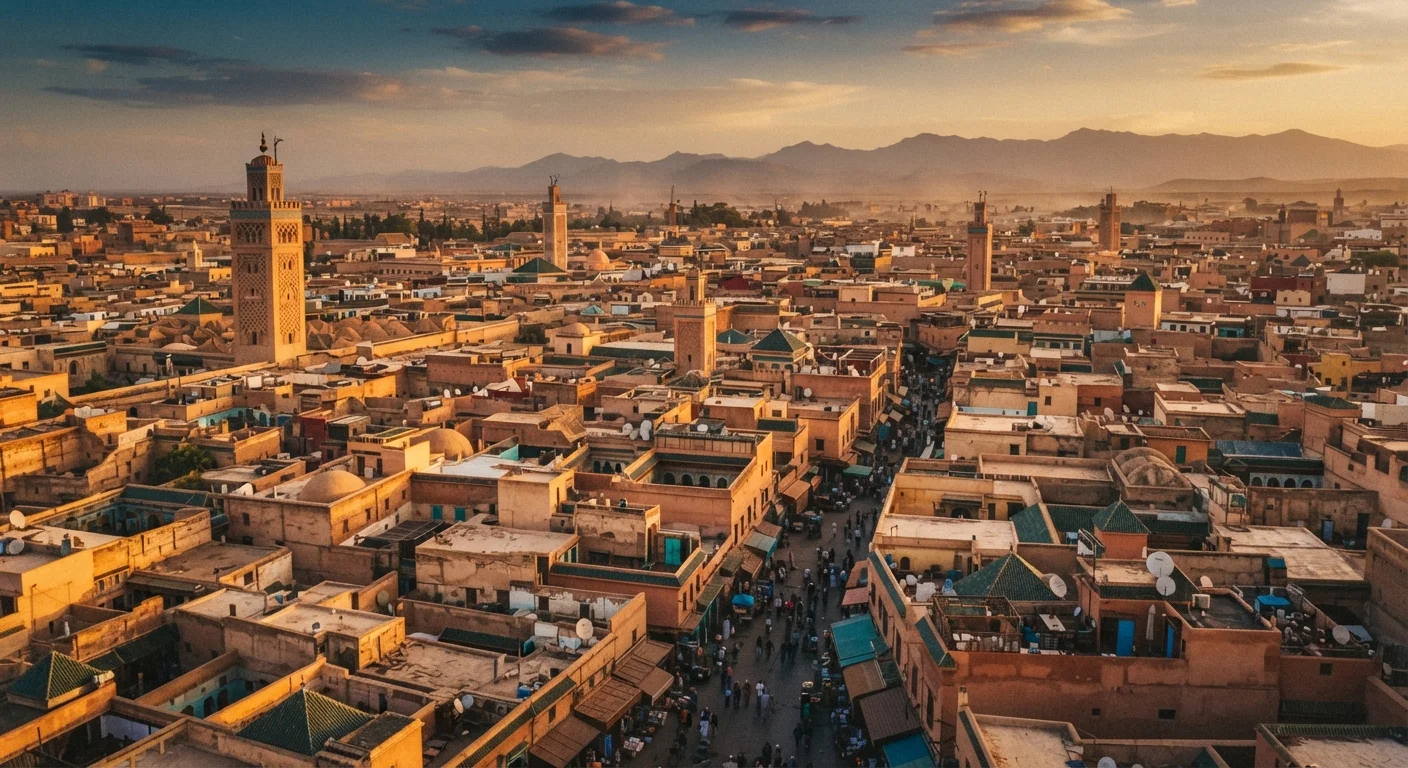
What Makes a City 'Imperial'?
Morocco has four cities that carried the title of capital at different points in the country's dynastic history: Fes, Marrakech, Meknes, and Rabat. Together they are called the Imperial Cities (villes impériales), and each served as a seat of power under one or more of Morocco's ruling dynasties. This designation is more than ceremonial — it signals a city packed with royal palaces, monumental medersas (Quranic schools), historic mosques, and medinas (old walled cities) that earned UNESCO World Heritage recognition.
Travelers often encounter these four on a single circuit, but each city rewards a different travel style and appetite. Use the quick reference below to calibrate how much time each deserves on your itinerary.
| Number of Imperial Cities | 4 (Fes, Marrakech, Meknes, Rabat) |
| Current National Capital | Rabat |
| Most Visited Imperial City | Marrakech (Morocco National Tourism Office) |
| UNESCO World Heritage Medinas | All four cities hold UNESCO-listed medinas or sites (UNESCO World Heritage List) |
| Best Rail Hub for the Circuit | Casablanca — connects to all four cities |
| Oldest University Affiliation | Al-Qarawiyyin, Fes (founded 859 CE) (Guinness World Records recognition) |
| Recommended Minimum Visit | 7–9 days for a full circuit |
City-by-City Highlights
Fes — The Living Medieval City
Fes el-Bali, the old medina of Fes, is widely considered one of the best-preserved medieval urban centers in the world. Its 9,000-plus alleyways form a maze so dense that GPS is largely useless. Highlights include the Chouara tanneries, the 9th-century Al-Qarawiyyin University (recognized among the oldest continuously operating universities globally), and the ornate Bou Inania Medersa. Plan at least two full days; one is not enough.
Marrakech — Energy, Color, and Commerce
Morocco's most visited city pulses around Jemaa el-Fna square, a UNESCO-listed gathering place where food stalls, musicians, and storytellers converge nightly. The Bahia Palace, Saadian Tombs, and Majorelle Garden (a historic botanical garden) anchor the main sightseeing circuit. Marrakech is also the gateway to day trips into the High Atlas Mountains and the Ourika Valley.
Meknes — The Underrated Imperial Capital
Often overshadowed by its neighbors, Meknes offers a quieter, more local-paced experience. Sultan Moulay Ismail transformed it into a grand capital in the 17th century, leaving behind colossal granaries, the monumental Bab Mansour gate, and vast stables that once housed thousands of horses. It sits close to Volubilis, a well-preserved Roman archaeological site, making it a natural pairing for history-focused travelers.
Rabat — The Modern Capital with Ancient Roots
Morocco's current administrative capital balances contemporary governance with genuine historic depth. The Hassan Tower, an unfinished 12th-century minaret, and the nearby Mausoleum of Mohammed V are among the country's most visited monuments. Rabat's Kasbah of the Udayas — a fortified neighborhood overlooking the Atlantic — offers one of the most atmospheric café stops in any Moroccan city. The city's pace is noticeably calmer than Marrakech or Fes.
Medina
The historic walled old city of a North African urban center, typically featuring dense, pedestrian-only alleyways, souks, and historic monuments. In Morocco, many medinas are UNESCO World Heritage Sites.
Medersa
An Islamic school of higher learning, often architecturally ornate with carved cedar wood, zellige tilework, and stucco plasterwork. Historically attached to mosques, they functioned as student residences and teaching spaces.
Kasbah
A citadel or fortified quarter within a North African city, historically used as a royal residence or defensive structure. Kasbahs often sit at elevated positions overlooking a medina or waterway.
Souk
A traditional market or bazaar, typically organized by trade — spice souks, leather souks, textile souks — within or adjacent to a medina.
Zellige
A form of Moroccan mosaic tilework made from individually hand-cut pieces of fired, glazed clay assembled into intricate geometric patterns. It is a defining decorative element in palaces, fountains, and mosques.
Planning Your Imperial Cities Circuit
Most travelers approach the Imperial Cities as a loop from either Casablanca or an international gateway airport. A common itinerary allocates roughly two days in Fes, one to two in Marrakech, one in Meknes, and one in Rabat — though Marrakech often warrants more if you plan Atlas day trips. Train service connects Rabat, Meknes, Fes, and (via Casablanca) Marrakech, making rail a practical and scenic choice between cities.
Train Travel Between Imperial Cities
Morocco's ONCF national rail network offers reliable, comfortable connections between Rabat, Meknes, Fes, and Casablanca. A separate high-speed Al Boraq line links Casablanca to Tangier. For the Marrakech leg, travelers change at Casablanca. Schedules and fares can shift seasonally, so verify current timetables directly with ONCF or a reliable local travel resource before your trip.
Seasonality matters considerably. Marrakech and Fes can reach extreme heat between June and August; spring (March–May) and autumn (September–November) offer more comfortable conditions for medina walking. Rabat's Atlantic position keeps temperatures moderate year-round by comparison. Always verify current entry requirements, visa rules, and any travel advisories with your government's official travel portal before booking.
~14 million
International tourists visiting Morocco annually
According to the World Tourism Organization's pre-pandemic benchmarks, Morocco consistently ranked among Africa's top tourism destinations.
859 CE
Founding year of Al-Qarawiyyin, Fes
The Guinness World Records recognizes Al-Qarawiyyin as the oldest continuously operating degree-granting institution in the world.
The content on this site is for informational purposes only and is not a substitute for professional advice. Always consult a qualified professional for guidance specific to your situation.